
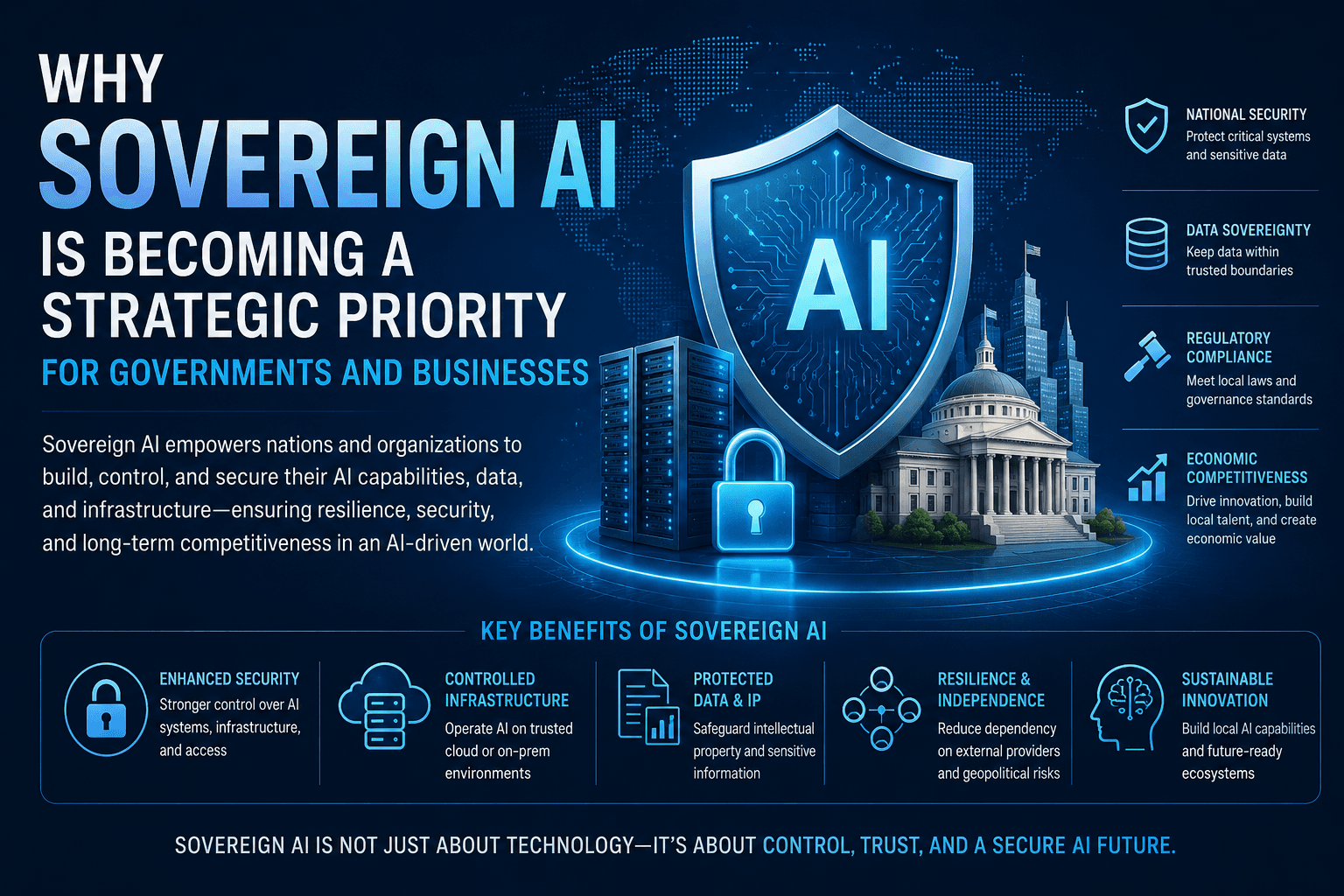

Artificial intelligence has become one of theWhy Sovereign AI Is Becoming a Strategic Priority for Governments and Businesses.Artificial intelligence is rapidly becoming a critical component of national economies, public services, cybersecurity, and business operations. As AI adoption accelerates, governments and enterprises are increasingly asking an important question: Who controls the infrastructure, data, models, and computing resources behind AI systems?
This question is driving the rise of Sovereign AI.
Sovereign AI refers to the ability of a country or organization to develop, operate, and govern AI capabilities while maintaining control over critical data, infrastructure, technology, and regulatory requirements.
For governments and businesses, sovereignty is becoming more than a technology issue. It is increasingly connected to national security, economic resilience, data privacy, regulatory compliance, and long-term competitiveness.
What Is Sovereign AI?
Sovereign AI is an approach in which AI capabilities are developed and operated with a high degree of control over the underlying technology and data.
Depending on the organization, this can involve control over:
AI models
Computing infrastructure
Training data
Enterprise data
Cloud environments
AI applications
Security systems
Governance frameworks
Regulatory compliance
Sovereignty does not necessarily mean building every component independently. Countries and companies may still use international technologies while maintaining appropriate control over critical workloads and information.
The central objective is greater technological independence and control.
Why Sovereign AI Is Becoming Important
The growing importance of AI has created new dependencies.
Organizations may rely on external cloud providers, foreign AI models, international data centers, proprietary software, and specialized semiconductor technologies.
These dependencies can create risks if geopolitical tensions, regulatory changes, supply-chain disruptions, or commercial decisions affect access to critical AI resources.
Sovereign AI offers a way to reduce exposure to these risks.
For governments, it can strengthen national technological resilience. For businesses, it can provide greater control over sensitive data and AI operations.
Data Sovereignty and AI
Data is one of the most important reasons organizations are exploring sovereign AI.
Governments and enterprises often manage highly sensitive information, including financial records, healthcare information, intellectual property, citizen data, and confidential business information.
Organizations may need to ensure that this data remains within specific geographic or regulatory boundaries.
Sovereign AI architectures can support these requirements by allowing sensitive workloads to operate within controlled environments.
This can be particularly important for sectors such as:
Government
Defense
Banking
Healthcare
Telecommunications
Energy
Critical infrastructure
AI and National Security
AI is increasingly connected to national security.
Governments are using AI for cybersecurity, intelligence analysis, defense applications, public safety, and critical infrastructure management.
Relying entirely on external AI technologies for these functions can create strategic vulnerabilities.
Sovereign AI can help governments maintain greater control over sensitive systems and reduce dependence on external providers.
It can also support the development of domestic AI capabilities, including local research, talent, computing infrastructure, and AI models.
Sovereign AI and Economic Competitiveness
AI is becoming a major driver of economic productivity.
Countries that develop strong AI ecosystems can potentially improve productivity, create technology industries, attract investment, and develop new products and services.
Sovereign AI strategies can encourage domestic investment in:
AI research
Data centers
Semiconductor infrastructure
Cloud computing
AI startups
Technical education
Research institutions
AI talent
This can contribute to the development of a broader national AI ecosystem.
Why Businesses Are Adopting Sovereign AI
Sovereign AI is not limited to governments.
Large businesses are increasingly evaluating where their AI systems run, who controls the infrastructure, and how sensitive information is processed.
Organizations may choose sovereign or highly controlled AI environments when they need stronger guarantees around:
Data residency
Privacy
Security
Regulatory compliance
Intellectual property protection
Operational continuity
For multinational businesses, these requirements can vary significantly between jurisdictions.
A flexible sovereign AI strategy can help companies adapt their AI infrastructure to different regulatory environments.
Regulatory Compliance
AI regulations and data protection requirements are becoming increasingly complex.
Governments are introducing rules covering AI safety, data protection, algorithmic accountability, cybersecurity, and data localization.
Organizations that process sensitive information need to understand where data is stored and processed and which legal frameworks apply.
Sovereign AI infrastructure can make compliance easier by providing greater visibility and control over AI workloads.
However, sovereignty alone does not guarantee compliance. Organizations still need strong governance, security controls, documentation, and risk-management processes.
The Role of Sovereign Cloud Infrastructure
Cloud computing is a major part of the sovereign AI discussion.
Traditional cloud platforms offer enormous computing capacity, but governments and regulated organizations may require stronger controls over where workloads are processed and who can access infrastructure.
Sovereign cloud environments can provide additional controls around data residency, access, encryption, operational governance, and jurisdiction.
These capabilities can become an important foundation for sovereign AI deployments.
Sovereign AI and Generative AI
Generative AI has made sovereignty particularly important because large language models can process sensitive enterprise and government information.
Organizations may want to use AI assistants for internal research, customer service, coding, document analysis, and decision support without sending sensitive information into environments they cannot fully control.
Deploying models within controlled environments can help organizations balance AI adoption with privacy and security requirements.
Reducing Vendor Dependency
Another strategic benefit is reducing excessive dependence on a single AI or cloud provider.
Vendor concentration can create operational risks if pricing changes, services become unavailable, APIs are modified, or geopolitical restrictions affect access.
A sovereign AI strategy can encourage organizations to maintain multiple options across models, infrastructure providers, and deployment environments.
This can improve technological resilience and negotiating power.
The Challenges of Sovereign AI
Despite its strategic advantages, sovereign AI comes with significant challenges.
High Infrastructure Costs
Building and operating advanced AI infrastructure requires substantial investment in computing, energy, networking, and data centers.
Limited AI Talent
Countries and businesses need specialized expertise in machine learning, cloud infrastructure, cybersecurity, semiconductor technology, and AI governance.
Technology Dependencies
Complete technological independence can be difficult because modern AI ecosystems depend on globally distributed hardware, software, and supply chains.
Rapid Technological Change
AI technology evolves quickly. Infrastructure built today may need significant upgrades within a relatively short period.
Balancing Sovereignty and Innovation
Organizations need to balance technological independence with access to the best global AI technologies.
The objective should not necessarily be isolation. Instead, it should be strategic control over critical capabilities.
Building a Sovereign AI Strategy
Governments and businesses can approach sovereign AI through several steps.
1. Identify Critical AI Workloads
Determine which AI applications involve sensitive data, critical infrastructure, or strategically important operations.
2. Classify Data
Separate information according to sensitivity, regulatory requirements, and business value.
3. Evaluate Infrastructure
Assess whether workloads should operate on public cloud, private infrastructure, sovereign cloud, or hybrid environments.
4. Develop Multiple Technology Options
Avoid unnecessary dependence on a single model, provider, or infrastructure platform.
5. Invest in Local Talent
Build domestic or organizational expertise in AI engineering, cybersecurity, data management, and governance.
6. Establish AI Governance
Create policies covering security, privacy, model evaluation, access controls, transparency, and accountability.
The Future of Sovereign AI
Sovereign AI is likely to become a major component of national and corporate technology strategies.
As AI becomes embedded in critical infrastructure and business operations, control over AI capabilities will increasingly be viewed as a strategic asset.
The future is unlikely to be defined by complete technological isolation. Instead, countries and enterprises will probably pursue selective sovereignty—maintaining strong control over their most sensitive data, models, infrastructure, and AI workloads while continuing to participate in the global technology ecosystem.
Conclusion
Sovereign AI is emerging because artificial intelligence is becoming too important to treat as just another software capability.
For governments, it can support national security, economic resilience, technological independence, and control over sensitive information.
For businesses, it can strengthen data protection, regulatory compliance, intellectual property security, and operational resilience.
The organizations that understand where AI dependency creates strategic risk—and where greater control creates strategic value—will be better positioned for the next phase of the AI economy.
Sovereign AI is therefore not simply about owning technology. It is about having the control, resilience, and governance necessary to use AI strategically.
FAQs
1. What is Sovereign AI?
Sovereign AI refers to the ability of governments or organizations to maintain control over critical AI infrastructure, models, data, workloads, and governance.
2. Why is Sovereign AI important for governments?
It can help governments reduce technological dependency, protect sensitive information, strengthen national security, and develop domestic AI capabilities.
3. How can businesses benefit from Sovereign AI?
Businesses can gain greater control over data residency, privacy, security, intellectual property, regulatory compliance, and critical AI workloads.
4. Does Sovereign AI mean avoiding foreign technology?
Not necessarily. Sovereign AI generally focuses on maintaining strategic control over critical capabilities rather than completely eliminating international technology.
5. Is Sovereign AI expensive?
It can require substantial investment in computing infrastructure, data centers, cybersecurity, talent, and AI research. Organizations therefore need to determine which workloads genuinely require sovereign infrastructure.
6. How does Sovereign AI support data privacy?
By giving organizations greater control over where sensitive data is stored and processed, sovereign environments can help support data residency and privacy requirements.
7. What is the future of Sovereign AI?
Sovereign AI is likely to become increasingly important as governments and businesses treat ai infrastructure, data, and models as strategic resources. world's most valuable strategic technologies.