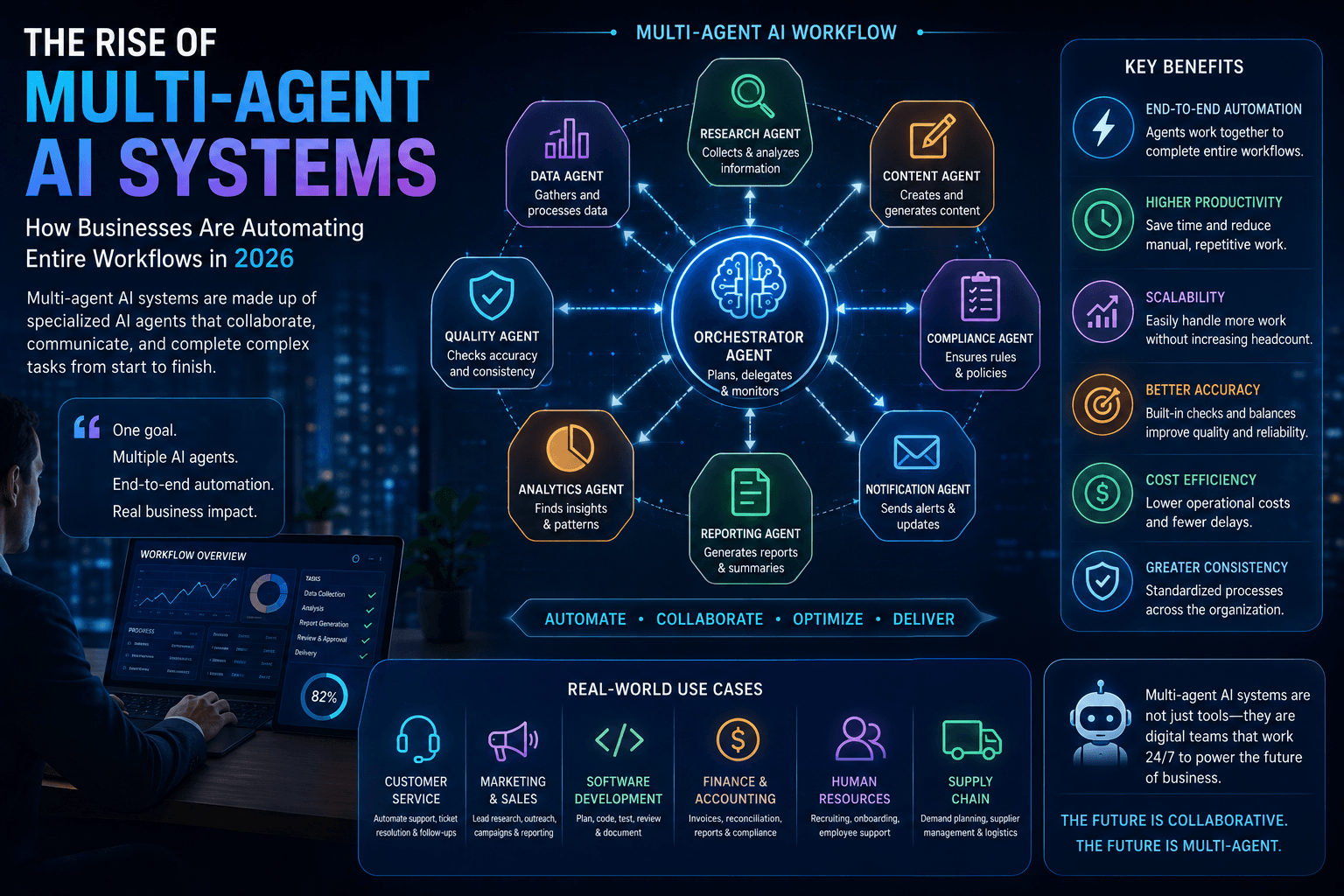

In 2026, artificial intelligence is moving beyond individual AI assistants and single-purpose automation tools. Businesses are increasingly adopting multi-agent AI systems—networks of specialized AI agents that work together to complete complex tasks and automate entire workflows.
Instead of relying on one AI model to handle every step, multi-agent systems divide work among multiple intelligent agents. One agent might analyze data, another could create a report, another may verify the results, and a coordinating agent can manage the overall process.
This evolution is changing how businesses approach productivity, operations, customer service, software development, finance, and decision-making.
What Are Multi-Agent AI Systems?
A multi-agent AI system consists of multiple AI agents that can communicate, collaborate, and perform different tasks toward a shared objective.
Each agent can have a specific role. For example, an e-commerce business might use:
A research agent to collect market information
A pricing agent to analyze competitors
A content agent to create product descriptions
A quality-control agent to check accuracy
A reporting agent to summarize results
A supervisor agent to coordinate the workflow
Together, these agents can complete a process that would traditionally require several employees, software systems, and manual handoffs.
Why Multi-Agent AI Is Growing in 2026
Businesses have already used AI for tasks such as generating text, analyzing documents, answering customer questions, and writing code.
The next step is connecting these capabilities into complete workflows.
Instead of asking AI to perform one task at a time, organizations can create systems that understand an objective and determine which agents should perform each step.
For example:
“Analyze this month's sales performance and prepare an executive report.”
A multi-agent system could automatically collect sales data, identify trends, compare performance with previous months, detect anomalies, generate charts, write an executive summary, and route the report for approval.
This moves AI from task automation to workflow automation.
How Multi-Agent Workflows Operate
A typical multi-agent workflow can involve several stages.
1. Goal Identification
A user or business system provides an objective.
For example:
“Prepare a quarterly supplier risk report.”
2. Task Planning
A coordinating agent breaks the objective into smaller tasks.
These could include collecting supplier information, analyzing risk scores, reviewing compliance records, and identifying high-risk vendors.
3. Specialized Agents Perform Tasks
Different agents handle different parts of the workflow.
One agent might retrieve information while another analyzes it and another checks the results.
4. Agents Share Information
The agents communicate through shared data, tools, APIs, or workflow platforms.
This allows one agent's output to become another agent's input.
5. Verification
A review agent can check the work for inconsistencies, missing information, or errors.
6. Final Output
The system produces the requested report, recommendation, action, or business process result.
This structure makes complex automation more manageable.
Business Workflows Being Transformed by Multi-Agent AI
Customer Service
Customer service is one of the most promising applications.
A customer request may involve multiple systems and departments. Instead of routing the request manually, AI agents can collaborate to understand the issue, retrieve account information, check policies, investigate the problem, and recommend a resolution.
A separate quality-control agent can review the response before it reaches the customer.
This can reduce response times while allowing human employees to focus on complex cases.
Sales and Marketing
Multi-agent systems can automate significant portions of sales and marketing workflows.
A system might:
Research target companies.
Identify potential customers.
Analyze their business needs.
Personalize outreach.
Schedule follow-ups.
Track responses.
Update the CRM.
Generate performance reports.
Instead of simply generating sales emails, AI can participate in the broader sales workflow.
Software Development
Software engineering is another major area of multi-agent adoption.
A development workflow can include specialized agents for:
Requirements analysis
Architecture
Coding
Testing
Security review
Documentation
Debugging
Code optimization
One agent can write code while another tests it and another reviews the implementation for security issues.
Human developers remain important, particularly for architecture, complex decisions, and final approval, but AI can increasingly automate repetitive development tasks.
Finance and Accounting
Financial workflows often contain repetitive processes that involve large amounts of structured information.
Multi-agent AI can help with:
Invoice processing
Expense classification
Financial reconciliation
Anomaly detection
Reporting
Forecasting
Compliance checks
For example, an invoice-processing workflow could automatically extract information, verify the supplier, compare the invoice with purchase orders, identify discrepancies, and route exceptions to a human employee.
Human Resources
HR departments can use multi-agent systems to automate employee and recruitment workflows.
AI agents can help screen applications, schedule interviews, prepare candidate summaries, answer routine employee questions, and organize onboarding tasks.
However, businesses must be especially careful with fairness, privacy, and regulatory requirements when AI is used in employment-related decisions.
Supply Chain and Operations
Multi-agent AI can also coordinate complex operational processes.
For example, an operations system could monitor inventory, identify shortages, analyze supplier performance, forecast demand, and recommend procurement actions.
Instead of simply reporting that inventory is low, an AI system could investigate why, identify alternatives, estimate costs, and prepare a recommended action for approval.
The Benefits of Multi-Agent AI
Greater Automation
Organizations can automate entire processes instead of isolated tasks.
Improved Productivity
Employees spend less time on repetitive administrative work.
Faster Decision-Making
AI agents can process large amounts of information quickly and provide recommendations.
Better Scalability
Businesses can handle increasing workloads without necessarily increasing manual effort at the same rate.
Specialized Intelligence
Different agents can be optimized for different responsibilities instead of forcing one system to handle every task.
Continuous Operations
AI-powered workflows can potentially operate continuously, monitoring systems and responding to predefined events.
Multi-Agent AI vs. Traditional Automation
Traditional automation generally follows predefined rules.
For example:
If an invoice arrives, extract the amount and send it to accounting.
Multi-agent AI can handle more dynamic situations.
For example:
Analyze this invoice, determine whether the charge is consistent with the contract, investigate discrepancies, assess the supplier's risk, and recommend the appropriate action.
The key difference is flexibility.
Traditional automation is highly effective when processes are predictable. Multi-agent AI becomes particularly valuable when workflows involve interpretation, reasoning, unstructured information, and changing conditions.
Challenges Businesses Must Consider
Multi-agent AI is powerful, but it is not risk-free.
Accuracy and Hallucinations
AI agents can produce incorrect information. Verification mechanisms are therefore essential for important workflows.
Coordination Complexity
As the number of agents increases, managing communication, permissions, dependencies, and conflicting outputs becomes more complicated.
Security
AI agents may have access to sensitive business systems and data. Organizations need strong authentication, authorization, monitoring, and access controls.
Cost
Running multiple AI agents can increase infrastructure and model costs. Businesses need to measure whether automation produces sufficient value.
Lack of Transparency
Organizations may struggle to understand why a system reached a particular conclusion if agent decisions are poorly documented.
Human Oversight
High-impact decisions should generally include appropriate human review, particularly in areas such as finance, employment, healthcare, legal matters, and security.
The Importance of AI Governance
As businesses give AI agents more autonomy, governance becomes increasingly important.
Organizations should establish clear policies covering:
Data access
Agent permissions
Human approvals
Audit logs
Model monitoring
Security controls
Error handling
Regulatory compliance
Performance evaluation
A well-designed multi-agent system should not simply be capable of taking action. It should also know when it needs permission, when it should request human intervention, and when it should stop.
The Future of Autonomous Business Operations
The long-term impact of multi-agent AI could be significant.
Businesses may increasingly build digital workforces in which AI agents perform specialized operational roles while humans focus on strategy, creativity, leadership, relationships, and complex decision-making.
This does not necessarily mean that AI will replace entire departments. Instead, the structure of work may change.
Employees may increasingly manage AI systems rather than manually execute every step of a process.
For example, a marketing manager might oversee a group of AI agents responsible for market research, campaign creation, customer segmentation, analytics, and reporting.
A finance manager might supervise agents responsible for reconciliation, forecasting, reporting, and compliance monitoring.
This creates a new model of work in which humans and AI agents collaborate as a team.
How Businesses Can Prepare for Multi-Agent AI
Companies considering multi-agent systems should start with well-defined workflows rather than attempting to automate everything immediately.
A practical approach is to:
Identify repetitive, high-volume processes.
Map the existing workflow.
Determine which tasks require human judgment.
Assign suitable AI agents to specific tasks.
Establish data and system permissions.
Add verification and approval steps.
Monitor performance.
Expand automation gradually.
The most successful implementations are likely to focus on measurable business outcomes rather than simply deploying AI for its own sake.
Conclusion
The rise of multi-agent AI systems represents an important shift in enterprise automation. Businesses are moving from using AI for individual tasks toward building intelligent systems capable of coordinating entire workflows.
In 2026, multi-agent AI is helping organizations automate customer service, sales, marketing, software development, finance, HR, supply chain management, and other operational processes.
The technology offers enormous potential, but successful adoption requires more than powerful AI models. Businesses also need strong governance, security, human oversight, reliable data, and carefully designed workflows.
The future of business automation is unlikely to be about a single AI assistant doing everything. Instead, it may involve teams of specialized AI agents working together—with humans providing direction, judgment, and accountability.
FAQs
1. What is a multi-agent AI system?
A multi-agent AI system consists of multiple AI agents that collaborate to complete complex tasks or workflows. Each agent can have a specialized role.
2. How is multi-agent AI different from a single AI assistant?
A single AI assistant generally handles tasks within one interaction or system. Multi-agent AI divides complex workflows among specialized agents that can communicate and coordinate with one another.
3. What business processes can multi-agent AI automate?
Multi-agent systems can support customer service, sales, marketing, finance, accounting, software development, HR, supply chain operations, research, reporting, and many other workflows.
4. Can multi-agent AI completely replace employees?
Not necessarily. Multi-agent AI is more commonly used to automate repetitive work and assist employees. Human oversight remains important for strategic, sensitive, and high-impact decisions.
5. What are the main benefits of multi-agent AI?
Key benefits include greater automation, faster workflows, improved productivity, scalability, specialized AI capabilities, and the ability to coordinate complex processes.
6. What are the risks of multi-agent AI?
Major risks include inaccurate outputs, security vulnerabilities, excessive autonomy, poor coordination, privacy concerns, bias, and insufficient human oversight.
7. How can companies safely implement multi-agent AI?
Companies should begin with clearly defined workflows, limit agent permissions, use strong security controls, add human approval where appropriate, maintain audit logs, and continuously monitor system performance.
8. Will multi-agent AI become a digital workforce?
It could become an important component of digital workforces. Businesses may increasingly use groups of specialized AI agents to perform operational tasks while employees supervise and manage these systems.
9. What industries can benefit most from multi-agent AI?
Industries with complex, repetitive, data-intensive workflows—including finance, e-commerce, technology, logistics, customer service, and professional services—can benefit significantly.
10. Why is multi-agent AI important in 2026?
Multi-agent AI represents a shift from automating individual tasks to coordinating complete workflows. This allows businesses to use AI more strategically across multiple departments and operational processes.