

The artificial intelligence boom is entering a new phase. The biggest challenge for the AI industry is no longer simply developing increasingly powerful models—it is building enough computing infrastructure, data centers, chips, networking systems, and power capacity to run them.
Nvidia is now making a major move to address that challenge.
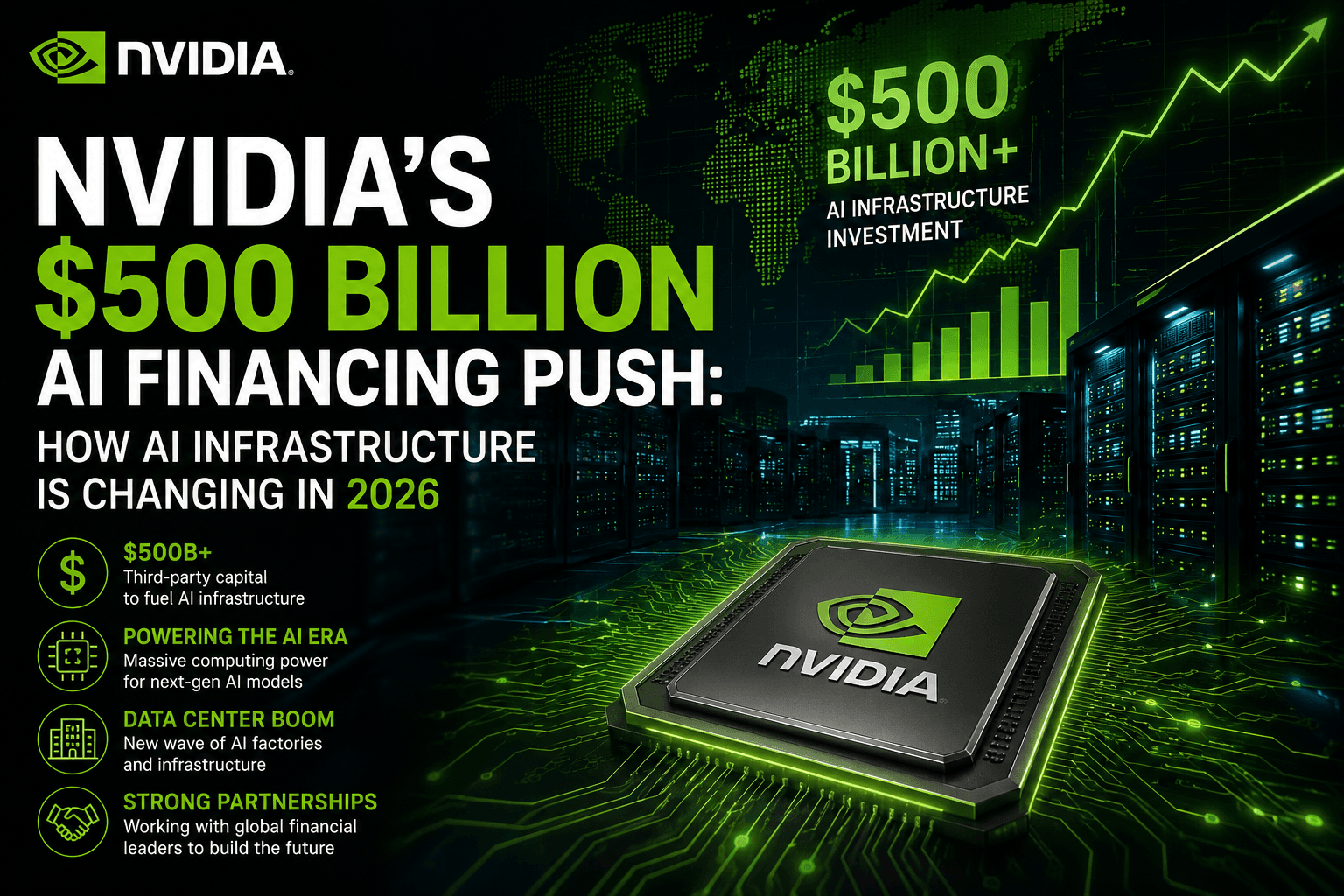
On August 10, 2026, Nvidia announced strategic partnerships with Apollo, BlackRock, Blackstone, Brookfield, Goldman Sachs, and KKR to establish financing platforms designed to mobilize more than $500 billion of third-party capital over time for AI computing infrastructure. (NVIDIA Newsroom)
The announcement highlights how AI infrastructure is increasingly being treated not simply as technology spending, but as a major long-term investment opportunity.
What Is Nvidia’s $500 Billion AI Financing Initiative?
Nvidia's initiative is designed to help finance the massive infrastructure required to expand AI computing.
The company is working with some of the world's largest investment and financial institutions to create financing platforms for AI infrastructure projects. The goal is to make it easier for developers and operators to obtain the capital required for expensive computing facilities.
Importantly, the $500 billion figure refers to third-party capital that the platforms aim to mobilize over time, rather than Nvidia simply spending $500 billion of its own money. (NVIDIA Newsroom)
This distinction is important because AI data centers require enormous upfront investments.
Companies need capital for:
Advanced AI chips
Data-center construction
Networking equipment
Cooling systems
Electricity infrastructure
Long-term power capacity
Storage systems
Computing platforms
Facility operations
As AI workloads continue expanding, these requirements are becoming increasingly difficult to finance through traditional technology budgets.
Why Does AI Need So Much Infrastructure?
Generative AI models require enormous amounts of computing power.
Training sophisticated models can involve thousands or even millions of GPUs operating simultaneously. Once a model is trained, businesses and consumers still need computing resources to generate responses, analyze information, create images, write code, and perform other AI tasks.
This creates two major infrastructure requirements:
Training infrastructure is used to develop and improve AI models.
Inference infrastructure is used to operate those models after they have been trained.
As AI adoption increases, both requirements continue to grow.
This means the AI economy depends not only on better models but also on physical infrastructure capable of supporting them.
Nvidia Wants AI Compute to Become an Investable Asset
One of the most important ideas behind Nvidia's announcement is the concept that AI computing infrastructure can be treated as a productive asset.
Historically, companies purchased servers and other technology equipment as capital expenditures. Nvidia's strategy points toward a broader financial model in which AI computing facilities can attract long-term institutional investment.
This could fundamentally change how new AI infrastructure is built.
Instead of every technology company funding an entire data center independently, specialized financing platforms could help bring together:
Technology companies
AI model developers
Data-center operators
Chip manufacturers
Banks
Asset managers
Private-equity firms
Infrastructure investors
That could make the AI infrastructure market more similar to other large infrastructure industries.
Wall Street Is Becoming More Important to AI
The involvement of major financial institutions is significant.
Apollo, BlackRock, Blackstone, Brookfield, Goldman Sachs, and KKR manage or advise on enormous pools of capital. Their participation demonstrates that AI infrastructure is attracting attention far beyond traditional technology investors. (NVIDIA Newsroom)
For Wall Street, AI infrastructure represents a potentially enormous long-term market.
For the technology industry, institutional capital could provide the funding needed to build infrastructure at a much faster pace.
This creates an increasingly close relationship between finance and artificial intelligence.
Data Centers Are Becoming the Backbone of the AI Economy
The AI revolution depends on data centers.
Modern AI facilities are fundamentally different from traditional data centers because advanced AI workloads can require huge quantities of GPUs and networking equipment.
They also consume significant amounts of electricity and require sophisticated cooling systems.
As companies deploy larger AI models and more AI-powered products, demand for specialized data-center capacity is likely to remain strong.
Nvidia has previously described itself as a full-stack AI infrastructure company spanning chips, systems, networking, software, and AI platforms. (NVIDIA)
The latest financing initiative extends that infrastructure strategy into the financial side of the industry.
What Does This Mean for AI Companies?
For AI companies, access to infrastructure financing could become a major competitive advantage.
Developing a powerful AI model is only part of the challenge. Companies must also have sufficient computing capacity to serve customers.
A startup with strong AI technology but limited access to GPUs and data-center capacity could struggle to compete with a better-funded rival.
More financing options could therefore help AI companies secure the infrastructure required to scale.
At the same time, large-scale infrastructure commitments could create greater financial pressure if AI demand does not grow as quickly as expected.
The Growing Importance of Nvidia GPUs
Nvidia remains central to the AI infrastructure ecosystem because its GPUs are widely used for AI training and inference.
The company's Blackwell platform and newer generations are designed for increasingly demanding AI workloads.
Nvidia's own financial materials show how rapidly its data-center business has expanded. Its second-quarter fiscal 2026 results reported $41.1 billion in data-center revenue, up 56% from a year earlier. (NVIDIA Newsroom)
That growth illustrates why infrastructure investment has become such a major part of the AI economy.
More AI applications create demand for more computing.
More computing creates demand for more GPUs.
More GPUs require more data centers and electricity.
And larger infrastructure requirements create demand for more financing.
This creates a powerful cycle connecting AI software, hardware, infrastructure, and finance.
Could This Accelerate the AI Data-Center Boom?
Potentially.
One of the biggest limitations facing AI expansion is the time and capital required to build infrastructure.
Financing platforms could help accelerate projects by making institutional capital available for AI infrastructure development.
This could lead to faster construction of:
AI data centers
GPU clusters
Cloud computing facilities
High-speed networking infrastructure
Power-generation capacity
AI-focused computing campuses
The result could be an even faster expansion of global AI capacity.
But There Are Also Risks
The scale of the financing initiative raises important questions.
AI infrastructure requires enormous amounts of capital, and investors ultimately expect those assets to generate returns.
If AI demand grows rapidly, infrastructure investments could become highly productive.
However, if AI companies fail to generate enough revenue to support their infrastructure costs, investors could face significant risks.
There are also concerns surrounding:
High levels of infrastructure debt
Rapid hardware depreciation
Electricity availability
Data-center construction costs
AI demand forecasts
Concentration around a small number of technology companies
Long-term returns on AI infrastructure
Financial institutions will therefore need to carefully evaluate whether projected AI demand can justify the enormous cost of building new computing capacity.
AI Infrastructure Is Becoming a New Investment Category
The Nvidia announcement reflects a broader transformation.
AI infrastructure is increasingly being viewed as an investment category in its own right.
Instead of seeing GPUs, data centers, and computing systems simply as technology expenses, investors are increasingly examining them as assets capable of supporting long-term revenue generation.
This could attract even more institutional capital into the AI ecosystem.
Over time, AI infrastructure could become comparable in importance to other major infrastructure markets.
What Does It Mean for Businesses?
Businesses that use AI should pay attention to this development.
More investment in computing infrastructure could eventually increase access to AI services and computing capacity.
It could also accelerate innovation as AI companies gain the resources needed to develop and deploy increasingly sophisticated systems.
For enterprises, this could mean:
More powerful AI models
Faster AI services
Greater availability of AI computing
More specialized AI applications
Potentially broader enterprise AI adoption
Companies should therefore think about AI infrastructure as part of their long-term technology strategy rather than simply as a software subscription.
The Future of AI Depends on More Than Algorithms
The AI industry often focuses on model performance, benchmarks, and new software capabilities.
But the Nvidia financing initiative highlights another reality: AI needs physical infrastructure.
Power plants, data centers, GPUs, networking equipment, cooling systems, fiber connections, and financing are all becoming essential components of the AI economy.
The next stage of AI development may therefore be determined as much by infrastructure availability as by breakthroughs in algorithms.
Conclusion
Nvidia's partnership with major financial institutions to mobilize more than $500 billion in third-party capital marks an important moment for the AI industry. (NVIDIA Newsroom)
The initiative demonstrates how rapidly AI is expanding beyond software and becoming a major infrastructure and financial market.
As demand for AI computing continues to rise, companies will need enormous quantities of capital to build the data centers, computing systems, and power infrastructure required to support the next generation of artificial intelligence.
For businesses, investors, and technology leaders, the message is clear: the future of AI will not be built by algorithms alone. It will also be built by infrastructure—and increasingly, by the capital required to finance it.
FAQs
1. What is Nvidia's $500 billion AI financing initiative?
Nvidia has partnered with major financial institutions to establish financing platforms designed to mobilize more than $500 billion of third-party capital over time for AI computing infrastructure. (NVIDIA Newsroom)
2. Is Nvidia investing $500 billion of its own money?
No. The $500 billion figure represents the third-party capital the financing platforms aim to mobilize over time. Nvidia is partnering with major financial institutions rather than simply committing $500 billion of its own cash. (NVIDIA Newsroom)
3. Why does AI require so much infrastructure?
Advanced AI models require enormous computing capacity for both training and inference. This requires GPUs, data centers, networking systems, cooling, storage, and substantial electricity.
4. Which financial companies are working with Nvidia?
Nvidia announced partnerships involving Apollo, BlackRock, Blackstone, Brookfield, Goldman Sachs, and KKR. (NVIDIA Newsroom)
5. Why are data centers important for AI?
Data centers provide the computing infrastructure required to train and operate modern AI models. As AI adoption increases, demand for specialized AI computing facilities also grows.
6. How could the financing initiative affect AI companies?
Greater access to infrastructure financing could make it easier for AI companies and data-center operators to obtain the capital needed to expand computing capacity.
7. Could this increase Nvidia GPU demand?
Potentially. More AI infrastructure projects generally require substantial quantities of advanced computing hardware, although actual demand will depend on future projects and customer requirements.
8. What are the risks of investing heavily in AI infrastructure?
Potential risks include excessive debt, changing AI demand, hardware depreciation, electricity constraints, construction costs, and uncertainty about whether AI revenues will justify infrastructure spending.
9. How could businesses benefit from greater AI infrastructure investment?
Greater computing capacity could support more powerful AI services, broader availability of AI applications, and potentially faster enterprise adoption of artificial intelligence.
10. What is the bigger trend behind Nvidia's announcement?
The bigger trend is the transformation of AI infrastructure into a major investment market, bringing technology companies, data-center operators, and large financial institutions increasingly together.
