Introduction
For more than a decade, Software as a Service (SaaS) transformed how businesses managed customer relationships, accounting, human resources, marketing, and collaboration. Companies adopted cloud-based platforms because they were more flexible, affordable, and accessible than traditional software.
In 2026, another major transformation is underway. Businesses are increasingly adopting AI-native software—applications built with artificial intelligence at their core rather than adding AI as an extra feature. These intelligent platforms automate workflows, make decisions, generate insights, and complete tasks with minimal human input.
As organizations seek greater productivity and efficiency, AI-native software is beginning to replace traditional SaaS platforms across many industries.
What Is AI-Native Software?
AI-native software is designed around artificial intelligence from the beginning. Unlike conventional SaaS tools that rely on users to perform most tasks manually, AI-native applications proactively assist users by learning from data, automating processes, and providing intelligent recommendations.
Key characteristics include:
Natural language interaction
Autonomous task execution
Predictive analytics
Workflow automation
Continuous learning and improvement
Personalized user experiences
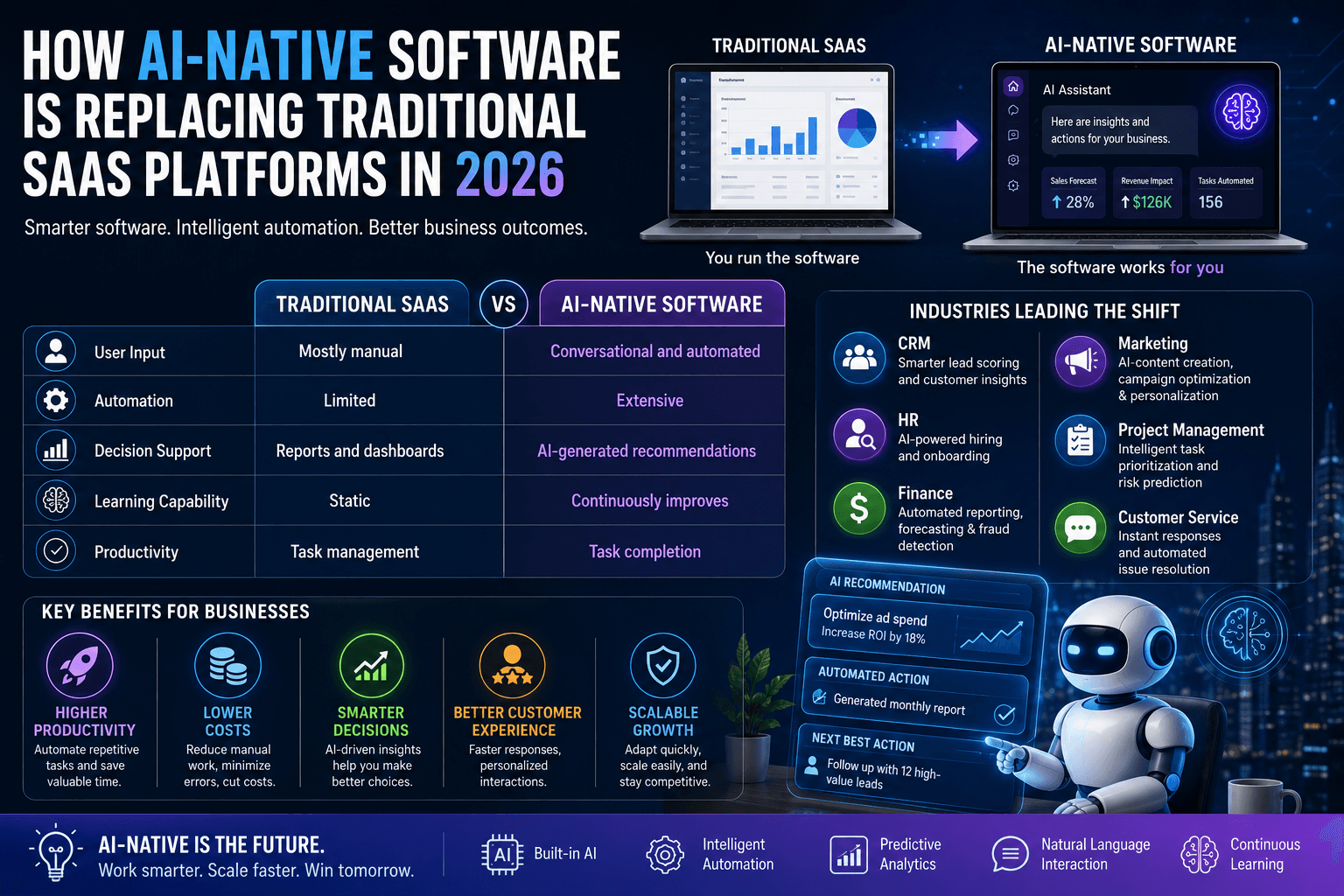
AI-Native Software vs. Traditional SaaS
Feature | Traditional SaaS | AI-Native Software |
|---|---|---|
User Input | Mostly manual | Conversational and automated |
Automation | Limited | Extensive |
Decision Support | Reports and dashboards | AI-generated recommendations |
Learning Capability | Static | Continuously improves |
Productivity | Task management | Task completion |
Instead of simply helping users perform work, AI-native software increasingly performs the work itself.
Why Businesses Are Making the Shift
Increased Productivity
Employees spend less time on repetitive administrative tasks because AI automates scheduling, reporting, document creation, and data entry.
Better Decision-Making
AI analyzes large datasets in real time and delivers actionable insights that help managers respond quickly to changing business conditions.
Lower Operational Costs
Automation reduces manual labor, minimizes human error, and improves overall operational efficiency.
Faster Customer Service
AI-native customer support platforms respond instantly, personalize interactions, and resolve common issues without human intervention.
Improved Employee Experience
Employees can focus on creative thinking, innovation, and strategic planning while AI handles routine tasks.
Industries Leading AI-Native Adoption
Customer Relationship Management (CRM)
AI automatically prioritizes leads, predicts customer behavior, and recommends the next best actions for sales teams.
Human Resources
Recruitment platforms screen candidates, schedule interviews, and assist with onboarding.
Finance
AI automates expense management, invoice processing, forecasting, and fraud detection.
Marketing
AI creates content, optimizes advertising campaigns, analyzes customer engagement, and predicts purchasing behavior.
Project Management
Intelligent platforms prioritize tasks, allocate resources, and identify project risks before they become major problems.
Key Technologies Behind AI-Native Software
Modern AI-native platforms combine several advanced technologies.
Large Language Models (LLMs)
Enable natural conversations and intelligent content generation.
Machine Learning
Continuously improves predictions based on new business data.
Generative AI
Creates reports, emails, presentations, code, and marketing content automatically.
Cloud Computing
Provides scalable infrastructure for AI processing.
APIs and Integrations
Allow AI-native applications to connect seamlessly with existing business systems.
Benefits for Small and Large Businesses
Both startups and enterprises benefit from AI-native software.
Advantages include:
Faster workflows
Reduced costs
Better customer experiences
Improved forecasting
Higher employee productivity
Scalable business operations
More accurate decision-making
These benefits allow organizations to remain competitive in rapidly changing markets.
Challenges of AI-Native Adoption
Despite its advantages, businesses should prepare for several challenges.
Data Privacy
Organizations must protect customer and employee information while complying with privacy regulations.
Employee Training
Teams need training to work effectively alongside .
Integration Complexity
Some legacy software may require updates before AI-native solutions can be fully integrated.
Ethical Considerations
Businesses should establish clear policies for responsible AI usage and human oversight.
How Businesses Can Prepare.
Organizations planning to adopt AI-native software should:
Evaluate current workflows
Identify repetitive tasks suitable for automation
Invest in employee AI training
Improve data quality
Develop an AI governance strategy
Choose scalable AI platforms
Measure performance regularly
A gradual implementation strategy helps reduce risks while maximizing business value.
The Future of Business Software
Experts predict that by 2027, many business applications will function as intelligent digital coworkers rather than passive software tools.
Future developments may include:
Autonomous business assistants
AI-managed workflows
Self-optimizing enterprise software
Predictive business operations
Fully conversational business platforms
Businesses that embrace AI-native software early will be better positioned to innovate and compete.
Conclusion
AI-native software represents the next evolution of business technology. By embedding artificial intelligence into every aspect of business operations, these platforms go beyond traditional SaaS by automating work, improving decision-making, and enhancing productivity.
While traditional SaaS solutions will continue to play an important role, AI-native applications are becoming the preferred choice for organizations seeking greater efficiency and long-term growth. Companies that adopt these intelligent platforms today will be better prepared for the future of digital business.
Frequently Asked Questions (FAQs)
What is AI-native software?
AI-native software is built with artificial intelligence at its core, enabling automation, predictive insights, and intelligent decision-making rather than simply adding AI as a feature.
How is AI-native software different from traditional SaaS?
Traditional SaaS helps users complete tasks manually, while AI-native software automates many tasks, learns from data, and provides proactive recommendations.
Which businesses benefit most from AI-native software?
Businesses in finance, healthcare, marketing, HR, customer service, manufacturing, and retail can all benefit from AI-native platforms.
Is AI-native software replacing SaaS completely?
Not entirely. Many traditional SaaS platforms are evolving by integrating AI features, while AI-native platforms are leading the next generation of business software.
5. Which industries benefit most from AI-native software?
Healthcare, finance, retail, manufacturing, logistics, education, technology, and customer service industries are among the biggest adopters.
6. What are the main advantages of AI-native applications?
Benefits include intelligent automation, faster workflows, predictive analytics, personalized experiences, lower operational costs, and continuous learning.
7. Does AI-native software require cloud computing?
Most AI-native platforms rely on cloud infrastructure for scalability, AI model training, and real-time processing, although some support edge deployment.
8. What role does generative AI play in AI-native software?
Generative AI enables applications to create content, write code, summarize information, answer questions, and assist users through natural language interactions.
9. How does AI-native software improve productivity?
It automates repetitive tasks, analyzes business data, generates insights, and assists employees with complex workflows, allowing teams to focus on higher-value work.
10. Is AI-native software secure?
Leading AI-native platforms include encryption, identity management, compliance controls, monitoring, and AI governance to protect business data.
11. What challenges do businesses face when adopting AI-native software?
Common challenges include integration with legacy systems, employee training, governance, implementation costs, and data quality.
12. Can small businesses use AI-native platforms?
Yes. Many AI-native solutions are cloud-based and offer scalable pricing, making them accessible for startups and small businesses.
13. What is agentic AI?
Agentic AI refers to AI systems capable of planning, reasoning, making decisions, and completing multi-step tasks autonomously.
14. How does AI-native software support digital transformation?
It modernizes business operations through automation, intelligent workflows, predictive analytics, and real-time decision support.
15. Will AI-native software reduce the need for manual work?
It automates repetitive administrative tasks but complements human expertise rather than replacing strategic decision-making.
16. How does AI-native software improve customer experience?
It delivers personalized recommendations, faster support, intelligent chatbots, predictive service, and real-time responses.
17. What technologies power AI-native software?
Large language models (LLMs), machine learning, generative AI, cloud computing, APIs, vector databases, and intelligent automation.
18. Why are enterprises investing in AI-native platforms?
Organizations seek greater efficiency, lower costs, competitive advantages, improved innovation, and scalable AI-powered operations.
19. What is the future of traditional SaaS?
Traditional SaaS is expected to evolve by integrating AI capabilities, while many new applications will be designed as AI-native from the start.
20. Why should businesses prepare for AI-native software now?
Early adoption helps companies increase productivity, improve decision-making, automate workflows, enhance customer experiences, and remain competitive as enterprise software rapidly evolves.