
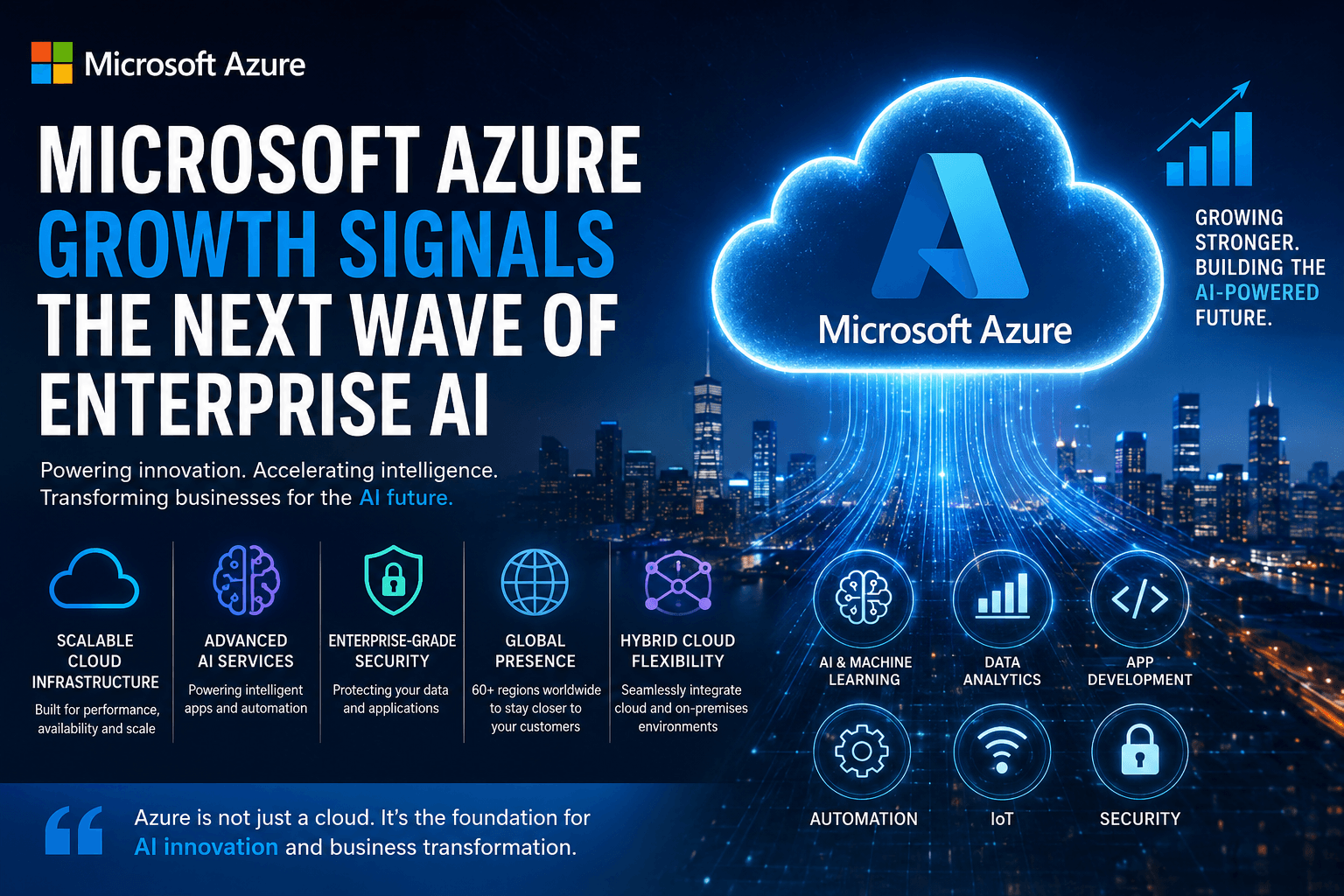

The enterprise technology landscape is undergoing one of the most significant transformations in decades, with artificial intelligence becoming a core driver of innovation, efficiency, and competitive advantage. At the center of this transformation is Microsoft Azure, whose continued growth demonstrates how cloud computing and AI have become inseparable components of modern business strategy.
Organizations of all sizes are no longer viewing AI as an experimental technology. Instead, they are investing heavily in AI-powered applications, intelligent automation, predictive analytics, and generative AI solutions that improve operations and customer experiences. Microsoft's Azure platform has become one of the leading destinations for these workloads because it combines enterprise-grade cloud infrastructure with advanced AI capabilities.
As businesses race to modernize their operations, Azure's expanding ecosystem is signaling the next phase of enterprise AI adoption.
The Rise of Enterprise AIk
Artificial intelligence has evolved from simple automation into sophisticated systems capable of generating content, analyzing complex datasets, predicting business outcomes, and assisting employees with everyday tasks.
Today's enterprises use AI for:
Customer service automation
Intelligent document processing
Predictive maintenance
Financial forecasting
Fraud detection
Marketing personalization
Software development assistance
Supply chain optimization
These applications require scalable cloud infrastructure capable of processing enormous volumes of data. Azure provides the computing resources needed to support these demanding AI workloads.
Why Azure Continues to Grow
Several factors contribute to Microsoft's strong Azure growth.
Enterprise Trust
Many organizations already rely on Microsoft products such as Windows, Microsoft 365, Teams, and Dynamics 365. Azure integrates naturally with these platforms, allowing businesses to expand into AI without rebuilding their technology stack.
AI-Optimized Infrastructure
Training and deploying AI models require powerful computing resources. Azure offers specialized hardware, GPU clusters, high-performance storage, and global networking that support demanding AI applications.
Global Availability
Microsoft operates data centers across numerous regions worldwide, enabling organizations to deploy applications closer to customers while meeting regional compliance requirements.
Hybrid Cloud Leadership
Unlike cloud platforms focused entirely on public cloud environments, Azure supports hybrid and multi-cloud strategies, allowing businesses to combine on-premises infrastructure with cloud services.
AI Is Becoming a Business Necessity
Companies that once viewed AI as optional now recognize it as essential.
Businesses use AI to:
Reduce operational costs
Improve productivity
Deliver faster customer support
Analyze customer behavior
Detect cybersecurity threats
Accelerate innovation
Improve decision-making
Azure enables these capabilities through a comprehensive collection of AI services designed for organizations at every stage of digital transformation.
Generative AI Is Driving Cloud Demand
One of the biggest drivers behind Azure's recent momentum is the rapid adoption of generative AI.
Organizations are building AI assistants that:
Draft emails
Summarize meetings
Generate software code
Create marketing content
Analyze contracts
Produce business reports
Answer customer questions
These applications require reliable cloud infrastructure with high computing performance.
Azure provides the environment businesses need to deploy these solutions securely while maintaining enterprise governance and compliance.
Azure Supports Every Industry
The flexibility of Azure allows organizations across industries to adopt AI according to their specific needs.
Healthcare
Hospitals use AI for diagnostic support, patient scheduling, medical imaging analysis, and predictive healthcare.
Financial Services
Banks leverage Azure for fraud detection, regulatory compliance, risk management, and personalized financial recommendations.
Manufacturing
Manufacturers utilize predictive maintenance, robotics, quality inspection, and production optimization powered by AI.
Retail
Retailers improve inventory management, recommendation engines, pricing strategies, and customer engagement using Azure AI.
Education
Educational institutions deploy AI tutors, learning analytics, virtual classrooms, and administrative automation.
Security Remains a Top Priority
As AI adoption increases, cybersecurity becomes increasingly important.
Azure includes enterprise-grade security features such as:
Identity management
Multi-factor authentication
Data encryption
Threat detection
Continuous monitoring
Compliance certifications
Zero Trust architecture
These capabilities help organizations protect sensitive business information while adopting AI technologies.
The Importance of AI Infrastructure
Artificial intelligence depends on far more than software.
Successful AI requires:
High-performance processors
Advanced GPUs
Massive storage systems
Fast networking
Reliable cloud platforms
Data management
Security controls
Azure combines these elements into a unified cloud platform capable of supporting enterprise-scale AI applications.
Supporting Developers and Innovation
Developers play a crucial role in enterprise AI adoption.
Azure offers tools that simplify:
Application development
AI model deployment
API integration
Machine learning workflows
DevOps automation
Data analytics
Container management
These resources reduce development time while enabling organizations to bring AI-powered products to market more quickly.
The Future of Intelligent Enterprises
The next generation of enterprise software will increasingly rely on AI agents capable of assisting employees, automating workflows, and making data-driven recommendations.
Businesses are moving toward:
AI-powered business assistants
Autonomous customer service
Intelligent workflow automation
Predictive decision support
Smart knowledge management
Personalized digital experiences
Azure provides the cloud infrastructure required to support these emerging technologies at scale.
Challenges Businesses Must Address
Although AI adoption is accelerating, organizations still face important challenges.
These include:
Data privacy
Regulatory compliance
AI governance
Skills shortages
Infrastructure costs
Responsible AI implementation
Cybersecurity risks
Companies that establish strong governance frameworks while investing in employee training will be better positioned to realize the full value of AI.
Why Azure Is Positioned for Long-Term Growth
Several long-term trends support continued Azure expansion.
Organizations continue migrating workloads from on-premises environments to the cloud.
AI applications require increasingly powerful computing resources.
Businesses demand integrated security and compliance.
Developers need scalable platforms for innovation.
Hybrid cloud strategies continue expanding.
These factors position Azure as a foundational platform for enterprise digital transformation.
Final Thoughts
Microsoft Azure's continued growth reflects more than the success of a cloud platform—it represents the accelerating adoption of enterprise AI across every major industry. Organizations are investing in AI to improve efficiency, enhance customer experiences, strengthen cybersecurity, and create new business opportunities.
As artificial intelligence becomes embedded into everyday business operations, cloud platforms capable of delivering scalable infrastructure, robust security, and advanced AI services will play an increasingly important role. Azure's combination of enterprise integration, AI capabilities, hybrid cloud support, and global infrastructure positions it as a key enabler of the next wave of intelligent business transformation.
Companies that begin building AI strategies today will be better equipped to compete in a future where intelligent automation, data-driven decision-making, and AI-powered innovation become standard components of business success.
Frequently Asked Questions (FAQs)
1. What is Microsoft Azure?
Microsoft Azure is a cloud computing platform offering services for computing, storage, networking, databases, AI, and application development.
2. Why is Azure growing so rapidly?
Its growth is fueled by increasing enterprise demand for AI, cloud migration, and digital transformation.
3. How does Azure support enterprise AI?
Azure provides AI models, machine learning tools, GPU infrastructure, and cloud services for deploying AI applications.
4. What industries benefit from Azure AI?
Healthcare, finance, retail, manufacturing, education, logistics, and government all benefit from Azure AI solutions.
5. What is Azure OpenAI Service?
It enables organizations to access advanced AI models through Microsoft's secure cloud platform.
6. Is Azure suitable for small businesses?
Yes. Azure offers scalable pricing and services suitable for startups and small businesses.
7. How secure is Microsoft Azure?
Azure includes encryption, identity management, threat detection, compliance certifications, and Zero Trust security.
8. What is AI infrastructure?
AI infrastructure includes GPUs, cloud servers, networking, storage, and software needed for AI workloads.
9. Why is cloud computing important for AI?
Cloud platforms provide scalable computing power and storage required for training and deploying AI models.
10. Can Azure run generative AI applications?
Yes. Azure supports generative AI, large language models, and enterprise AI assistants.
11. Does Azure support hybrid cloud?
Yes. Azure enables organizations to combine on-premises systems with public cloud services.
12. How does Azure improve productivity?
It automates workflows, analyzes data, and powers AI tools that help employees work more efficiently.
13. What are Azure AI Foundry and AI Studio?
They provide tools for building, testing, deploying, and managing enterprise AI applications.
14. How does Azure help developers?
Azure offers APIs, DevOps tools, AI services, databases, and application hosting for faster development.
15. What role do GPUs play in Azure?
GPUs accelerate AI model training and inference, improving performance for machine learning workloads.
16. Can Azure support global businesses?
Yes. Microsoft's global data center network enables organizations to serve customers worldwide.
17. What challenges do businesses face with AI adoption?
Common challenges include governance, security, compliance, costs, and workforce skills.
18. Why are enterprises investing more in AI?
AI improves efficiency, reduces costs, enhances customer experiences, and supports innovation.
19. What makes Azure competitive?
Its integration with Microsoft products, hybrid cloud capabilities, AI services, and enterprise security.
20. What is the future of Microsoft Azure?
Azure is expected to remain a leading platform for enterprise AI, cloud computing, automation, and digital transformation as businesses continue adopting intelligent technologies.Microsoft Azure Growth Signals the Next Wave of Enterprise AI