
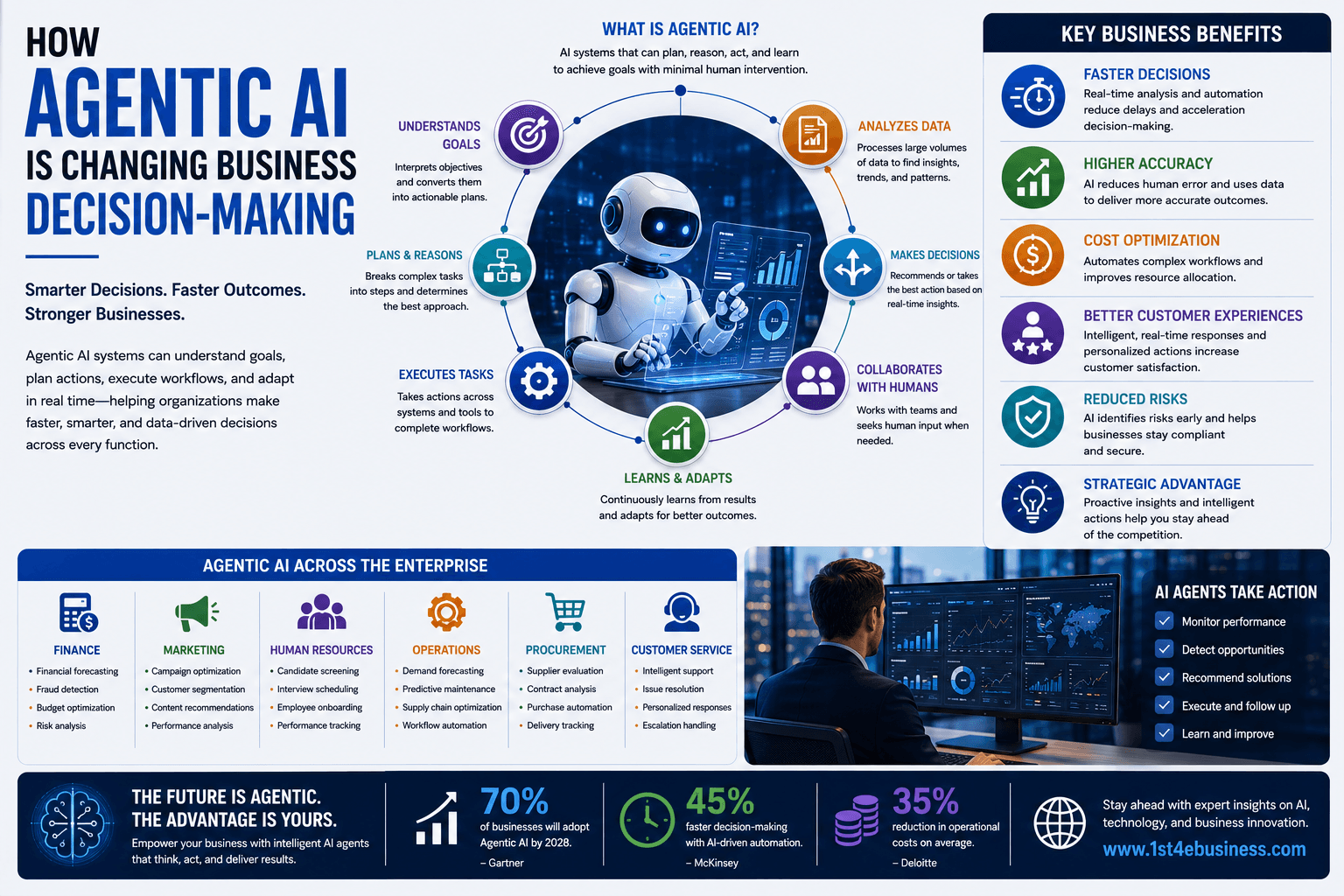
Business decision-making has traditionally depended on executives, analysts, dashboards, reports, and predefined software workflows. While these tools remain important, the rise of Agentic AI is introducing a new approach in which AI systems can independently analyze information, evaluate options, coordinate tasks, and take actions within defined boundaries.
Unlike conventional AI applications that respond to individual prompts, agentic AI can pursue objectives through multi-step processes. This capability is changing how organizations approach operational, financial, customer, and strategic decisions.
What Is Agentic AI?
Agentic AI refers to AI systems that can operate with a degree of autonomy to achieve specific goals.
An AI agent can potentially:
Understand a business objective
Gather relevant information
Analyze data
Evaluate possible actions
Use business software and tools
Make recommendations
Execute approved tasks
Monitor results
Adjust its approach based on new information
This creates a shift from AI as an assistant toward AI as an active decision-making participant.
For example, a traditional analytics platform might show that sales have declined in a particular region. An agentic AI system could investigate the decline, compare pricing and customer data, identify potential causes, model possible responses, and recommend an action plan.
From Data Analysis to Decision Execution
Traditional business analytics is largely focused on helping humans understand information.
Agentic AI connects analysis with action.
Consider inventory management. A traditional system may show that a product is approaching its minimum stock level. An employee then reviews supplier information, checks demand forecasts, and places an order.
An AI agent could monitor inventory continuously, analyze projected demand, compare approved suppliers, evaluate pricing and delivery times, and prepare or execute an order according to company policies.
The important change is that intelligence becomes embedded directly into the workflow.
Faster Business Decisions
Speed is becoming increasingly important in competitive markets.
Organizations often have access to enormous amounts of data, but collecting and interpreting that information can take time. By the time a decision is made, market conditions may already have changed.
Agentic AI can continuously monitor relevant information and respond to changes.
For example, a sales agent could monitor customer activity and identify accounts showing signs of churn. It could investigate the reasons, recommend retention strategies, and create tasks for the appropriate sales representatives.
This allows organizations to respond to opportunities and risks much faster.
AI Agents Can Connect Multiple Systems
One of the most powerful characteristics of agentic AI is its ability to interact with different business systems.
An agent might retrieve information from a CRM, analyze financial data, access inventory systems, review customer-support records, and use project-management software.
Instead of requiring employees to move between multiple applications, the agent can coordinate information across them.
This can reduce workflow friction and make decision-making more connected.
Improving Strategic Decision-Making
Agentic AI is not limited to repetitive operational tasks.
It can also support strategic planning by analyzing different scenarios.
For example, a company considering expansion into a new market could ask an AI agent to evaluate:
Market demand
Competitor activity
Pricing
Customer demographics
Operating costs
Regulatory considerations
Supply-chain requirements
The system could compare scenarios and present potential risks and opportunities.
Executives would still make the final strategic decision, but they could do so with a broader and faster analysis.
Real-Time Risk Management
Agentic AI can continuously monitor business environments for emerging risks.
In cybersecurity, an agent might identify suspicious activity, investigate related events, assess potential impact, and initiate predefined containment procedures.
In finance, agents could monitor transactions for unusual patterns.
In supply chains, they could detect supplier delays or transportation disruptions.
This changes risk management from periodic assessment toward continuous monitoring and response.
Personalizing Customer Decisions
Agentic AI can also transform customer-facing decisions.
Instead of relying only on predefined recommendation rules, AI agents can evaluate customer context dynamically.
For example, an agent could analyze a customer's previous interactions, current needs, product usage, and support history before determining the most appropriate next action.
This could help businesses deliver more relevant recommendations and services.
The same technology can support sales agents, customer-service representatives, and marketing teams.
Multi-Agent Business Systems
The next stage of agentic AI may involve multiple specialized agents working together.
For example, an organization could have:
A sales agent
A finance agent
A procurement agent
A customer-service agent
A risk agent
An operations agent
These systems could exchange information and coordinate activities.
A sales agent might identify a large new opportunity. A finance agent could evaluate profitability, while a procurement agent assesses supply requirements. A risk agent could review potential risks before the organization proceeds.
This creates the possibility of AI-powered business ecosystems in which multiple agents collaborate across departments.
Human Oversight Remains Essential
Greater autonomy does not mean businesses should allow AI systems to make every decision independently.
Some decisions have significant financial, legal, ethical, or reputational consequences.
Organizations should establish clear boundaries around agentic AI.
For example:
Low-risk decisions: AI may act independently.
Medium-risk decisions: AI prepares recommendations and requests approval.
High-risk decisions: Humans retain final authority.
This approach allows companies to benefit from automation while maintaining accountability.
The Importance of AI Governance
As AI agents gain the ability to take actions, governance becomes more important.
Businesses need to establish:
Permission controls
Audit trails
Data-access policies
Approval workflows
Security controls
Model evaluation
Monitoring systems
Clear accountability
Organizations should know what an AI agent is allowed to access, what actions it can perform, and why it made a particular decision.
This is particularly important when agents interact with financial systems, customer information, or other sensitive resources.
Agentic AI and Employee Productivity
Agentic AI can change employee roles by taking over repetitive decision-support activities.
Employees may spend less time collecting information and performing routine analysis and more time on strategic and interpersonal responsibilities.
For example, instead of manually preparing a weekly business report, an employee could ask an AI agent to analyze performance, identify unusual changes, explain the major drivers, and highlight decisions requiring human attention.
The employee becomes less of a data collector and more of a decision supervisor.
Challenges of Agentic AI
Despite its potential, agentic AI introduces several challenges.
Accuracy
AI agents can make incorrect assumptions or act on incomplete information.
Security
An agent with access to multiple business systems can create significant security risks if permissions are poorly managed.
Accountability
Organizations need to determine who is responsible when an AI-driven action produces an undesirable outcome.
Integration
Agents need reliable connections to enterprise systems and high-quality data.
Governance
Businesses must define which actions agents can perform autonomously and which require human approval.
Addressing these issues will be essential for responsible adoption.
The Future of Business Decision-Making
Agentic AI is moving organizations toward a new model of decision-making.
Traditional systems largely provide information.
AI assistants provide recommendations.
Agentic AI can increasingly analyze, decide, coordinate, and act within defined boundaries.
This does not mean human decision-makers will disappear. Instead, businesses are likely to develop hybrid operating models in which humans establish goals, policies, and strategic direction while AI agents handle large portions of analysis and execution.
The competitive advantage may ultimately come from how effectively a company combines human judgment with machine intelligence.
Conclusion
Agentic AI is transforming business decision-making by connecting intelligence with action.
Its ability to monitor information, analyze complex situations, evaluate alternatives, coordinate workflows, and execute approved tasks can help organizations make decisions faster and operate more efficiently.
The organizations that benefit most will not simply deploy AI agents across isolated tasks. They will integrate them into broader business processes while maintaining strong governance and human oversight.
As agentic AI continues to mature, decision-making is likely to become increasingly continuous, intelligent, automated, and adaptive—creating a new generation of AI-powered businesses.