

Introduction
Search is undergoing its most significant transformation since the rise of Google. Instead of presenting users with a list of webpages, AI-powered search platforms increasingly generate complete answers by combining information from multiple trusted sources. Users can now receive explanations, comparisons, recommendations, and summaries without visiting numerous websites.
This shift has introduced a new discipline known as Generative Engine Optimization (GEO).
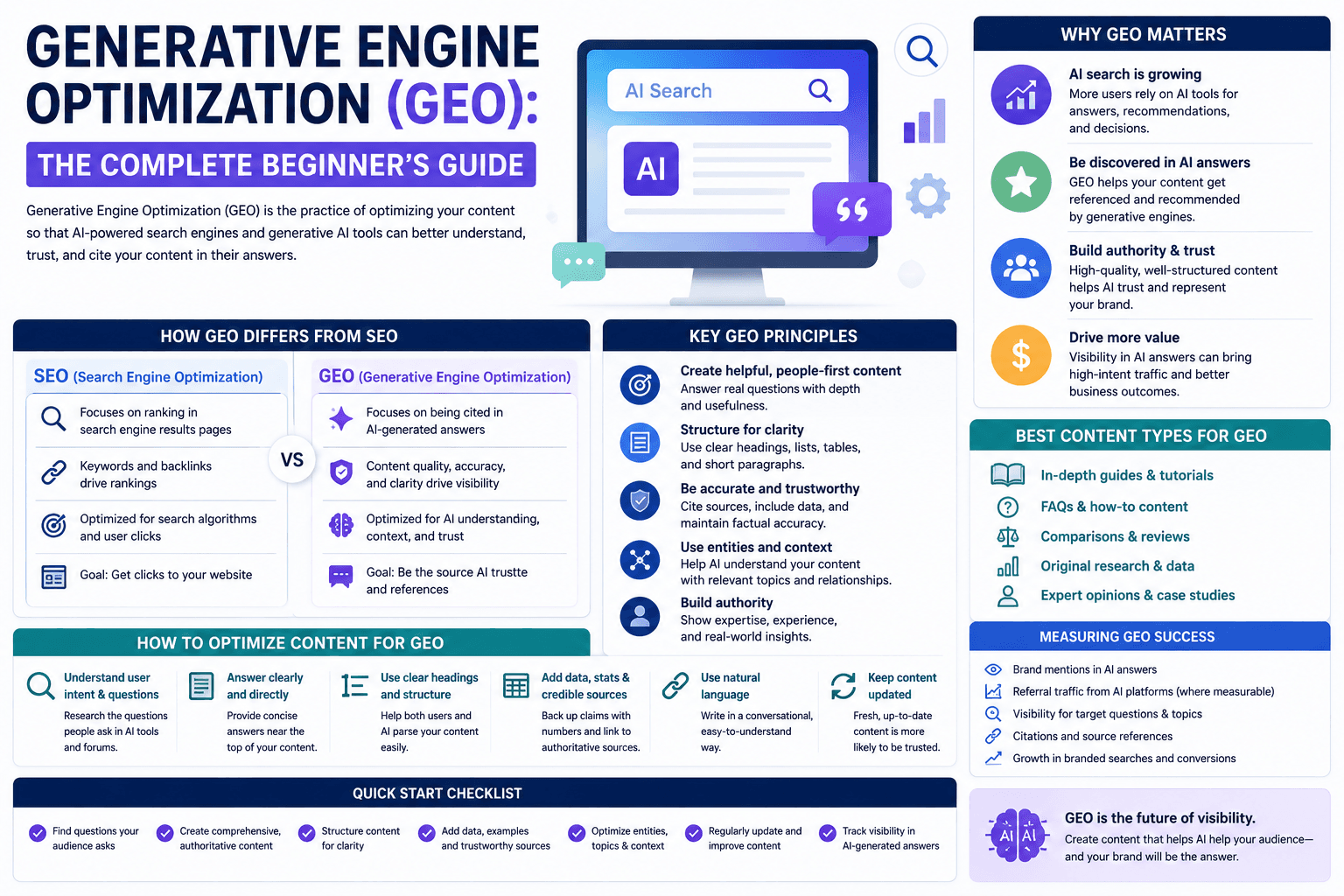
While traditional Search Engine Optimization (SEO) focuses on improving search rankings and increasing organic traffic, GEO is designed to help content become understandable, trustworthy, and valuable enough for AI systems to reference in generated responses.
As AI-powered search continues expanding across platforms such as ChatGPT, Google AI Overviews, Gemini, and other generative assistants, businesses that adapt their content strategy early may gain a significant competitive advantage.
What Is Generative Engine Optimization?
Generative Engine Optimization (GEO) is the practice of creating content that artificial intelligence systems can easily understand, evaluate, and reference when generating answers.
Unlike traditional search engines that primarily rank webpages, generative AI analyzes multiple trusted sources, identifies consistent information, and produces conversational responses.
Instead of asking:
"Which webpage ranks highest?"
AI systems increasingly ask:
"Which source provides the clearest, most accurate, and most trustworthy explanation?"
This change places greater emphasis on content quality, expertise, structure, and topical authority rather than keyword rankings alone.
Why GEO Matters More Than Ever
AI-assisted search is changing how people discover information.
Users increasingly expect:
Direct answers
Step-by-step explanations
Product recommendations
Business comparisons
Personalized guidance
Rather than clicking through multiple search results, many users now rely on AI-generated summaries.
For businesses, this means visibility depends not only on ranking well in Google but also on becoming a trusted information source for AI systems.
GEO vs Traditional SEO
Traditional SEO | Generative Engine Optimization |
|---|---|
Focuses on rankings | Focuses on AI citations |
Keyword optimization | Topic authority |
Meta titles | Information quality |
Backlinks | Trustworthiness |
Organic clicks | AI visibility |
SERP performance | AI-generated mentions |
Both strategies complement each other rather than compete.
How AI Evaluates Content
Modern AI systems assess far more than keyword usage.
They consider:
Context
Does the article answer the topic completely?
Accuracy
Are statements factual and supported by reliable information?
Readability
Can both humans and AI easily understand the content?
Structure
Are headings, lists, and sections logically organized?
Originality
Does the article provide unique insights instead of repeating existing information?
Freshness
Has the content been updated to reflect current developments?
Characteristics of High-Quality GEO Content
Successful GEO content generally includes:
Comprehensive topic coverage
Clear section headings
Short paragraphs
Practical examples
Frequently Asked Questions (FAQs)
Internal links
Original analysis
Updated information
Helpful summaries
These elements improve readability while helping AI understand the article's context.
Why Original Analysis Matters
One of the strongest signals for AI-powered search is originality.
Instead of rewriting information available elsewhere, businesses should include:
Industry observations
Practical recommendations
Case studies
Comparative analysis
Expert commentary
Real-world applications
Content that contributes new ideas is more likely to be referenced than content that simply summarizes existing articles.
E-E-A-T Still Plays a Critical Role
Google's Experience, Expertise, Authoritativeness, and Trustworthiness (E-E-A-T) principles remain highly relevant.
Businesses should demonstrate:
Practical experience
Subject expertise
Topical authority
Accurate information
Regular updates
Transparent authorship
These signals improve credibility for both search engines and AI systems.
Technical SEO Still Supports GEO
Although GEO focuses heavily on content quality, technical optimization remains essential.
Important factors include:
Fast loading pages
Mobile-friendly design
HTTPS security
Clean HTML structure
Proper heading hierarchy
Internal linking
XML sitemap
Schema markup
Canonical tags
Technical SEO ensures AI systems can efficiently crawl and understand website content.
Common GEO Mistakes
Many websites unintentionally reduce their AI visibility by:
Publishing thin content
Writing duplicate articles
Overusing keywords
Ignoring topical authority
Publishing outdated information
Using misleading titles
Poor internal linking
Avoiding these mistakes strengthens long-term visibility.
Practical GEO Strategy
A beginner-friendly GEO workflow includes:
Choose one core topic.
Research related user questions.
Create the most complete resource possible.
Use descriptive headings.
Answer important questions immediately.
Include original insights.
Link related articles together.
Update content regularly.
This approach builds topical authority over time.
Measuring GEO Success
Unlike traditional SEO, GEO success is measured using broader visibility indicators such as:
AI citations
Brand mentions
Referral traffic
Direct visits
User engagement
Backlinks
Growth in topical authority
Businesses should monitor both search performance and AI visibility together.
The Future of GEO
Generative AI is expected to become a permanent part of digital search.
Organizations investing in authoritative, trustworthy, and well-structured content today are likely to benefit as AI search continues evolving.
Rather than replacing SEO, GEO expands optimization into a broader ecosystem where usefulness, expertise, and trust are more important than keyword density alone.
Businesses that consistently publish original, high-quality knowledge resources will be better positioned across traditional search engines and AI-powered platforms.
Conclusion
Generative Engine Optimization represents the next evolution of digital content strategy. While traditional SEO continues to drive search rankings, GEO focuses on ensuring content is comprehensive, trustworthy, and valuable enough for AI systems to understand and reference.
Organizations that invest in expert knowledge, original insights, strong technical foundations, and regular content updates will be better positioned as AI-powered search becomes increasingly influential. The future of online visibility will belong to businesses that prioritize usefulness, credibility, and long-term authority over short-term optimization tactics.
FAQs: Generative Engine Optimization (GEO)
1. What is Generative Engine Optimization (GEO)?
Generative Engine Optimization (GEO) is the practice of optimizing content so that AI-powered search engines and generative AI tools are more likely to understand, reference, and recommend it in their answers.
2. How is GEO different from traditional SEO?
Traditional SEO focuses primarily on improving visibility in search-engine results pages. GEO focuses on making content useful and recognizable to AI systems that generate direct answers from multiple sources.
3. Why is GEO important for businesses?
GEO can help businesses increase visibility in AI-generated answers, reach users who rely on tools such as AI assistants, and strengthen their authority in an increasingly AI-driven search environment.
4. How can I optimize content for GEO?
Create clear, accurate, well-structured, and authoritative content. Use descriptive headings, answer specific questions, provide trustworthy information, include relevant entities and statistics, and keep important information easy for AI systems to understand.
5. Does GEO replace SEO?
No. GEO complements SEO rather than replacing it. Strong technical SEO, useful content, authoritative sources, and good website structure can support both traditional search visibility and AI discoverability.
6. What types of content work best for GEO?
Content that directly answers user questions tends to work well. Examples include comprehensive guides, FAQs, comparisons, how-to articles, original research, expert analysis, and clearly structured educational content.
7. Do backlinks matter for GEO?
Backlinks can still contribute to authority and credibility. However, GEO also benefits from factors such as content quality, factual accuracy, citations, brand recognition, and how clearly information can be interpreted by AI systems.
8. Can small businesses use GEO?
Yes. Small businesses can use GEO by creating highly relevant, expert, and locally or industry-specific content that directly addresses the questions their target customers ask AI tools.
9. How do I measure GEO performance?
Businesses can monitor brand mentions in AI-generated answers, referral traffic from AI platforms where measurable, visibility for target queries, citations, branded searches, and changes in organic traffic and conversions.
10. Is GEO a one-time optimization process?
No. AI search systems and user behavior continue to evolve. Businesses should regularly update content, verify facts, monitor AI visibility, and adjust their GEO strategy as generative search technology develops.