
The Future of AI-Powered Customer Experience Beyond Chatbots
Customer experience is entering a new phase. For years, businesses primarily associated artificial intelligence with chatbots, automated replies, and basic virtual assistants. While these tools have improved customer support, AI is now moving far beyond answering frequently asked questions.
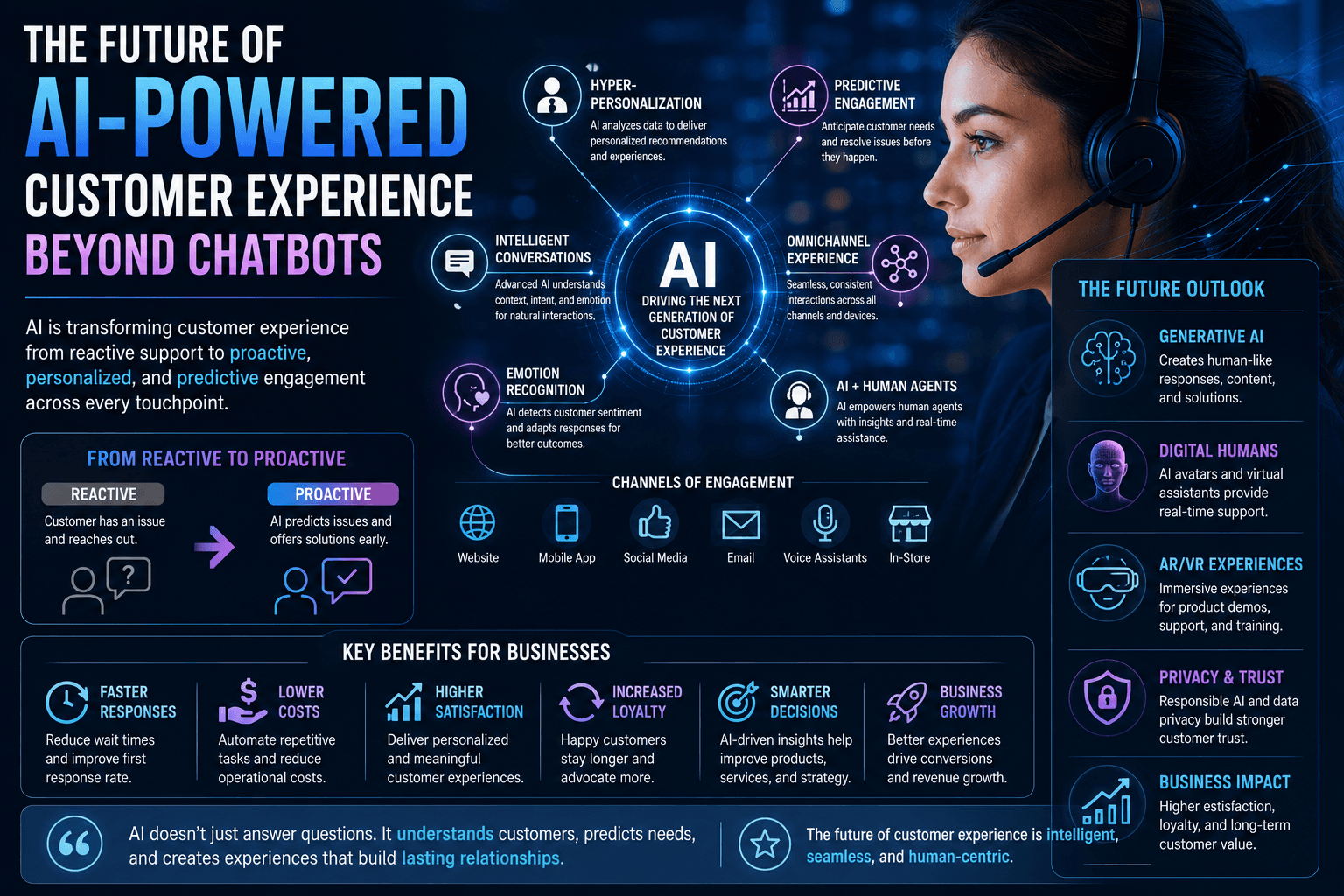
The next generation of AI-powered customer experience will involve systems that understand customer intent, predict needs, personalize interactions, automate complex processes, and coordinate experiences across multiple channels.
Instead of simply responding to customers, AI will increasingly help businesses anticipate what customers need before they ask.
From Chatbots to Intelligent Customer Experiences
Traditional chatbots were designed around predefined questions and answers. Customers could ask about shipping, pricing, account information, or basic services, and the chatbot would provide a response.
Modern AI systems are becoming significantly more capable.
Large language models, predictive analytics, machine learning, speech recognition, computer vision, and AI agents can work together to create customer experiences that are more personalized and context-aware.
For example, an AI-powered customer system could recognize that a customer has repeatedly searched for a particular product, identify their previous purchases, understand their current question, and recommend the most relevant solution.
This changes the role of AI from automated answering to intelligent assistance.
Hyper-Personalization at Scale
One of the biggest opportunities for AI in customer experience is personalization.
Traditional personalization often relies on basic information such as names, locations, previous purchases, or browsing history. AI can analyze much larger amounts of behavioral and contextual information.
Businesses can use AI to understand:
Customer preferences
Purchase behavior
Browsing patterns
Communication preferences
Previous support interactions
Product interests
Engagement levels
Potential purchasing intent
This information can help businesses deliver more relevant experiences.
An e-commerce platform, for example, could dynamically adjust product recommendations based on a customer's changing interests rather than relying only on historical purchases.
The result is a customer journey that feels less generic and more relevant to the individual.
Predictive Customer Service
Customer service has traditionally been reactive.
A customer experiences a problem, contacts the company, and waits for assistance.
AI can help organizations move toward predictive customer service.
Machine learning models can identify patterns that indicate a potential problem before the customer reports it.
For example, a telecommunications company could detect unusual network behavior and notify customers about a potential service disruption. A software company could identify unusual usage patterns that suggest a customer may encounter an issue and provide guidance proactively.
This approach can reduce customer frustration while improving trust.
The objective is simple: solve problems before customers have to ask for help.
AI Agents Will Transform Customer Support
AI agents represent another major development beyond traditional chatbots.
Instead of simply generating responses, AI agents can potentially perform multi-step tasks.
For example, a customer might say
"My order hasn't arrived. Please check its status and tell me what I should do."
An AI agent could potentially:
Verify the customer's identity.
Find the relevant order.
Check shipping information.
Determine whether the package is delayed.
Identify the appropriate resolution.
Initiate a replacement or refund when authorized.
Update the customer.
This creates a more complete service experience.
Rather than acting as another communication layer, AI becomes an operational assistant capable of interacting with business systems.
Omnichannel Customer Experiences
Customers rarely interact with companies through only one channel.
They may discover a product through social media, visit a website, ask a question through live chat, purchase through a mobile application, and later contact customer service by phone.
AI can help connect these interactions.
A future customer experience platform could maintain relevant context across channels so customers do not have to repeatedly explain their situation.
For example, if a customer begins a conversation through a website and later contacts the company by phone, the support representative—or AI system—could have access to the relevant conversation history.
This creates a more seamless customer journey.
Voice AI Is Becoming More Important
Customer experience is also moving beyond text.
Advances in speech recognition and generative AI are improving the capabilities of voice-based customer service systems.
Future voice assistants may be able to understand conversational language, interruptions, emotional context, accents, and complex requests more effectively.
Instead of forcing customers through rigid phone menus, AI-powered voice systems could allow customers to explain their problems naturally.
For businesses, this could reduce call-center workloads while allowing human agents to focus on more complex situations.
Sentiment and Emotion Analysis
AI can also help organizations understand how customers feel.
Natural language processing can analyze customer messages, reviews, surveys, and support conversations to identify sentiment and recurring concerns.
For example, an organization could identify that customers are increasingly frustrated with a particular product feature.
Instead of relying exclusively on periodic surveys, businesses could use AI to continuously analyze customer feedback and identify emerging problems.
However, businesses should use emotion-related AI carefully and transparently because customer sentiment analysis can involve privacy, accuracy, and ethical considerations.
AI-Powered Recommendations
Recommendation engines are already widely used, but AI is making them more sophisticated.
Rather than simply recommending products based on what similar customers purchased, AI systems can consider multiple contextual signals.
A recommendation could take into account:
Previous purchases
Current browsing behavior
Customer preferences
Product availability
Seasonality
Price sensitivity
Customer intent
Previous interactions
This allows companies to provide more useful recommendations across e-commerce, financial services, travel, entertainment, and other industries.
AI in Retail Customer Experience
Retail is likely to be one of the biggest beneficiaries of AI-powered customer experience.
AI can support customers throughout the entire shopping journey.
Before purchase, AI can provide personalized product recommendations and answer questions.
During purchase, AI can assist with product comparisons and checkout.
After purchase, AI can track deliveries, handle returns, provide product guidance, and identify opportunities for additional support.
Physical stores can also use AI-powered technologies to connect digital and physical experiences.
The long-term goal is not simply automation. It is creating a more convenient and personalized shopping journey.
AI-Powered Customer Experience in Banking
Financial institutions handle large amounts of customer data and interactions, making them strong candidates for AI-powered experiences.
AI can help customers understand transactions, identify unusual activity, receive personalized financial insights, and navigate banking services.
AI systems can also help employees understand customer histories and provide more informed assistance.
However, financial services require particularly strong safeguards because AI decisions can affect customers' money, privacy, and access to financial products.
Human oversight and transparent decision-making will therefore remain important.
The Human-AI Partnership
Despite the rapid development of AI, the future of customer experience will not necessarily be completely automated.
Human employees remain essential for complex, emotional, sensitive, and high-value interactions.
The more effective model is likely to be AI + human expertise.
AI can handle repetitive questions, summarize customer histories, retrieve information, identify patterns, and complete routine tasks.
Human employees can focus on negotiation, empathy, creative problem-solving, relationship building, and difficult decisions.
This combination can improve both employee productivity and customer satisfaction.
Privacy Will Become a Major Competitive Factor
As AI systems become more personalized, they will require access to more customer information.
This creates a significant responsibility for businesses.
Companies will need to be transparent about how customer data is collected, stored, analyzed, and used.
Customers may increasingly prefer companies that provide personalized experiences without making them feel constantly monitored.
Data governance, consent, security, and responsible AI practices will therefore become central parts of customer experience strategies.
AI Will Change Customer Experience Metrics
Traditional customer experience metrics include customer satisfaction scores, response times, resolution rates, and Net Promoter Scores.
AI-powered experiences could introduce additional measurements.
Businesses may increasingly analyze:
Personalization accuracy
Customer effort
Predictive resolution rates
AI-to-human escalation rates
Automated resolution quality
Customer sentiment trends
Interaction consistency
AI recommendation effectiveness
The focus will shift from simply measuring how quickly a company responds to understanding whether the company actually solved the customer's problem.
The Future: AI That Understands Intent
The biggest transformation may come from AI systems becoming better at understanding customer intent.
Customers do not always clearly explain what they need.
Someone might say, "This isn't working anymore," without explaining the exact problem.
An intelligent AI system could use conversation history, account information, product data, and contextual signals to determine what the customer may actually need.
This could make customer interactions more natural and efficient.
Conclusion
The future of AI-powered customer experience is much bigger than chatbots.
AI is moving toward predictive service, hyper-personalization, autonomous agents, voice interfaces, intelligent recommendations, omnichannel experiences, and proactive problem-solving.
The most successful companies will not simply add AI to existing customer service channels. They will redesign the entire customer journey around intelligent systems while maintaining appropriate human oversight.
The ultimate goal is not to make customer interactions more automated for their own sake. It is to make them faster, more relevant, more convenient, and more human-centered.
As AI continues to evolve, businesses that successfully combine intelligent automation with human expertise could gain a significant advantage in customer loyalty, operational efficiency, and long-term growth.
FAQs
1. What is AI-powered customer experience?
AI-powered customer experience uses artificial intelligence to personalize interactions, predict customer needs, automate support tasks, analyze feedback, provide recommendations, and improve customer journeys across different channels.
2. Is AI-powered customer experience replacing chatbots?
It is expanding beyond traditional chatbots rather than simply replacing them. Chatbots remain useful for basic conversations, while newer AI systems can understand context, perform tasks, make recommendations, and coordinate more complex customer interactions.
3. What are AI agents in customer service?
AI agents are systems capable of handling multi-step tasks rather than simply answering questions. Depending on their permissions and integrations, they can retrieve information, update records, initiate workflows, and resolve certain customer requests.
4. How does AI personalize customer experiences?
AI can analyze customer behavior, preferences, previous interactions, purchase history, and other relevant information to generate more personalized recommendations and communications.
5. Can AI predict customer needs?
Yes. Predictive AI can identify behavioral patterns and signals that may indicate a customer's future needs, potential problems, or purchasing intent.
6. How does AI improve customer support?
AI can reduce response times, automate repetitive questions, summarize customer histories, retrieve information, assist human agents, and resolve certain requests without requiring manual intervention.
7. Will humans still be needed in customer service?
Yes. Human employees are likely to remain important for complex, sensitive, emotional, and high-value interactions. AI can handle routine work while humans focus on situations requiring judgment and empathy.
8. How can AI improve omnichannel customer experience?
AI can connect relevant information across websites, mobile applications, social media, email, chat, and voice channels, helping customers receive more consistent service without repeatedly providing the same information.
9. What role will voice AI play in customer experience?
Voice AI can make customer service more conversational by allowing customers to explain problems naturally instead of navigating rigid menus. Improvements in speech recognition and generative AI are expanding its potential.
10. Can AI analyze customer sentiment?
Yes. Natural language processing can analyze reviews, surveys, messages, and support conversations to identify sentiment patterns and recurring customer concerns.
11. What are the risks of AI-powered customer experience?
Potential risks include privacy violations, inaccurate responses, biased recommendations, security vulnerabilities, excessive automation, and poor handling of sensitive situations.
12. How can businesses protect customer privacy when using AI?
Businesses should establish clear data governance policies, limit unnecessary data collection, secure customer information, control access, provide appropriate transparency, and comply with applicable privacy regulations.
13. Can AI improve customer retention?
AI can contribute to retention by identifying customer dissatisfaction, personalizing interactions, predicting potential problems, and providing proactive support. Retention ultimately depends on the quality of the overall customer experience.
14. How will AI affect e-commerce customer experience?
AI can provide personalized recommendations, intelligent product searches, virtual assistance, automated order support, dynamic customer service, and more personalized post-purchase experiences.
15. Can AI help call-center employees?
Yes. AI can summarize conversations, suggest responses, retrieve information, analyze customer sentiment, automate after-call documentation, and help agents resolve problems more efficiently.
16. What is predictive customer service?
Predictive customer service uses data and AI models to identify potential customer problems before customers report them. Businesses can then provide proactive notifications or solutions.
17. Will AI make customer service completely automated?
Complete automation is unlikely to be appropriate for every situation. Businesses will generally need human involvement for complex decisions, sensitive cases, escalations, and situations where AI cannot confidently provide an appropriate solution.
18. Why is personalization important in AI-powered customer experience?
Personalization helps customers receive information, recommendations, and support that are more relevant to their individual needs, potentially reducing customer effort and improving engagement.
19. What is the future of AI customer experience beyond chatbots?
The future includes autonomous AI agents, predictive support, voice AI, intelligent recommendations, real-time personalization, connected omnichannel experiences, and AI systems capable of taking actions rather than simply generating responses.
20. Why should businesses invest in AI-powered customer experience?
Businesses can use AI to improve service efficiency, personalize interactions, reduce repetitive workloads, identify customer needs, and create more responsive experiences. Organizations that implement AI responsibly may gain advantages in both customer satisfaction and operational efficiency.