
TCThe Cost of Cross-Border Trade: Navigating Supply Chain Disruptions in Regional Tech Sectors
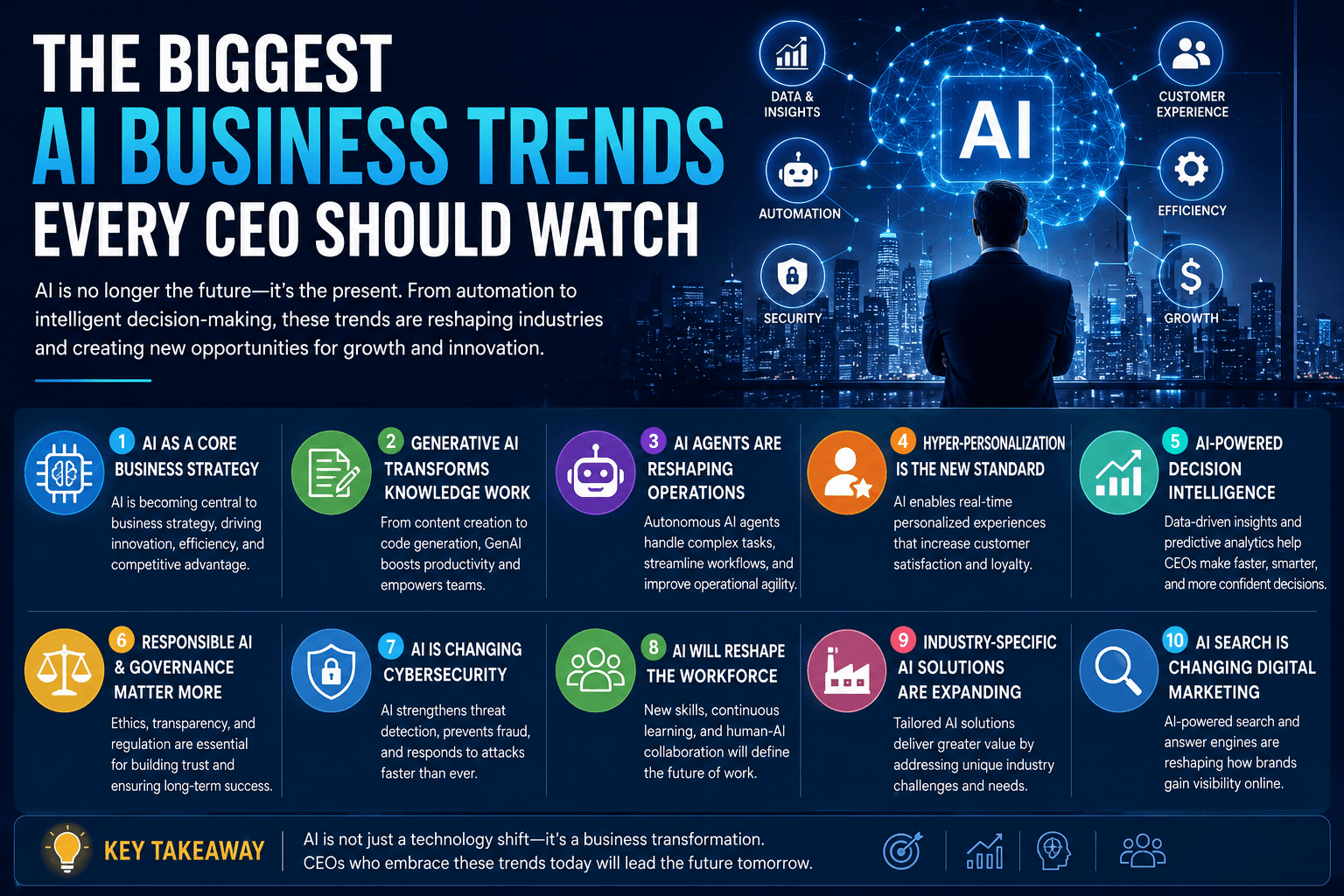
Artificial intelligence is moving from an experimental technology to a core business capability. In 2026, CEOs are increasingly focused not only on adopting AI but on understanding how it can change operations, customer experiences, workforce productivity, cybersecurity, and competitive strategy.
The most important AI trends are no longer limited to generative content. Businesses are entering an era of AI agents, intelligent automation, real-time decision-making, AI-powered cybersecurity, and increasingly autonomous enterprise workflows.
For CEOs, understanding these trends is essential for making informed technology and investment decisions.
1. AI Agents Are Moving Into Enterprise Workflows
One of the biggest AI trends in 2026 is the growth of AI agents.
Unlike traditional chatbots that primarily answer questions, AI agents can be designed to perform multi-step tasks. They can gather information, use business applications, make recommendations, and complete approved actions.
Enterprise applications include:
Sales lead qualification
Customer support
IT operations
Financial analysis
Procurement
HR administration
Research
Report generation
The strategic opportunity is significant because companies can move from automating individual tasks to automating entire workflows.
CEOs should evaluate where employees spend the most time on repetitive coordination and information gathering. These processes may be strong candidates for agent-based automation.
2. AI Is Becoming a Decision-Making Layer
business have used analytics for years, but AI is changing how organizations interpret data.
Modern AI systems can analyze large volumes of structured and unstructured information and help identify patterns, anomalies, risks, and opportunities.
Instead of simply asking:
"What happened?"
executives can increasingly ask:
"Why did it happen, what is likely to happen next, and what should we do?"
This is pushing businesses toward predictive and prescriptive decision intelligence.
For CEOs, the competitive advantage may come from making better decisions faster rather than simply accumulating more data.
3. Generative AI Is Becoming More Specialized
The first wave of generative AI focused heavily on general-purpose models.
Businesses are increasingly looking for systems that understand specific industries, processes, customers, and internal knowledge.
Enterprise AI applications may be customized around:
Company policies
Product information
Legal documents
Customer records
Industry regulations
Internal knowledge
Proprietary data
This specialization can make AI more useful for real business processes.
CEOs should therefore look beyond generic AI tools and consider where proprietary business knowledge can create differentiated AI capabilities.
4. AI-Powered Search Is Changing Digital Discovery
Search is undergoing a major transformation.
AI-powered search experiences can provide direct answers, summarize information, compare options, and guide users through conversational interactions.
This affects businesses that depend on organic search traffic.
Traditional SEO remains important, but companies increasingly need to consider:
AI-generated answers
Brand mentions
Source visibility
Conversational queries
Structured information
Original expertise
Brand authority
CEOs should recognize that digital visibility is evolving beyond traditional search rankings.
5. AI Is Reshaping Customer Experience
Customers increasingly expect fast, personalized, and intelligent interactions.
AI can help businesses understand customer behavior and provide more relevant experiences across websites, applications, email, sales channels, and support platforms.
For example, an AI system could combine purchase history, previous interactions, preferences, and current activity to personalize recommendations.
The goal is not simply to deploy a chatbot.
The bigger opportunity is creating a connected AI-powered customer journey.
6. AI-Powered Cybersecurity Is Becoming Essential
AI creates opportunities for defenders—but also for attackers.
Cybercriminals can use AI to automate phishing, generate convincing social engineering messages, discover vulnerabilities, and scale attacks.
Businesses are therefore adopting AI-driven security tools that continuously monitor systems and identify suspicious behavior.
AI can help security teams analyze enormous volumes of activity and prioritize potential threats.
CEOs should treat AI security as a strategic business issue rather than simply an IT concern.
7. Smaller AI Models Are Becoming More Useful
Large AI models attract significant attention, but smaller specialized models can offer important advantages.
They may be cheaper to operate, faster, easier to deploy, and more suitable for specific tasks.
Businesses may increasingly use a combination of models rather than relying on one general-purpose system.
This could create an enterprise AI architecture where different models perform different functions based on cost, speed, accuracy, privacy, and complexity.
8. AI Is Moving Closer to Real-Time Business Operations
Traditional business intelligence often relies on periodic reports.
AI and streaming analytics are enabling companies to monitor operations continuously.
Businesses can analyze events such as:
Customer transactions
Website activity
Inventory changes
Equipment signals
Financial transactions
Security events
AI can identify important changes and trigger alerts or approved actions.
This creates the possibility of 24/7 intelligent business operations rather than decision-making based primarily on yesterday's data.
9. AI Governance Is Becoming a Competitive Advantage
As AI adoption expands, organizations need stronger governance.
CEOs must consider:
Data privacy
Security
Model reliability
Bias
Intellectual property
Regulatory compliance
Human oversight
AI accountability
Companies that implement responsible AI practices can potentially reduce risk while building greater trust among customers, employees, and partners.
AI governance should therefore be treated as part of corporate strategy rather than simply a compliance exercise.
10. AI Is Changing the Workforce
AI isn't only changing technology. It is changing how work gets done.
Employees may increasingly work alongside AI assistants and agents that handle repetitive tasks.
This can shift human responsibilities toward:
Creativity
Strategic thinking
Relationship management
Leadership
Problem-solving
Judgment
CEOs will need to rethink workforce development accordingly.
AI training shouldn't be limited to technical teams. Employees across departments need to understand how to work effectively with AI.
11. AI Skills Are Becoming Leadership Skills
AI literacy is increasingly important for business leaders.
CEOs don't necessarily need to become AI engineers, but they should understand fundamental concepts such as:
Generative AI
AI agents
Machine learning
Automation
Data governance
AI security
Model limitations
AI economics
Leadership teams should be able to distinguish between genuine business opportunities and technology hype.
12. AI Infrastructure Is Becoming Strategic
Successful AI adoption requires more than software.
Organizations also need reliable data infrastructure, cloud resources, security controls, integrations, and governance systems.
Companies are increasingly evaluating:
Cloud AI platforms
Specialized computing
Data platforms
AI development environments
Model management
Enterprise integrations
Infrastructure decisions can directly affect the cost, scalability, and security of AI programs.
13. AI ROI Is Becoming More Important
Early AI experimentation often focused on what technology could do.
In 2026, CEOs are increasingly asking a different question:
"What measurable business value does this create?"
Successful AI initiatives should be connected to outcomes such as:
Revenue growth
Cost reduction
Productivity
Customer retention
Faster decision-making
Risk reduction
Improved service quality
The organizations that succeed won't necessarily deploy the most AI. They'll deploy AI where it creates measurable value.
14. Multi-Agent Systems Are Emerging
A single AI agent can perform a useful workflow, but more complex business processes may involve multiple specialized agents.
For example, one agent might handle research, another data analysis, another compliance checks, and another reporting.
These agents can potentially coordinate with one another under defined rules.
This creates the possibility of AI-powered digital teams that perform specialized tasks collaboratively.
However, governance becomes increasingly important as systems become more autonomous.
15. AI Is Becoming a Competitive Strategy
Perhaps the biggest trend is that AI is no longer simply a technology project.
It is becoming part of competitive strategy.
Companies are asking how AI can help them:
Create new products
Improve customer experiences
Reduce operating costs
Enter new markets
Respond faster to competitors
Improve employee productivity
Build new revenue streams
CEOs therefore need to connect AI investments directly to the company's broader strategic objectives.
What CEOs Should Do Now
CEOs don't need to adopt every new AI technology.
Instead, they should focus on a few strategic priorities:
Identify high-value AI use cases.
Evaluate opportunities for AI-agent automation.
Improve enterprise data quality and accessibility.
Establish clear AI governance.
Invest in workforce AI literacy.
Measure AI initiatives using business outcomes.
Strengthen cybersecurity for AI-enabled operations.
Experiment quickly while maintaining appropriate controls.
The goal should be a balanced approach: move quickly enough to capture opportunities while maintaining the security and governance necessary for enterprise-scale deployment.
Conclusion
AI is entering a new stage of business adoption in 2026.
The biggest trends—from AI agents and decision intelligence to AI-powered search, cybersecurity, governance, and workforce transformation—are changing how organizations operate and compete.
For CEOs, the central challenge isn't simply deciding whether to use AI.
It is deciding where AI can create sustainable competitive advantage.
Companies that combine AI capabilities with strong data, skilled employees, responsible governance, and clear business objectives will be better positioned to turn artificial intelligence from an emerging technology into a long-term business advantage.