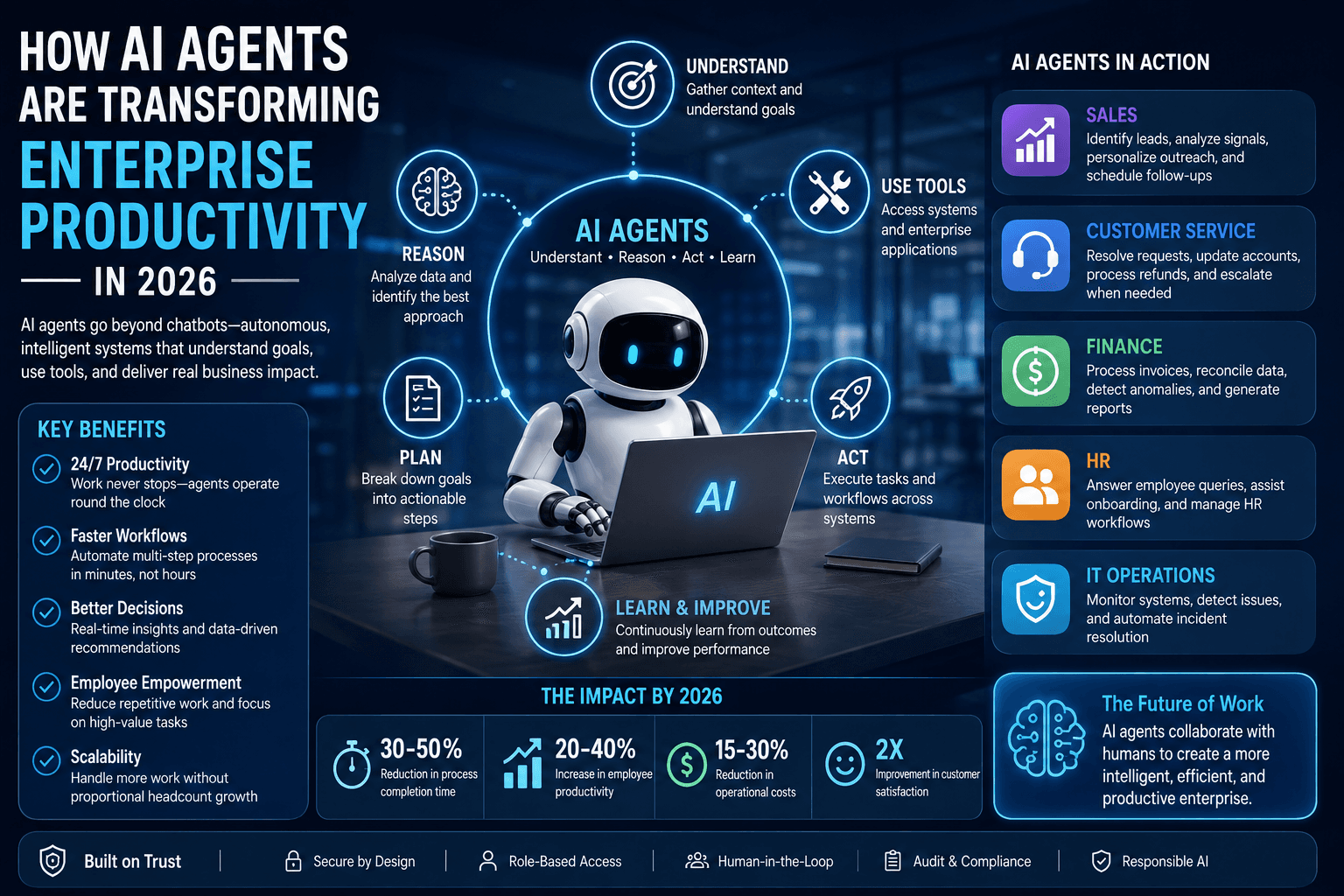

Enterprise productivity is entering a new phase in 2026. For years, businesses have used software to automate individual tasks, analyze data, and improve collaboration. Now, AI agents are expanding automation from simple tasks to multi-step workflows that can understand goals, use business tools, make recommendations, and perform actions with varying degrees of autonomy.
This shift could fundamentally change how employees work.
Instead of asking employees to complete every step manually, organizations can increasingly delegate repetitive and structured workflows to AI agents while allowing people to focus on strategy, creativity, relationships, and complex decision-making.
What Are AI Agents?
AI agents are software systems that can perceive information, reason about a task, use digital tools, and take actions to achieve a defined objective.
Traditional automation generally follows predetermined instructions.
AI agents can be more flexible.
A traditional workflow might look like:
Trigger → Rule → Action
An AI-agent workflow can look more like:
Goal → Analyze context → Plan → Use tools → Execute → Evaluate → Adjust
For example, instead of simply sending an automated email after a sales event, an AI agent could review a customer's history, prepare a personalized message, update the CRM, schedule a follow-up, and notify a salesperson when human intervention is needed.
Why AI Agents Matter for Enterprise Productivity
Large organizations contain thousands of repetitive processes.
Employees may spend significant time:
Searching for information
Updating systems
Preparing reports
Scheduling meetings
Processing documents
Responding to routine requests
Monitoring workflows
Creating summaries
Moving information between applications
AI agents can potentially automate multiple steps within these processes.
This creates an important distinction between task automation and workflow automation.
Instead of automating one action, businesses can automate an entire sequence.
AI Agents Are Moving Beyond Chatbots
Enterprise AI initially gained widespread attention through conversational assistants and chatbots.
AI agents represent a broader concept.
A chatbot primarily responds to a user's request.
An AI agent may be able to take action after understanding the request.
For example, an employee could ask:
"Prepare the weekly sales report and highlight accounts that need attention."
An agent could potentially gather information from the CRM, analyze sales activity, identify unusual changes, generate the report, and deliver it to the appropriate team.
The system isn't simply answering a question. It is completing a workflow.
Automating Knowledge Work
One of the biggest opportunities for AI agents is knowledge work.
Many enterprise processes require employees to gather information from multiple systems before taking action.
AI agents can potentially connect these systems and handle repetitive information-processing tasks.
Examples include:
Research
Report preparation
Data reconciliation
Document processing
Customer support
Sales operations
Procurement
HR administration
IT support
This can reduce the amount of time employees spend on administrative work.
AI Agents in Sales
Sales organizations are already highly data-driven, making them strong candidates for agent-based automation.
An AI sales agent could help monitor customer activity and identify opportunities.
It might analyze:
CRM records
Email engagement
Website activity
Previous purchases
Meeting notes
Support interactions
Based on this information, the agent could prioritize leads or recommend follow-up actions.
Human sales professionals can then spend more time on conversations and negotiations rather than manually searching for prospects.
AI Agents in Customer Service
Customer service is another major application.
AI agents can potentially handle routine requests such as:
Order-status questions
Appointment scheduling
Account updates
Basic troubleshooting
Returns
Frequently asked questions
More importantly, an agent can potentially move beyond answering questions by taking actions across connected systems.
For example, it could verify an order, check eligibility for a refund, initiate an approved process, update the customer's record, and notify the customer.
Complex or sensitive cases can be escalated to human representatives.
AI Agents in Finance
Finance departments manage repetitive processes involving large amounts of data.
AI agents can assist with:
Invoice processing
Expense review
Financial reporting
Reconciliation
Payment monitoring
Anomaly detection
Data collection
For example, an agent could identify invoices that don't match purchase orders and route exceptions to the appropriate employee.
This can reduce manual processing while allowing finance professionals to focus on analysis and financial strategy.
AI Agents in Human Resources
HR teams handle large volumes of employee requests and administrative processes.
Agents can help answer questions about company policies, benefits, onboarding, leave procedures, and internal resources.
During onboarding, an AI agent could potentially coordinate multiple steps across HR systems, IT platforms, and communication tools.
This can create a more consistent employee experience.
However, sensitive employment decisions should receive appropriate human oversight.
AI Agents in IT Operations
IT departments are increasingly using AI to detect and respond to operational issues.
AI agents can monitor systems, investigate alerts, retrieve technical information, and recommend or execute predefined remediation steps.
For example, if an application experiences a known type of failure, an agent may identify the problem and initiate an approved recovery procedure.
This can reduce response times and help IT teams manage large environments more efficiently.
Productivity Gains Come From Workflow Redesign
Simply adding an AI agent to an existing process doesn't guarantee productivity improvements.
Businesses need to rethink workflows.
Instead of asking:
"Where can we insert AI?"
organizations should ask:
"Which parts of this workflow require human judgment, and which parts can be intelligently automated?"
This approach can help companies avoid automating inefficient processes.
AI Agents and Human Employees
The most effective enterprise model is unlikely to be humans versus AI.
It will increasingly be humans working with AI agents.
AI agents can handle:
Repetitive work
Information gathering
Monitoring
Initial analysis
Routine execution
Employees can focus on:
Strategic decisions
Creativity
Leadership
Negotiation
Relationship building
Complex problem-solving
This division of work can increase the value of human expertise.
Enterprise Data Is Critical
AI agents need access to accurate information to work effectively.
Enterprise data may exist across:
CRM systems
ERP platforms
Databases
Cloud applications
Knowledge bases
Document repositories
Communication platforms
Connecting these systems allows agents to access relevant context.
However, integration alone isn't enough. Businesses need reliable data, clear permissions, and well-defined workflows.
Governance and Security
Greater AI autonomy creates greater governance requirements.
Organizations need to determine:
What an AI agent can access
Which actions it can perform
When human approval is required
How decisions are recorded
How errors are handled
How sensitive information is protected
Low-risk actions may be automated.
High-impact actions should often include human review.
A strong enterprise approach is to establish clear permission boundaries for every agent.
Measuring AI-Agent Productivity
Organizations should measure actual business outcomes rather than simply counting how many AI agents have been deployed.
Useful metrics include:
Time saved
Workflow completion time
Error reduction
Cost per transaction
Employee productivity
Customer response time
Revenue generated
Customer satisfaction
Process automation rate
The objective is not to maximize automation.
It is to maximize business value.
Challenges Enterprises Must Address
AI agents also introduce challenges.
Reliability
An agent that misunderstands a task can create errors at scale.
Hallucinations and Incorrect Reasoning
AI-generated recommendations need appropriate validation, especially in high-risk environments.
Security
Agents with access to business systems require strong identity and access controls.
Integration
Agents need reliable connections to enterprise applications.
Employee Adoption
Workers need training and clarity about how AI will affect their responsibilities.
Governance
Organizations need policies defining acceptable AI behavior and human accountability.
How Enterprises Can Prepare for AI Agents
Companies can start with clearly defined, low-risk workflows.
Good initial candidates include repetitive processes with measurable outcomes and established rules.
Organizations should then:
Identify suitable workflows.
Define the desired business outcome.
Connect the necessary data sources.
Establish agent permissions.
Add human approval where appropriate.
Monitor performance.
Improve the workflow based on results.
This gradual approach allows businesses to learn before deploying agents across critical operations.
The Future of Enterprise Productivity
AI agents are likely to become an important layer between employees and enterprise software.
Instead of employees manually navigating dozens of applications, they may increasingly describe a desired outcome and allow AI agents to coordinate the necessary steps.
The workplace could shift from:
People operating software
to:
People directing intelligent systems that operate software.
This doesn't mean humans disappear from enterprise workflows. Instead, their role can shift toward supervision, judgment, creativity, and strategic decision-making.
Conclusion
AI agents are transforming enterprise productivity by moving automation from individual tasks toward intelligent, multi-step workflows.
In 2026, businesses are increasingly exploring how agents can support sales, customer service, finance, HR, IT, research, and other functions.
The biggest opportunity isn't simply reducing the number of tasks employees perform. It is redesigning work so that AI handles repetitive coordination while people concentrate on higher-value activities.
Organizations that combine capable AI agents with strong data infrastructure, security, governance, and human oversight will be better positioned to turn AI automation into sustainable productivity gains.