
Artificial intelligence is becoming a core part of modern business, helping companies automate operations, improve customer experiences, and make faster decisions. However, as AI adoption accelerates, businesses face increasing legal, ethical, and regulatory responsibilities. In 2026, having an AI compliance strategy is no longer optional—it is essential.
Organizations that establish clear AI governance can reduce risks, protect customer trust, and ensure responsible innovation.
What Is an AI Compliance Strategy?
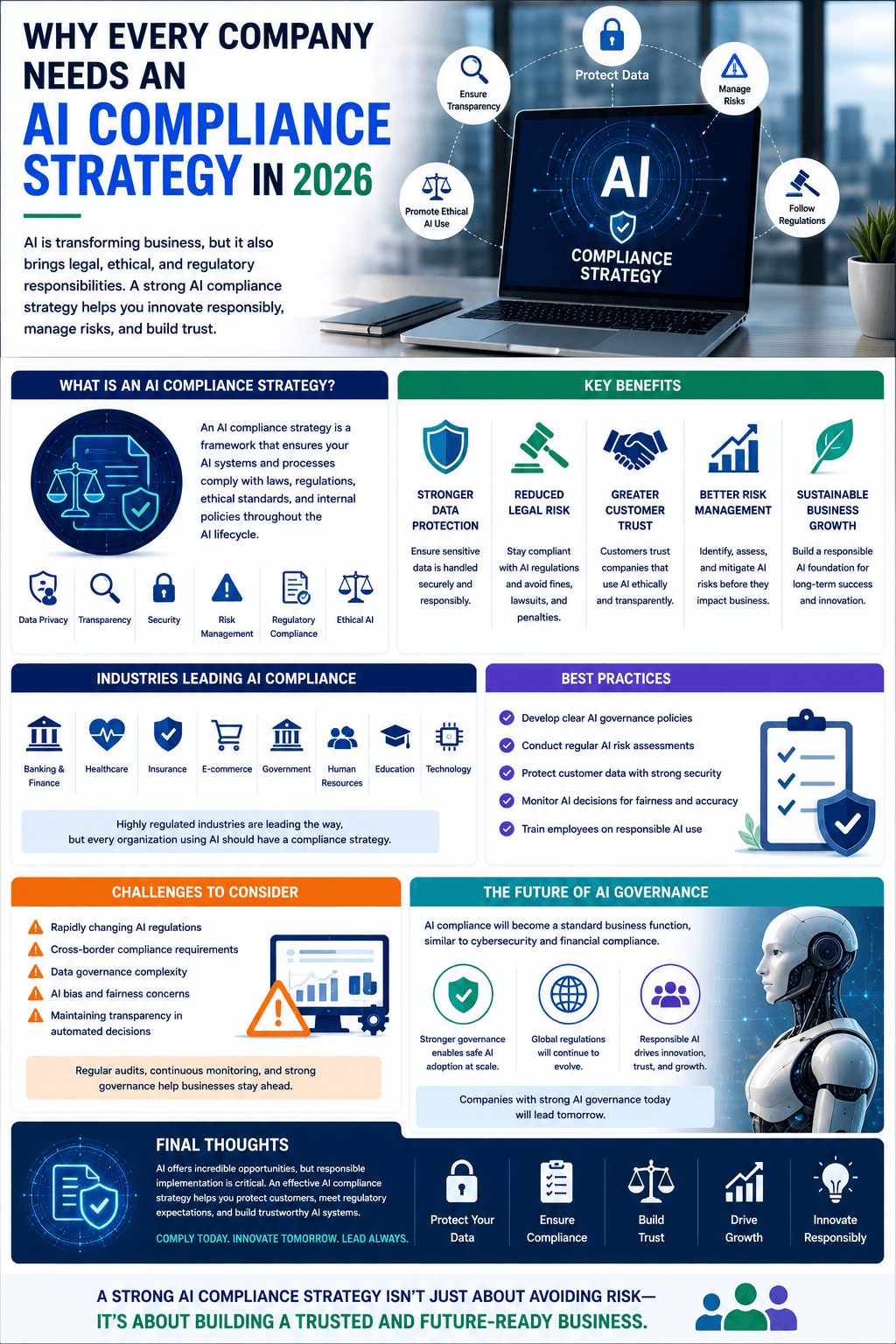
An AI compliance strategy is a structured framework that ensures AI systems operate according to legal regulations, ethical standards, and company policies.
It helps businesses manage:
Data privacy
AI transparency
Security
Risk management
Regulatory compliance
Ethical AI decision-making
Rather than slowing innovation, compliance enables businesses to use AI with confidence.
Why AI Compliance Matters
Governments and industry regulators are introducing stricter AI regulations to protect consumers and businesses. Companies using AI without proper governance may face legal penalties, financial losses, and reputational damage.
An effective compliance strategy helps organizations:
Protect sensitive customer data
Reduce legal risks
Improve transparency
Build customer trust
Support responsible AI innovation
Key Benefits
1. Stronger Data Protection
AI compliance ensures personal and business information is handled securely and responsibly.
2. Reduced Legal Risk
Following AI regulations helps businesses avoid fines, lawsuits, and compliance violations.
3. Greater Customer Trust
Customers are more likely to trust companies that use AI transparently and ethically.
4. Better Risk Management
Organizations can identify potential AI risks before they affect operations.
5. Sustainable Business Growth
Responsible AI practices support long-term innovation while protecting brand reputation.
Industries Leading AI Compliance
AI governance is becoming essential in:
Banking and Finance
Healthcare
Insurance
E-commerce
Government
Human Resources
Education
Technology Companies
Highly regulated industries are leading adoption, but every business using AI can benefit.
Best Practices
Businesses should:
Develop clear AI governance policies.
Conduct regular AI risk assessments.
Protect customer data with strong security measures.
Monitor AI decisions for fairness and accuracy.
Train employees on responsible AI use.
Compliance should be an ongoing process rather than a one-time project.
Challenges to Consider
Organizations should prepare for:
Rapidly changing AI regulations
Cross-border compliance requirements
Data governance complexity
AI bias and fairness concerns
Maintaining transparency in automated decisions
Regular audits and continuous monitoring help businesses adapt to evolving requirements.
The Future of AI Governance
Experts predict AI compliance will become a standard business function, similar to cybersecurity and financial compliance. Companies with strong AI governance will be better positioned to expand globally, earn customer trust, and adopt emerging AI technologies safely.
Businesses that invest in AI compliance today will reduce risk while creating a strong foundation for long-term innovation.
Final Thoughts
Artificial intelligence offers tremendous opportunities, but responsible implementation is critical. An effective AI compliance strategy helps businesses protect customers, meet regulatory expectations, and build trustworthy AI systems.
As AI continues reshaping industries, organizations that prioritize compliance will gain a lasting competitive advantage.
Why Every Company Needs an AI Compliance Strategy in 2026
Artificial intelligence is becoming deeply integrated into business operations, from customer service and marketing to hiring, finance, cybersecurity, and decision-making. As organizations adopt AI at a faster pace, they also face growing responsibilities around privacy, security, transparency, fairness, intellectual property, and regulatory compliance.
That is why an AI compliance strategy is becoming an essential business requirement in 2026. Companies can no longer focus only on what AI can accomplish. They also need to understand how AI is being used, what risks it creates, and whether those uses meet applicable laws, regulations, contractual requirements, and internal policies.
FAQs: AI Compliance Strategy in 2026
1. What is an AI compliance strategy?
An AI compliance strategy is a structured approach for ensuring that a company's use and development of artificial intelligence follows applicable laws, regulations, industry requirements, ethical principles, and internal policies. It typically covers areas such as data protection, security, transparency, risk management, human oversight, documentation, and accountability.
2. Why does every company need an AI compliance strategy in 2026?
AI is being used across more business functions than ever before, increasing the number of potential legal and operational risks. A compliance strategy helps companies identify these risks early, establish responsible AI practices, and prepare for changing regulatory requirements while still allowing teams to benefit from AI technology.
3. Is AI compliance only important for large corporations?
No. Small and medium-sized businesses also need to consider AI compliance, especially when they use AI tools to process customer information, evaluate employees, make decisions, or handle sensitive business data. A smaller company may need a simpler framework, but responsible AI governance is relevant regardless of company size.
4. What areas should an AI compliance strategy cover?
A comprehensive strategy can address data privacy, cybersecurity, AI transparency, bias and discrimination, intellectual property, third-party AI vendors, model risk, documentation, human oversight, employee training, and incident management. The exact requirements depend on the company's industry, location, AI applications, and applicable laws.
5. How does AI compliance protect customer data?
AI systems may process large quantities of personal or confidential information. A compliance strategy helps companies determine what data can be used, establish appropriate access controls, limit unnecessary data collection, and ensure that information is handled according to applicable privacy requirements and company policies.
6. What role does AI governance play in compliance?
AI governance provides the organizational structure needed to manage AI responsibly. It can define who is accountable for AI systems, how risks are assessed, which uses require approval, how systems are monitored, and what happens when an AI application produces problematic results.
7. Can employees use public AI tools with company information?
Companies should establish clear policies before allowing employees to enter business or customer information into public AI tools. Sensitive data may create privacy, confidentiality, security, or intellectual-property risks depending on the service and its terms. Employees should know which information is permitted and which information must never be shared.
8. Why is AI documentation important for compliance?
Documentation creates a record of how an AI system is designed, trained or configured, used, monitored, and evaluated. It can help organizations demonstrate accountability, investigate incidents, understand system limitations, and provide evidence that appropriate controls are in place.
9. How can companies manage bias in AI systems?
Companies can reduce AI bias by evaluating training and input data, testing systems across relevant groups, monitoring outcomes, establishing review processes, and maintaining human oversight for high-impact decisions. Regular assessments are important because model behavior can change as systems and data evolve.
10. Does AI compliance apply to generative AI?
Yes. Generative AI creates its own set of compliance considerations, including inaccurate outputs, confidential-data exposure, copyright and intellectual-property concerns, misleading content, and inappropriate automated responses. Companies should establish clear rules for how generative AI can be used internally and externally.
11. What should an AI compliance policy include?
An AI compliance policy should explain approved and prohibited AI uses, data-handling requirements, security expectations, human-review procedures, accountability, vendor requirements, monitoring practices, and incident-reporting processes. It should also be updated as technology, business practices, and regulatory requirements change.
12. How does AI compliance affect AI vendors?
Companies should evaluate the AI providers they rely on rather than assuming that vendors automatically manage every compliance responsibility. Vendor assessments can examine security practices, data handling, privacy protections, contractual terms, model limitations, audit capabilities, and the provider's approach to responsible AI.
13. Who should be responsible for AI compliance?
Responsibility should generally be shared across relevant functions rather than assigned to one department alone. Legal, compliance, IT, cybersecurity, data protection, HR, risk management, and business teams may all have important roles. Senior leadership should provide oversight and establish clear accountability.
14. How can AI compliance reduce business risk?
A strong compliance program can help organizations identify problematic AI applications before they cause significant damage. It can reduce the likelihood of privacy violations, security incidents, discriminatory outcomes, regulatory problems, contractual disputes, and reputational harm while creating clearer processes for managing AI-related risks.
15. Does AI compliance slow down innovation?
It does not have to. Effective compliance should provide clear boundaries that allow employees to experiment safely. Instead of blocking AI adoption, companies can create approval processes, approved tools, risk classifications, and testing procedures that help teams innovate while maintaining appropriate safeguards.
16. How should companies prepare employees for AI compliance?
Employee training should explain both the benefits and risks of AI. Staff should understand approved AI tools, confidential-data restrictions, verification requirements, security practices, intellectual-property considerations, and procedures for reporting problems. Training should be practical and relevant to each employee's role.
17. Why is human oversight important for AI compliance?
AI systems can make mistakes, generate inaccurate information, or produce unexpected outcomes. Human oversight provides an additional layer of accountability, particularly when AI is involved in important decisions affecting customers, employees, finances, or business operations.
18. How often should an AI compliance strategy be reviewed?
AI compliance should be treated as an ongoing process rather than a one-time project. Companies should review their policies regularly and whenever they introduce significant AI systems, change vendors, enter new markets, or face important changes in applicable regulations.
19. What are the biggest AI compliance mistakes businesses make?
Common mistakes include adopting AI without understanding its risks, allowing employees to use unapproved tools, failing to document AI systems, ignoring vendor risks, collecting unnecessary data, and assuming that an AI provider is responsible for every compliance obligation. Lack of employee training can also create significant risks.
20. What is the future of AI compliance for businesses?
AI compliance is likely to become increasingly integrated into broader corporate governance, cybersecurity, privacy, and risk-management programs. Businesses that establish responsible AI processes early can be better prepared for regulatory changes while building greater trust with customers, employees, partners, and investors.