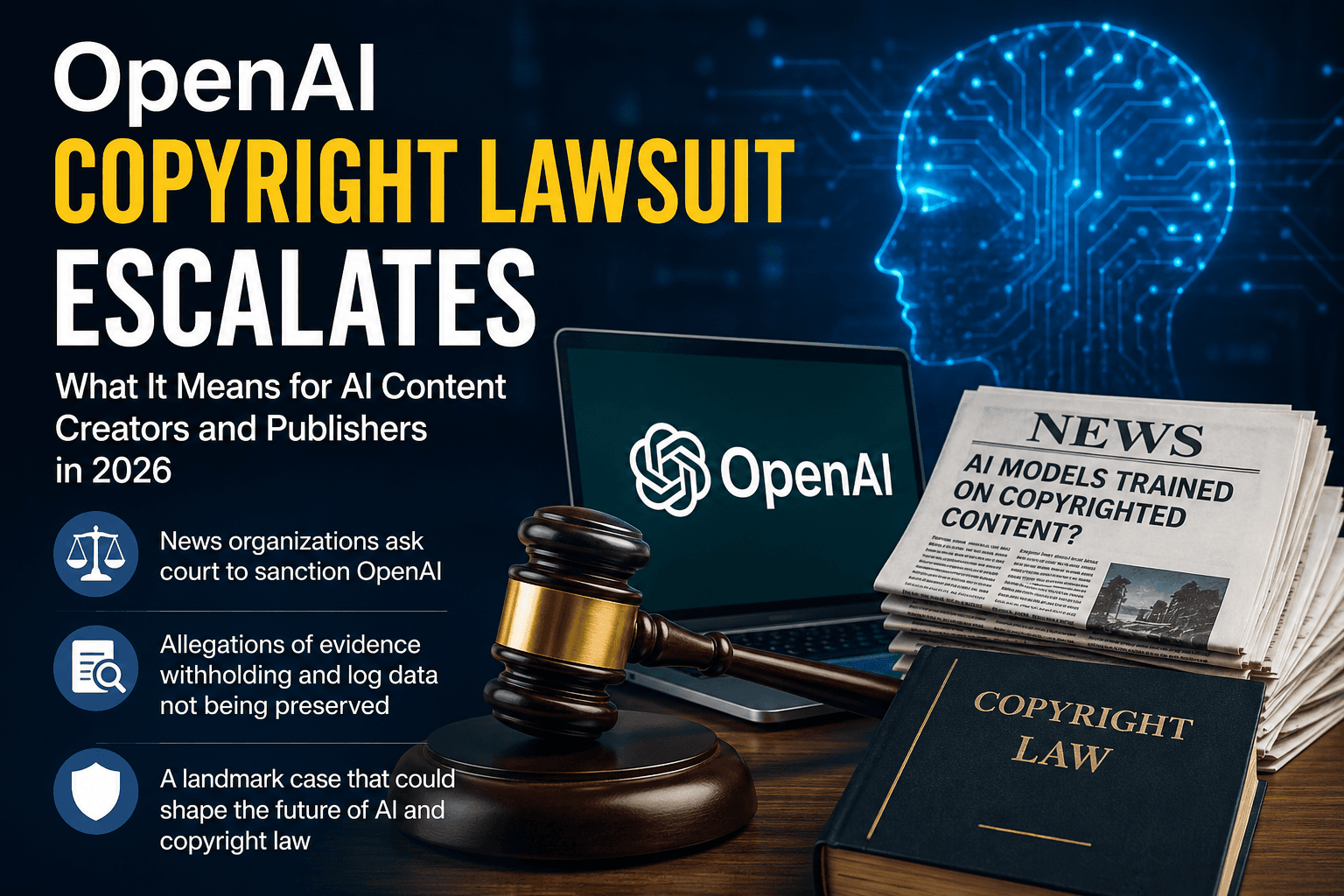

The relationship between artificial intelligence and copyright law is becoming one of the most important legal issues facing the technology industry.
As AI systems become capable of generating articles, images, videos, code, summaries, and other forms of content, questions about copyrighted training data, licensing, attribution, and ownership are becoming increasingly important for businesses and creators.
Legal disputes involving OpenAI and other AI companies could have significant consequences for AI content creators, publishers, authors, media organizations, and businesses that rely on generative AI.
In 2026, the central question is no longer simply whether AI can create content. It is increasingly about what data AI systems can legally learn from, how generated content can be used, and who should bear responsibility when copyright concerns arise.
Why AI Copyright Disputes Are Growing
Generative AI models are trained using enormous quantities of information.
Depending on the system and its development process, training data can include text, code, images, and other publicly available or licensed material.
This has created tension between AI developers and copyright holders.
Publishers and creators argue that their work has economic value and should not necessarily be used to develop commercial AI systems without appropriate authorization or compensation.
AI companies, meanwhile, have argued in various legal contexts that certain uses of copyrighted material can be legally permissible under applicable copyright doctrines.
The exact legal outcome depends on the facts and jurisdiction involved.
What Copyright Lawsuits Could Mean for AI Companies
Copyright litigation can affect AI companies in several ways.
Potential consequences include:
Licensing agreements
Changes to training practices
Restrictions on datasets
Content filtering
New attribution systems
Financial settlements
Changes to AI product design
If courts establish clearer boundaries around training data, AI companies may need to adjust how they acquire and use copyrighted material.
Why Publishers Are Paying Attention
Publishers have a particular interest in the issue because their businesses depend heavily on original content.
News organizations, magazines, research publishers, and digital media companies invest significant resources in producing information.
AI systems can potentially summarize, reproduce, transform, or provide answers based on information found across the web.
This raises an important commercial question:
If users can obtain information through an AI system without visiting the original publisher, how should publishers be compensated?
This debate could influence the future economics of online publishing.
The Impact on AI Content Creators
AI content creators are also affected.
Many creators use generative AI tools to produce:
Blog posts
Marketing materials
Images
Videos
Social media content
Product descriptions
Scripts
Copyright disputes may influence what AI tools are allowed to generate and how businesses can use generated material.
Creators should therefore understand the terms and policies of the AI tools they use.
Does AI-Generated Content Automatically Have Copyright Protection?
Not necessarily.
Copyright protection generally depends on the applicable law and the level of human authorship involved.
In the United States, for example, the Copyright Office has emphasized the importance of human creativity for copyright protection.
Simply entering a prompt into an AI system does not automatically mean that every resulting output receives copyright protection.
The legal treatment can vary depending on how much human creative contribution is involved.
Human Creativity Remains Important
Businesses using AI should not assume that AI-generated output automatically has the same copyright status as traditionally created work.
Human involvement can matter significantly.
For example, a person may use AI to generate an initial draft and then substantially:
Edit it
Restructure it
Rewrite sections
Add original research
Add creative elements
Make meaningful creative decisions
The legal status of the resulting work depends on the specific circumstances and applicable law.
What Publishers Should Do
Publishers should develop clear AI policies.
They can consider documenting:
How AI tools are used
Which content is AI-assisted
What sources are used
Who reviews AI-generated material
How copyright permissions are obtained
How original content is protected
Publishers should also monitor developments in AI search and answer engines because these systems can change how users discover information.
The Growing Importance of Licensing
One potential direction for the AI industry is increased reliance on licensed datasets and content partnerships.
Instead of relying entirely on publicly available information, AI developers may increasingly establish agreements with:
Publishers
Data providers
Authors
Media organizations
Image libraries
Software companies
Licensing could provide AI companies with clearer legal rights while giving content owners new revenue opportunities.
AI Search Could Change the Publishing Business
AI-powered search is another major issue.
Traditional search engines generally provide links to websites.
AI systems can increasingly provide direct answers.
This could reduce the number of users who click through to publishers' websites for certain types of information.
For publishers, this creates a new challenge:
How do you maintain traffic and revenue when AI systems become the primary interface between users and online information?
This could make direct relationships with audiences even more important.
What This Means for SEO
SEO strategies are also evolving.
Publishers can no longer rely exclusively on ranking high in traditional search results.
They may also need to focus on becoming credible sources that AI systems can identify and reference.
Important strategies include:
Original research
Expert analysis
Strong authorship signals
Accurate information
Brand authority
First-party data
Unique insights
The goal is to create information that provides value beyond content that can easily be reproduced elsewhere.
The Risk of AI Hallucinations
Copyright isn't the only concern.
AI systems can sometimes produce inaccurate information or incorrectly attribute claims.
For publishers, this can create reputational problems if their work is summarized inaccurately.
Creators should therefore verify AI-generated claims and references before publication.
Human editorial review remains especially important for journalism, finance, legal content, healthcare, and other high-stakes subjects.
AI Content Detection Is Not a Simple Solution
Some organizations have attempted to identify AI-generated content using automated detection systems.
However, AI-content detection can be imperfect.
It can produce false positives and may struggle as generative AI systems improve.
Rather than relying solely on detection tools, publishers may benefit from maintaining clear editorial processes and documenting how content is created and reviewed.
How Businesses Should Adapt in 2026
Businesses using generative AI should develop practical AI governance policies.
These policies can address:
Copyright
Data privacy
Confidential information
AI-generated content
Human review
Vendor terms
Attribution
Content ownership
Employees should understand what information they are allowed to provide to AI systems and how generated outputs can be used commercially.
The Importance of AI Vendor Terms
Businesses should carefully review the terms of the AI platforms they use.
Important questions include:
Who owns generated outputs?
Can submitted information be used for model improvement?
What intellectual-property protections are provided?
Are there commercial-use restrictions?
What happens when a third party claims infringement?
The answers can differ between providers and products.
Legal teams should review high-risk applications before deployment.
Could Copyright Law Change AI Development?
Yes.
Court decisions and legislation could influence how AI companies train models and how content creators protect their work.
Possible developments include:
More licensing agreements
New copyright rules for AI training
Greater transparency around training datasets
New requirements for attribution
Industry standards for AI-generated content
Expanded legal protections for creators
The regulatory environment is likely to continue evolving.
What Creators Should Do Now
Creators don't need to stop using AI.
Instead, they should use it thoughtfully.
Practical steps include:
Understand the terms of AI tools.
Avoid uploading confidential copyrighted material without permission.
Review AI-generated content before publication.
Add meaningful human creativity and editing.
Keep records of the content-production process.
Use licensed assets where required.
Monitor major legal developments.
These practices can reduce unnecessary risk.
The Future of AI and Copyright
The AI copyright debate is unlikely to be resolved by a single lawsuit.
The technology is evolving quickly, while copyright law was largely developed before generative AI existed.
The coming years will likely involve courts, lawmakers, AI companies, publishers, artists, authors, and technology users negotiating a new balance between innovation and intellectual-property rights.
The outcome could shape how AI models are trained, how creators are compensated, and how information is distributed online.
Conclusion
The escalation of copyright disputes surrounding AI has consequences far beyond the companies involved.
For AI content creators and publishers in 2026, the biggest lesson is that AI adoption needs to be accompanied by responsible copyright practices.
Businesses should understand the legal status of their data, review AI vendor policies, maintain human oversight, and invest in original content and intellectual property.
The future of AI content will likely depend on finding a workable balance between technological innovation, creator rights, fair compensation, and access to information.
As courts and lawmakers continue defining the boundaries, businesses and creators that build strong AI governance and content practices will be better prepared for whatever comes next.