
The role of the Chief Financial Officer is changing rapidly. CFOs are no longer responsible only for financial reporting, budgeting, and compliance. They are increasingly expected to help organizations navigate uncertainty, identify growth opportunities, manage risk, and make faster strategic decisions.
Artificial intelligence is becoming an important tool in that transformation.
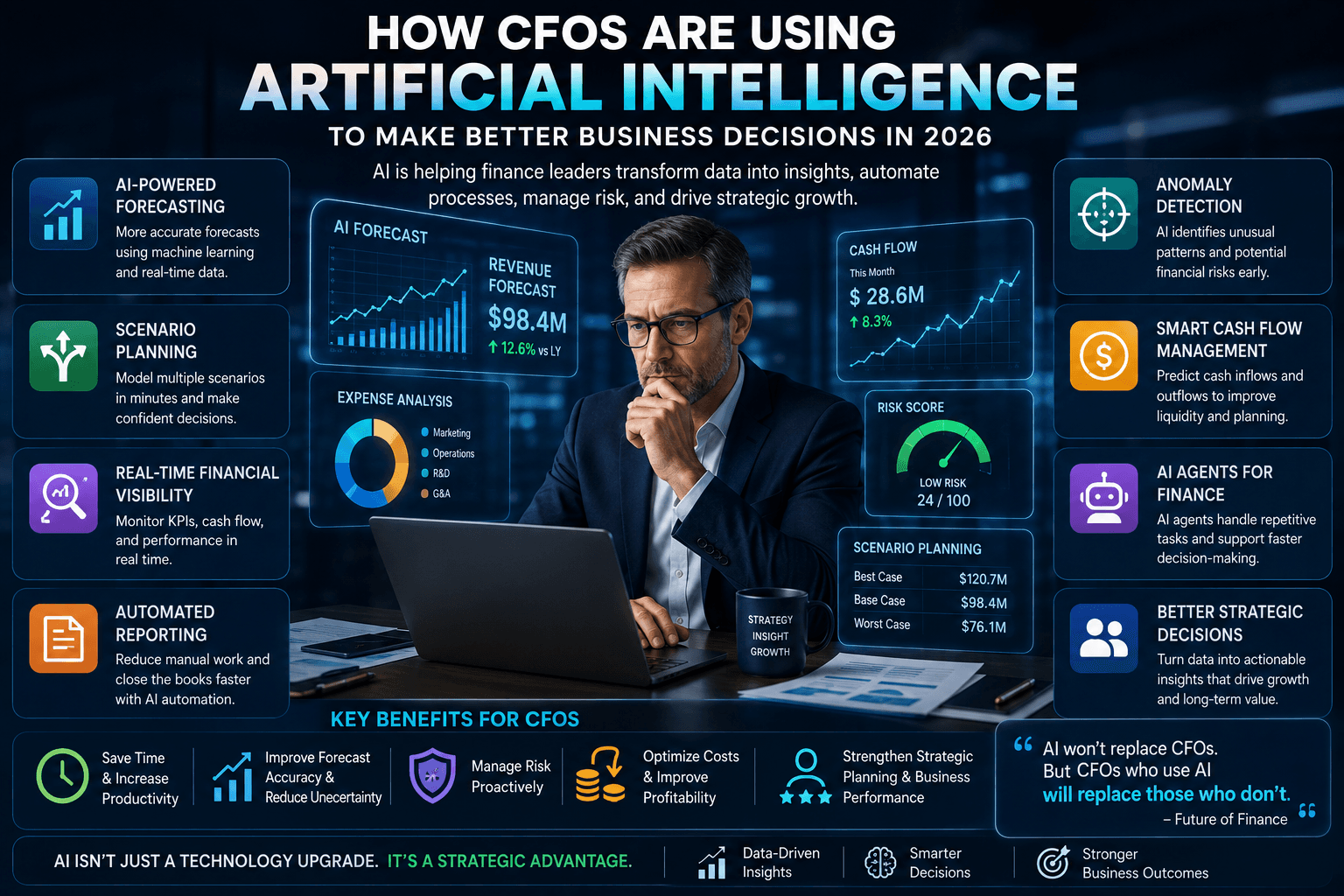
In 2026, CFOs are using AI to analyze financial information, improve forecasting, automate routine processes, detect anomalies, understand business performance, and support strategic planning.
The biggest opportunity isn't simply automating finance tasks. It is using AI to help finance leaders make better decisions with more timely and comprehensive information.
The Changing Role of the CFO
Traditional finance functions often relied on historical reporting.
A finance team might close the books, prepare reports, analyze previous performance, and then make recommendations based on what had already happened.
AI is helping move finance toward a more forward-looking model.
Instead of asking only:
"What happened?"
CFOs can increasingly ask:
"What is happening now, what could happen next, and what should we do about it?"
This shift is making finance a more strategic function within the enterprise.
1. AI-Powered Financial Forecasting
Forecasting is one of the most important applications of AI in finance.
Traditional forecasts can depend heavily on spreadsheets, historical assumptions, and manual adjustments.
AI systems can analyze large volumes of information and identify relationships that may be difficult to detect manually.
Potential inputs include:
Historical revenue
Customer behavior
Pricing changes
Seasonal patterns
Operating costs
Market conditions
Sales pipelines
Supplier information
AI can then help finance teams develop forecasts and test different scenarios.
This doesn't eliminate the need for CFO judgment. Instead, it gives financial leaders more information to evaluate potential outcomes.
2. Scenario Planning Becomes Faster
Business conditions can change quickly.
A CFO may need to understand what would happen if revenue declined, costs increased, interest rates changed, or a major customer was lost.
AI can help finance teams model multiple scenarios more efficiently.
For example:
What happens to cash flow if sales fall 10% for two quarters?
What happens if supplier costs increase by 15%?
How much additional working capital would the company need if growth accelerates?
AI-powered analytics can help generate and compare scenarios, allowing CFOs to evaluate potential decisions before implementing them.
3. Real-Time Financial Visibility
Traditional financial reporting often provides a historical snapshot.
AI and modern data platforms are making it possible to monitor financial and operational signals more continuously.
CFOs can potentially track:
Revenue
Cash flow
Expenses
Receivables
Payables
Customer activity
Inventory
Profit margins
This can help finance leaders identify emerging problems earlier.
Instead of discovering a margin problem at the end of the month, for example, an intelligent system may identify unusual changes as they occur.
4. Automated Financial Reporting
Financial reporting can involve substantial manual work.
Employees may need to collect information from different systems, reconcile data, format reports, and prepare explanations.
AI can automate parts of this process.
It can help:
Collect financial information
Identify anomalies
Generate summaries
Compare actuals with forecasts
Explain significant variances
Prepare management reports
Finance professionals can then spend more time interpreting results and advising business leaders.
5. Detecting Financial Anomalies
AI can analyze transactions and financial activity to identify unusual patterns.
For example, a system might detect:
Unexpected expense increases
Unusual payment patterns
Duplicate transactions
Abnormal invoice activity
Sudden changes in margins
Suspicious financial behavior
Instead of requiring finance teams to manually examine every transaction, AI can prioritize areas that deserve attention.
This can improve both efficiency and financial control.
6. Improving Cash Flow Management
Cash flow is one of the most important concerns for CFOs.
AI can help finance teams analyze receivables, payment patterns, expenses, inventory, and expected revenue to improve cash-flow forecasting.
A CFO could use AI to identify potential liquidity pressure before it becomes an immediate problem.
For example, if customer payments are slowing while major supplier payments are approaching, an intelligent system can highlight the potential cash-flow gap.
This allows management to consider corrective action earlier.
7. Smarter Accounts Payable and Receivable
AI is also transforming routine finance operations.
In accounts payable, AI can help process invoices, match invoices with purchase orders, and identify exceptions.
In accounts receivable, AI can help analyze customer payment behavior and prioritize collection activities.
These capabilities can reduce manual processing and help finance teams focus on exceptions rather than routine transactions.
8. AI-Assisted Budgeting
Annual budgeting can be time-consuming because finance teams often collect assumptions from multiple departments.
AI can help analyze historical spending and operational plans to identify unusual assumptions or potential inconsistencies.
It can also help teams compare different budget scenarios.
Rather than treating the budget as a fixed annual document, organizations can move toward more dynamic planning.
9. Profitability Analysis
CFOs need to understand not only how much revenue the company generates but where that revenue creates value.
AI can analyze profitability across:
Products
Customers
Regions
Business units
Sales channels
Contracts
This can reveal which areas generate strong margins and which may require strategic changes.
For example, a customer may generate significant revenue but have unusually high service costs. AI-powered analysis can help make such relationships more visible.
10. Supporting Strategic Investment Decisions
CFOs are often involved in major investment decisions.
AI can help analyze financial and operational information when evaluating potential investments.
It may assist with:
Scenario modeling
Risk analysis
Market research
Cost projections
Revenue assumptions
Sensitivity analysis
The final decision remains a leadership responsibility, but AI can accelerate the analytical process.
11. AI and Risk Management
Financial risk can come from many sources.
These include:
Customer concentration
Supplier dependencies
Market volatility
Currency movements
Credit exposure
Operational disruptions
AI can continuously monitor relevant signals and identify patterns that could indicate increasing risk.
This enables CFOs to move toward more proactive risk management.
12. Generative AI for Finance Teams
Generative AI is becoming useful for financial knowledge work.
CFOs and finance professionals can use AI assistants to:
Summarize reports
Explain financial variances
Draft management commentary
Analyze documents
Prepare meeting materials
Answer questions about financial data
For example, an executive could ask:
"Why did operating expenses increase this quarter?"
An AI system could potentially analyze relevant financial data and supporting information and produce an initial explanation for review.
13. AI Agents in Finance
The next step beyond AI assistants is the use of AI agents.
An AI agent could potentially coordinate multiple finance tasks.
For example, an agent might:
Monitor financial data.
Detect a significant variance.
Investigate related transactions.
Prepare an explanation.
Create a report.
Notify the appropriate finance manager.
For higher-risk actions, human approval can remain mandatory.
This model can help finance teams automate workflows without eliminating human accountability.
14. Better Collaboration Between Finance and Operations
AI can help connect financial information with operational data.
A CFO doesn't need to look at revenue separately from customer acquisition, inventory, employee costs, or production performance.
AI-powered systems can combine these signals to provide a broader view of business performance.
This can help finance leaders understand not only what changed financially, but also why it changed operationally.
15. AI Governance Is Critical for CFOs
AI adoption creates new responsibilities for finance leaders.
Financial data is highly sensitive, and AI systems must be appropriately governed.
CFOs should consider:
Data privacy
Access controls
Model accuracy
Auditability
Security
Regulatory requirements
Human oversight
Data quality
AI-generated financial recommendations should not automatically be treated as fact.
Human review remains important for high-impact financial decisions.
16. Measuring the ROI of AI in Finance
CFOs are uniquely positioned to ask whether AI investments actually create measurable value.
Useful metrics include:
Finance processing time
Forecast accuracy
Reporting cycle time
Cost per transaction
Error rates
Cash-flow forecasting accuracy
Accounts receivable performance
Employee productivity
AI operating costs
The goal should be to demonstrate that AI improves financial outcomes, not simply that employees are using an AI tool.
How CFOs Can Start Using AI
Organizations don't need to transform the entire finance function immediately.
A practical approach is to start with repetitive, data-intensive processes where results can be measured.
Potential starting points include:
Financial reporting
Forecasting
Invoice processing
Expense analysis
Cash-flow forecasting
Variance analysis
Anomaly detection
After establishing reliable workflows, finance teams can gradually expand AI into strategic planning and decision support.
The Future of AI-Powered Finance
The finance function is moving from retrospective reporting toward continuous intelligence and predictive decision-making.
CFOs may increasingly use AI systems that continuously monitor financial and operational information, identify emerging trends, model potential outcomes, and recommend actions.
The CFO's role will remain fundamentally human.
AI can analyze information quickly, but financial leadership still requires judgment, accountability, business understanding, and the ability to balance competing priorities.
Conclusion
Artificial intelligence is transforming how CFOs approach financial management and strategic decision-making in 2026.
From forecasting and cash-flow management to anomaly detection, scenario planning, reporting, and AI agents, the technology can help finance teams become faster, more proactive, and more data-driven.
The most successful CFOs won't use AI simply to reduce manual work. They will use it to improve visibility, anticipate risks, evaluate scenarios, and make better business decisions.
As AI becomes more integrated into enterprise finance, the CFO of the future may spend less time asking what happened and more time deciding what the business should do next.