TCThe Cost of Cross-Border Trade: Navigating Supply Chain Disruptions in Regional Tech Sectors
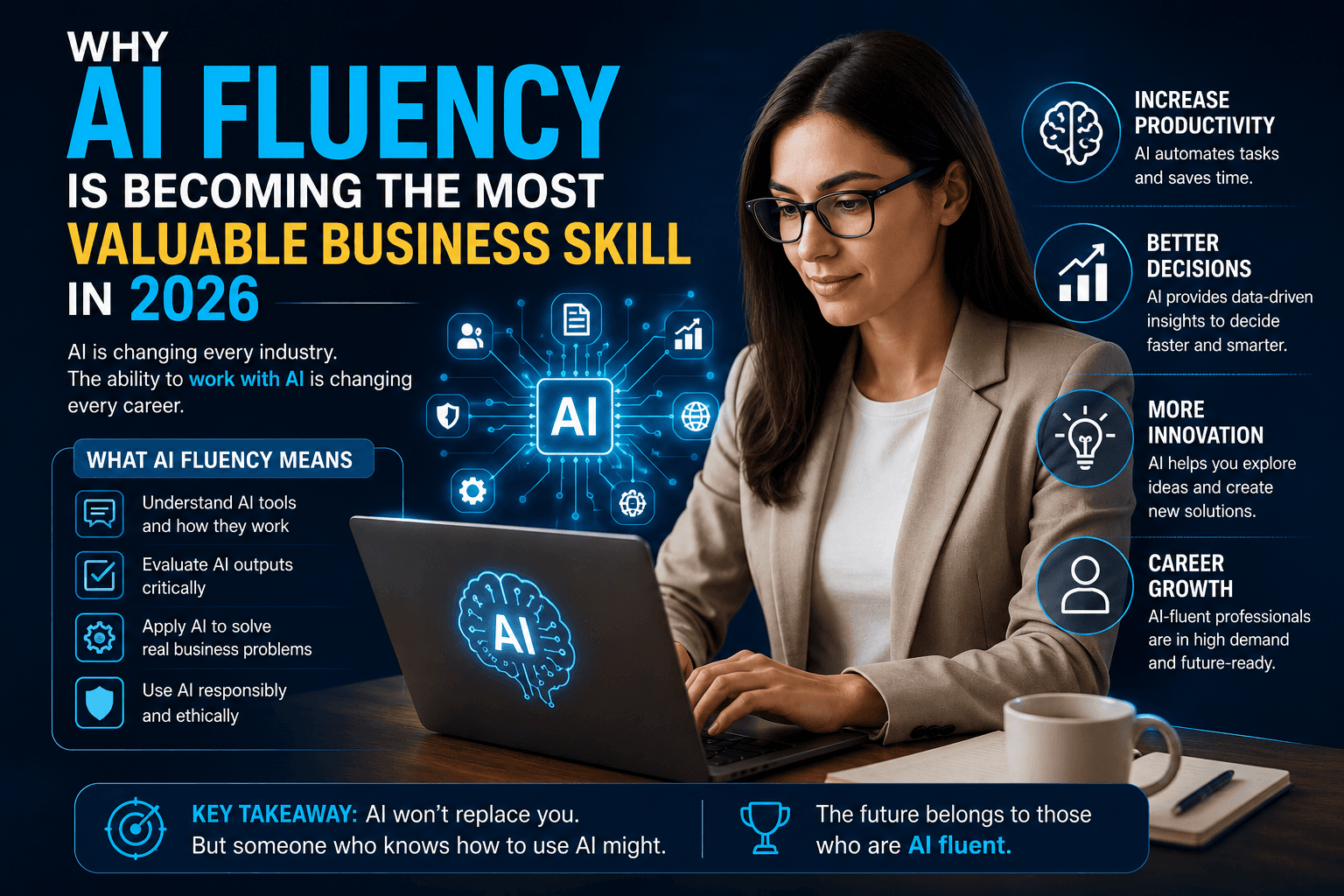
AI is rapidly changing how businesses operate, compete, and make decisions. In 2026, simply knowing that artificial intelligence exists is no longer enough. The ability to understand, use, evaluate, and strategically apply AI—often called AI fluency—is becoming one of the most valuable skills for business professionals.
AI fluency does not mean becoming a machine-learning engineer or learning how to build complex AI models. Instead, it means understanding what AI can do, recognizing its limitations, communicating effectively with AI tools, and knowing how to integrate those tools into everyday business processes.
AI Is Becoming Part of Every Business Function
AI is no longer limited to technology departments. Marketing teams use AI for content creation and customer insights, sales teams use it for lead qualification and forecasting, finance teams use it for analysis and risk detection, while HR departments use AI to improve recruitment and employee engagement.
As AI spreads across departments, employees who understand how to work with these systems can become significantly more productive.
For example, a marketing professional with AI fluency can use AI to analyze customer behavior, generate campaign ideas, personalize messaging, and identify trends. The professional still provides strategy and judgment, but AI helps accelerate the work.
AI Fluency Is Different From Technical Expertise
One of the biggest misconceptions about AI skills is that employees need advanced programming knowledge to benefit from AI.
In reality, business AI fluency is much broader.
An AI-fluent professional should understand:
How generative AI tools work at a practical level
How to write effective prompts and instructions
How to evaluate AI-generated information
When AI should and should not be used
How to protect sensitive business information
How AI can improve existing workflows
How to identify opportunities for automation
How to recognize bias, errors, and hallucinations
This makes AI fluency accessible to professionals across industries—not just software developers.
AI Fluency Can Dramatically Increase Productivity
Businesses are under constant pressure to accomplish more with limited resources. AI can help employees automate repetitive activities and spend more time on high-value work.
Tasks such as summarizing documents, analyzing large amounts of information, preparing reports, drafting communications, organizing research, and generating initial ideas can often be accelerated with AI.
However, productivity gains depend heavily on how effectively employees use these tools.
Two employees may have access to the same AI system but achieve very different results. The difference is often their ability to give clear instructions, provide useful context, verify outputs, and incorporate AI into a broader workflow.
That is why AI fluency is becoming a competitive advantage rather than simply another technical skill.
Better AI Users Can Make Better Business Decisions
AI can process enormous amounts of information quickly, but business decisions still require human judgment.
AI-fluent leaders can use AI as a decision-support tool rather than blindly accepting its recommendations. They can ask better questions, compare different scenarios, identify missing information, and challenge AI-generated conclusions.
This creates a powerful combination: AI provides speed and analytical capability, while humans provide context, judgment, ethics, and strategic thinking.
Companies that develop this combination can potentially make decisions faster while maintaining appropriate human oversight.
AI Fluency Is Becoming a Leadership Skill
Business leaders increasingly need to understand AI even when they are not directly involved in technology development.
Executives must evaluate AI investments, understand potential risks, determine where automation makes sense, and prepare their organizations for workforce changes.
A leader who understands AI can ask important questions:
What business problem are we trying to solve?
Can AI realistically improve this process?
What data does the system require?
What are the security and privacy risks?
How will success be measured?
Where is human oversight necessary?
Without AI fluency, organizations may spend heavily on AI solutions without achieving meaningful business value.
AI Fluency Can Improve Employee Adaptability
The workplace is evolving quickly. New AI tools and capabilities are emerging continuously, meaning specific software knowledge can become outdated rapidly.
AI fluency provides a broader foundation for adapting to these changes.
Instead of learning one particular AI application, employees learn how to evaluate new tools, understand their capabilities, experiment with them, and determine where they can create value.
This adaptability may become increasingly important as businesses adopt AI-powered software across their operations.
Human Skills Still Matter
The rise of AI does not make traditional business skills irrelevant. In many cases, it makes them more important.
Creativity, communication, critical thinking, leadership, emotional intelligence, negotiation, and strategic decision-making remain essential because AI does not fully replace human context and responsibility.
The most valuable professionals may therefore be those who combine strong human skills with AI fluency.
For example, an excellent manager who knows how to use AI for research, analysis, planning, and communication can potentially outperform someone who possesses AI tool knowledge but lacks leadership and business judgment.
Companies Are Moving Toward AI-Augmented Workforces
Rather than replacing every employee with AI, many organizations are moving toward models where humans and AI work together.
In an AI-augmented workplace, employees may use AI assistants to handle routine activities while focusing their own time on complex problems, relationships, strategy, and innovation.
This shift changes the definition of productivity. The question is no longer simply how quickly an employee can complete a task manually. It is increasingly about how effectively that employee can combine human expertise with AI capabilities.
AI Fluency Will Become a Core Career Advantage
As AI adoption continues, employers are likely to place greater value on professionals who can use AI responsibly and effectively.
An AI-fluent employee can potentially contribute by improving workflows, reducing repetitive work, analyzing information faster, and helping teams experiment with new ways of working.
For professionals, developing AI fluency can therefore be a practical way to remain competitive in a rapidly changing job market.
The Future Belongs to AI-Literate Organizations
AI fluency is becoming valuable because AI itself is becoming embedded in business operations.
The organizations most likely to benefit from AI will not necessarily be those that purchase the largest number of AI tools. They will be those that know how to use AI effectively, responsibly, and strategically.
For employees and leaders, the goal should not be to compete against AI. It should be to learn how to work with it.
In 2026, AI fluency is becoming more than a technology skill. It is becoming a core business capability—one that can influence productivity, decision-making, innovation, leadership, and long-term competitiveness.
FAQs: Why AI Fluency Is Becoming the Most Valuable Business Skill in 2026
1. What is AI fluency?
AI fluency is the ability to understand, use, evaluate, and apply artificial intelligence tools effectively in business and professional settings.
2. Why is AI fluency important in 2026?
AI is becoming integrated into marketing, finance, sales, operations, HR, customer service, and other business functions. AI fluency helps professionals work more efficiently and adapt to these changes.
3. Is AI fluency only useful for technology professionals?
No. AI fluency is valuable for professionals across industries, including marketers, managers, entrepreneurs, accountants, sales professionals, and HR specialists.
4. Do I need programming skills to become AI fluent?
No. Programming can be useful for advanced AI applications, but basic AI fluency mainly involves understanding AI capabilities, writing effective prompts, evaluating results, and using AI responsibly.
5. How can AI fluency improve productivity?
AI can help automate repetitive tasks, summarize information, analyze data, generate ideas, draft documents, and support research, allowing employees to focus on higher-value activities.
6. Can AI fluency help business leaders make better decisions?
Yes. AI-fluent leaders can use AI to analyze information, identify patterns, compare scenarios, and support strategic decisions while applying human judgment and oversight.
7. What skills are needed for AI fluency?
Important skills include prompt writing, critical thinking, AI tool evaluation, data awareness, information verification, automation knowledge, and understanding AI risks and limitations.
8. Will AI fluency become a requirement for jobs?
AI fluency is likely to become increasingly important across many roles as businesses continue adopting AI-powered tools and workflows.
9. Does AI fluency mean AI will replace human skills?
No. Human abilities such as creativity, communication, leadership, critical thinking, empathy, and strategic judgment remain essential. AI fluency helps people combine these skills with AI capabilities.
10. How can professionals develop AI fluency in 2026?
Professionals can start by experimenting with AI tools, learning effective prompting, applying AI to everyday tasks, verifying AI-generated information, studying responsible AI practices, and continuously exploring new AI capabilities.