
The delivery industry is entering a new era powered by artificial intelligence. In 2026, businesses are increasingly using AI-driven robots, autonomous vehicles, and drones to deliver goods faster, reduce costs, and improve customer satisfaction.
From groceries and medicines to e-commerce orders, autonomous delivery is transforming the last mile of logistics. As technology advances, companies that adopt AI-powered delivery solutions are gaining a significant competitive advantage.
What Is Autonomous Delivery?
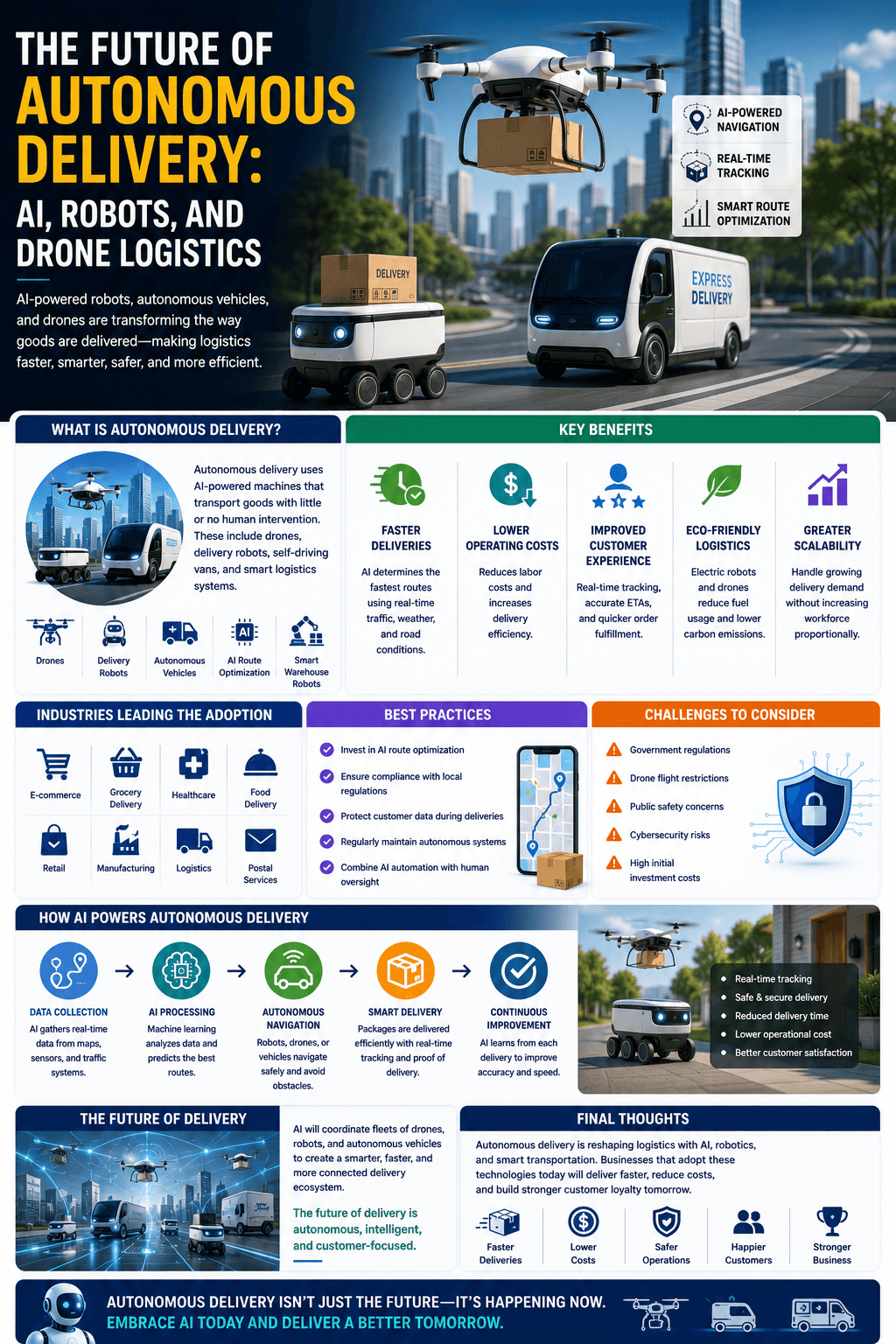
Autonomous delivery refers to the use of AI-powered machines that transport goods with minimal or no human intervention.
These technologies include:
Delivery drones
Sidewalk delivery robots
Self-driving delivery vans
AI route optimization systems
Smart warehouse robots
Artificial intelligence enables these systems to navigate safely, avoid obstacles, optimize routes, and deliver packages efficiently.
Why Businesses Are Investing in AI Delivery
Consumers expect faster and more convenient delivery services than ever before. AI helps businesses meet these expectations while reducing operational costs.
Companies are adopting autonomous delivery because it offers:
Faster deliveries
Lower transportation costs
Improved delivery accuracy
Reduced fuel consumption
24/7 delivery capabilities
Key Benefits
1. Faster Deliveries
AI determines the fastest routes using real-time traffic, weather, and road conditions.
2. Lower Operating Costs
Autonomous delivery reduces labor costs and increases delivery efficiency.
3. Improved Customer Experience
Customers receive real-time tracking, accurate delivery estimates, and quicker order fulfillment.
4. Environmentally Friendly Logistics
Electric robots and drones help reduce fuel usage and lower carbon emissions.
5. Greater Scalability
Businesses can manage growing delivery demand without proportionally increasing workforce costs.
Industries Leading the Adoption
Autonomous delivery is transforming:
E-commerce
Grocery Delivery
Healthcare
Food Delivery
Retail
Manufacturing
Logistics
Postal Services
Demand continues to grow across industries that rely on fast and reliable transportation
.The Impact on Last-Mile Delivery
The last mile is one of the most expensive parts of logistics.
A product may travel thousands of kilometers efficiently through a supply chain, but the final journey from a distribution center to the customer's home can be expensive and complicated.
Autonomous delivery technologies could help solve this problem.
Businesses could combine:
AI route optimization + autonomous vehicles + delivery robots + drones
to create flexible last-mile networks.
Best Practices
Businesses should:
Invest in AI route optimization.
Ensure compliance with local aviation and transportation regulations.
Protect customer data during deliveries.
Regularly maintain autonomous systems.
Combine AI automation with human oversight for exceptional situations.
The Rise of Autonomous Delivery Robot
These small autonomous machines can transport food, groceries, medicines, and packages over relatively short distances.
Using cameras, sensors, GPS, and AI-powered navigation, robots can identify obstacles and navigate local environments.
They are particularly suitable for:
University campuses
Residential communities
Business districts
Hotels
Shopping areas
Urban neighborhoods
Their relatively small size and electric operation can make them useful for localized deliveries.
Challenges to Consider
Organizations should prepare for:
Government regulations
Drone flight restrictions
Public safety concerns
Cybersecurity risks
High initial investment costs
Successful implementation depends on balancing innovation with safety and compliance.
The Future of Delivery
Experts predict autonomous delivery will become a standard part of supply chains over the next decade. AI will coordinate fleets of drones, robots, and autonomous vehicles that work together to complete deliveries with greater speed and precision.
Businesses that invest in intelligent delivery systems today will improve efficiency, lower costs, and strengthen customer loyalty.
Final Thoughts
Autonomous delivery is reshaping the logistics industry by combining artificial intelligence, robotics, and smart transportation technologies. As AI continues to advance, businesses will deliver products faster, safer, and more efficiently than ever before.
Companies that embrace autonomous delivery now will be well-positioned to lead the future of commerce.
FAQs: The Future of Autonomous Delivery: AI, Robots, and Drone Logistics
1. What is autonomous delivery?
Autonomous delivery uses technologies such as AI, robots, autonomous vehicles, and drones to transport goods with limited or no direct human control.
2. How is AI transforming delivery logistics?
AI helps optimize routes, predict demand, manage fleets, identify delivery risks, and coordinate autonomous delivery systems in real time.
3. What are delivery robots?
Delivery robots are small autonomous machines designed to transport packages, groceries, meals, and other goods over relatively short distances.
4. How do delivery drones work?
Delivery drones use GPS, sensors, cameras, AI, and navigation systems to travel to designated locations and deliver packages, often without requiring a human pilot to control every movement.
5. Are autonomous delivery systems available in 2026?
Yes. Autonomous delivery technologies are being tested and deployed in selected markets, although availability, regulations, and operating models vary significantly by location.
6. What are the main benefits of autonomous delivery?
Key benefits can include faster deliveries, lower operational costs, improved route efficiency, reduced labor requirements, and greater delivery availability.
7. Can autonomous delivery reduce logistics costs?
It has the potential to reduce certain delivery costs by automating repetitive transportation tasks and improving fleet utilization, although technology, maintenance, infrastructure, and regulatory costs must also be considered.
8. What role does AI play in drone logistics?
AI can help drones with route planning, obstacle detection, navigation, weather assessment, traffic management, and delivery optimization.
9. Are autonomous delivery robots safe?
Autonomous robots are designed with sensors, cameras, navigation systems, and safety controls, but their reliability depends on the technology, environment, operating conditions, and regulatory requirements.
10. What types of products can autonomous systems deliver?
Potential products include food, groceries, medicines, retail packages, documents, spare parts, and other lightweight goods.
11. How can autonomous delivery improve last-mile logistics?
Autonomous systems can help address the expensive and time-consuming last mile by automating short-distance deliveries and optimizing routes based on real-time conditions.
12. Will autonomous delivery replace human delivery drivers?
Not necessarily. Autonomous systems are more likely to change delivery roles and complement human workers. Humans may continue handling complex deliveries, exceptions, customer interactions, and logistics supervision.
13. What challenges face autonomous delivery?
Major challenges include safety, regulations, weather, cybersecurity, infrastructure, battery limitations, public acceptance, navigation complexity, and operating costs.
14. How does weather affect drone delivery?
Strong winds, heavy rain, storms, extreme temperatures, and poor visibility can affect drone performance and may require deliveries to be delayed or rerouted.
15. How does autonomous delivery affect warehouse operations?
Autonomous delivery can be integrated with automated warehouses, allowing AI systems to coordinate inventory, picking, packaging, dispatch, and transportation.
16. Can autonomous delivery operate 24/7?
Potentially, yes. Autonomous systems can operate beyond traditional working hours, although factors such as regulations, weather, battery capacity, maintenance, and safety restrictions may limit continuous operation.
17. How will autonomous delivery affect e-commerce?
It could enable faster and more flexible fulfillment, including same-day, scheduled, and potentially rapid local delivery for certain products.
18. Is autonomous delivery environmentally friendly?
It can reduce emissions in some delivery scenarios, particularly when electric robots or drones replace inefficient vehicle trips. However, the overall environmental impact depends on energy sources, fleet efficiency, manufacturing, and operational patterns.
19. How important is cybersecurity for autonomous logistics?
Cybersecurity is critical because connected vehicles, robots, drones, and logistics platforms can become targets for hacking, unauthorized access, data theft, or operational disruption.
20. What is the future of autonomous delivery?
The future is likely to involve a combination of AI-powered logistics platforms, delivery robots, drones, autonomous vehicles, smart warehouses, and human oversight. As technology and regulations mature, autonomous delivery could become an increasingly important part of global last-mile logistics.