
PFPersonal Finance in 2026: Smart Ways to Save Money & Build Wealth
Introduction
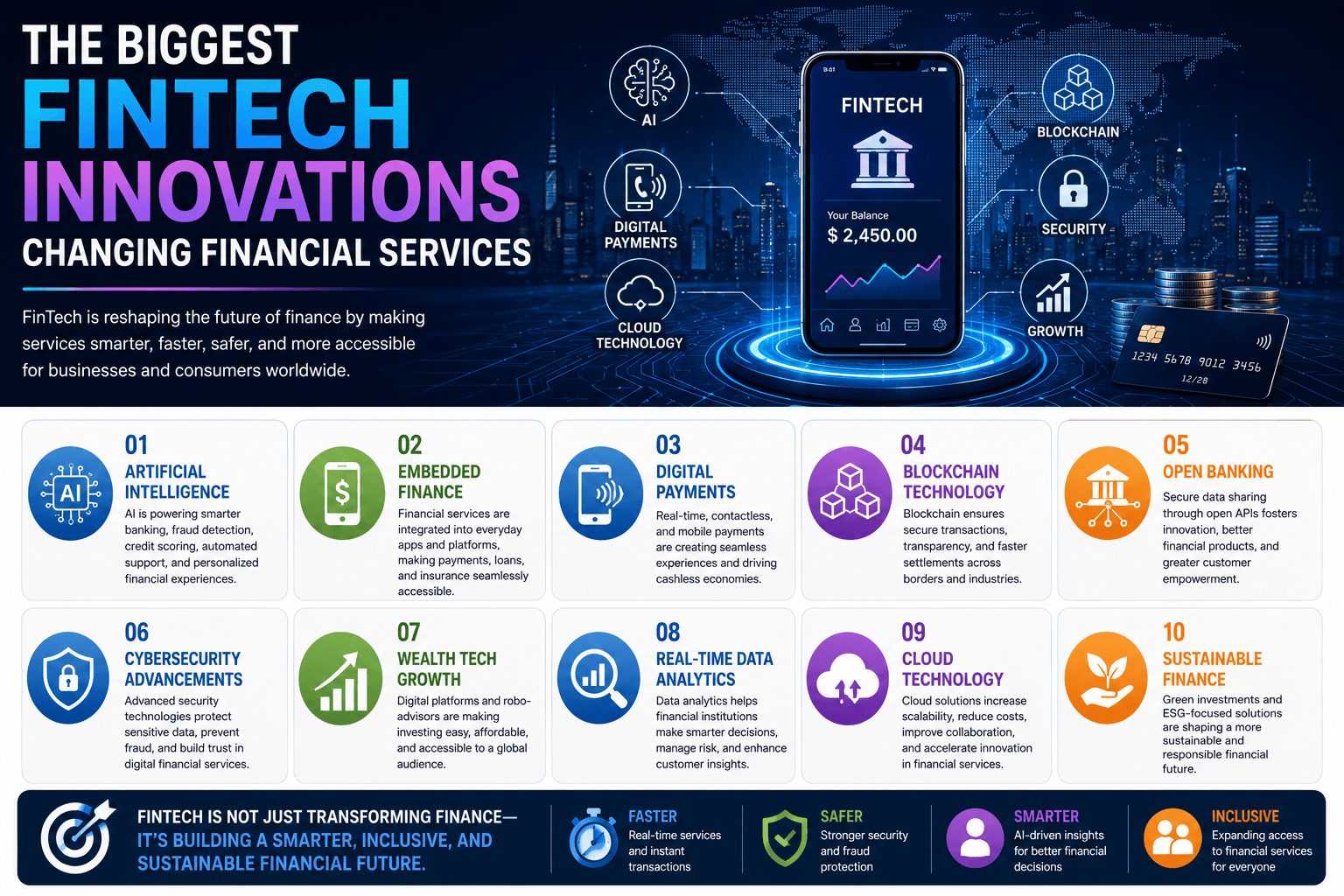
Financial technology (FinTech) is redefining how individuals, businesses, and financial institutions manage money. What began with online banking and digital payment apps has evolved into a sophisticated ecosystem powered by artificial intelligence (AI), blockchain, cloud computing, embedded finance, open banking, and real-time analytics.
Consumers today expect financial services that are secure, personalized, and available instantly from any device. At the same time, banks and financial institutions are modernizing legacy systems to improve efficiency, reduce operating costs, strengthen cybersecurity, and meet rapidly changing customer expectations.
As digital transformation accelerates, understanding the latest FinTech innovations has become essential for business leaders, investors, and technology professionals. Here are the major innovations reshaping financial services in 2026.
1. Artificial Intelligence Is Reshaping Financial Decision-Making
Artificial intelligence has become one of the most valuable technologies in modern finance.
Financial institutions are using AI to:
Detect fraud in real time
Automate customer service
Personalize financial recommendations
Improve credit scoring
Predict financial risks
Analyze customer spending behavior
Beyond automation, AI enables banks to process massive volumes of financial data within seconds, helping organizations make faster and more informed business decisions.
2. Embedded Finance Is Becoming Mainstream
Embedded finance allows non-financial businesses to integrate financial services directly into their digital platforms.
Common examples include:
Buy Now, Pay Later (BNPL)
Digital wallets
Merchant financing
Embedded insurance
In-app banking services
Subscription payment management
Consumers benefit from seamless financial experiences without leaving the applications they already use, while businesses increase customer engagement and create additional revenue opportunities.
3. Digital Payments Continue Their Rapid Expansion
The global shift toward cashless transactions continues to accelerate.
Consumers increasingly prefer:
Contactless payments
Mobile wallets
QR-code payments
Instant bank transfers
Digital banking applications
Cross-border payment solutions
Businesses benefit from faster settlements, improved cash flow, and enhanced customer convenience.
4. Blockchain Is Expanding Beyond Cryptocurrency
Blockchain technology is increasingly being adopted for enterprise financial applications rather than cryptocurrency alone.
Financial organizations are using blockchain to improve:
Cross-border payments
Trade finance
Digital identity verification
Smart contracts
Asset tokenization
Transaction transparency
Its secure and tamper-resistant architecture helps reduce fraud while improving operational efficiency.
5. Open Banking Is Driving Financial Innovation
Open banking enables customers to securely share financial information with authorized third-party providers.
This has encouraged the development of innovative services including:
Budget management platforms
Investment applications
Automated savings tools
Loan comparison services
Personalized financial planning
Consumers gain greater control over their financial data while benefiting from more competitive financial products.
6. Cybersecurity Is More Important Than Ever
As digital financial services expand, cybersecurity has become a board-level priority.
Organizations are investing in:
Multi-factor authentication
Biometric security
AI-powered fraud detection
End-to-end encryption
Zero-trust security frameworks
Continuous threat monitoring
Strong cybersecurity protects sensitive financial data and strengthens customer confidence.
7. Digital Wealth Management Is Becoming More Accessible
Technology is making investing available to a wider audience.
Modern investment platforms now offer:
Robo-advisors
Fractional investing
Goal-based portfolios
Automated portfolio management
Low-cost investment products
Financial education tools
These innovations enable new investors to participate in financial markets with lower costs and greater accessibility.
8. Data Analytics Is Improving Financial Performance
Financial institutions generate enormous amounts of transactional and customer data every day.
Advanced analytics helps organizations:
Improve lending decisions
Detect unusual activity
Forecast customer behavior
Reduce operational risks
Personalize customer experiences
Optimize business performance
Real-time insights allow organizations to respond quickly to changing market conditions.
9. Cloud Computing Is Modernizing Banking Infrastructure
Cloud technology has become the backbone of digital financial services.
Financial organizations use cloud platforms to:
Reduce infrastructure costs
Improve scalability
Accelerate software deployment
Support remote work
Improve disaster recovery
Enable faster innovation
Cloud-based infrastructure allows institutions to launch new financial products more efficiently.
10. Sustainable Finance Continues to Grow
Environmental, Social, and Governance (ESG) considerations are increasingly influencing investment decisions.
Financial institutions are expanding services such as:
Green investment funds
Sustainable lending
ESG-focused portfolios
Carbon tracking solutions
Climate-risk reporting
Consumers and institutional investors increasingly seek financial products aligned with long-term sustainability objectives.
Emerging Trends to Watch
Several emerging technologies are expected to influence the next phase of FinTech innovation:
Tokenized real-world assets
AI-powered financial assistants
Central Bank Digital Currencies (CBDCs)
Embedded insurance
Decentralized identity verification
Predictive financial analytics
Organizations that monitor these developments will be better prepared for future market changes.
Challenges Facing the FinTech Industry
Despite rapid innovation, the industry continues to face several challenges:
Cybersecurity threats
Regulatory compliance
Data privacy requirements
Legacy system integration
Customer trust
Increasing market competition
Successfully addressing these issues will remain essential for sustainable growth.
Best Practices for Financial Institutions
Organizations looking to remain competitive should focus on:
Investing in AI and automation
Strengthening cybersecurity
Modernizing cloud infrastructure
Improving customer experience
Leveraging open banking
Enhancing data analytics
Maintaining regulatory compliance
Supporting sustainable financial innovation
These strategies help businesses adapt to changing customer expectations while remaining competitive.
Frequently Asked Questions
What is FinTech?
FinTech refers to technology-driven innovations that improve financial services such as banking, payments, lending, investing, and insurance.
Why is AI important in financial services?
AI helps financial institutions automate operations, detect fraud, improve customer experiences, and make faster, data-driven decisions.
Is blockchain only used for cryptocurrency?
No. Blockchain also supports cross-border payments, trade finance, digital identity, tokenization, and secure record management.
How does embedded finance benefit businesses?
Embedded finance increases customer convenience, improves conversions, creates additional revenue streams, and strengthens customer loyalty.
Conclusion
FinTech continues to reshape the global financial industry through artificial intelligence, blockchain, cloud computing, embedded finance, cybersecurity, and advanced data analytics. These technologies are transforming how consumers access financial services while enabling businesses to improve efficiency, reduce costs, and deliver more personalized experiences.
As digital finance continues to evolve, organizations that embrace innovation while maintaining strong security, regulatory compliance, and customer trust will be best positioned for long-term success. The future of financial services will be increasingly intelligent, connected, and customer-focused, making continuous innovation a key driver of sustainable growth.
The Biggest FinTech Innovations Changing Financial Services
Financial technology has transformed the way individuals and businesses interact with money. Banking, payments, investing, lending, insurance, and financial management are increasingly powered by digital platforms and intelligent technologies.
The latest wave of FinTech innovation is going beyond simply moving traditional financial services online. Artificial intelligence, blockchain, embedded finance, open banking, digital currencies, biometric authentication, and automated financial tools are changing how financial products are designed and delivered.
As customer expectations rise and financial institutions face increasing competition from technology companies and digital-first startups, innovation is becoming a major factor shaping the future of financial services.
1. Artificial Intelligence in Financial Services
Artificial intelligence is one of the most significant FinTech innovations.
Financial institutions can use AI to analyze large volumes of data, identify patterns, automate processes, and support decision-making.
AI applications include:
Fraud detection
Credit risk assessment
Customer service
Financial forecasting
Personalized recommendations
Algorithmic trading
Compliance monitoring
Generative AI is also creating new opportunities for financial institutions to provide conversational assistance, summarize financial information, and automate administrative workflows.
2. Open Banking
Open banking allows customers to securely share financial information with authorized third-party providers through APIs.
This creates opportunities for consumers to access more personalized financial services.
For example, financial applications can potentially analyze information from multiple accounts and provide customers with a consolidated view of their finances.
Open banking can also encourage competition by allowing FinTech companies to develop services that work across traditional financial institutions.
3. Embedded Finance
Embedded finance integrates financial services directly into non-financial products and platforms.
For example, an e-commerce platform may offer payments, financing, insurance, or digital wallets within the shopping experience.
Instead of customers visiting a separate bank or financial institution, financial services become part of the platforms they already use.
This can make financial products more convenient and accessible.
4. Digital Payments
Digital payments continue to reshape financial transactions.
Mobile wallets, contactless payments, QR codes, instant payment systems, and digital banking applications are reducing dependence on cash and traditional payment methods.
Businesses can also benefit from faster transactions and improved payment tracking.
As digital payment infrastructure expands, consumers increasingly expect financial transactions to be fast, convenient, and available across devices.
5. Blockchain and Tokenization
Blockchain technology has introduced new approaches to recording and transferring digital assets.
Beyond cryptocurrencies, blockchain can support applications such as tokenization, digital identity, cross-border transactions, and certain forms of automated settlement.
Tokenization can represent real-world assets digitally, potentially making some financial assets easier to transfer, track, or fractionalize.
However, regulatory and security considerations remain important.
6. Digital Banking
Digital-only banks and modern banking platforms are changing customer expectations.
Customers increasingly expect to open accounts, transfer money, manage cards, monitor spending, and access financial services through smartphones and websites.
Digital banking can reduce the need for physical branches while allowing institutions to provide services around the clock.
Traditional banks are also investing heavily in digital platforms to compete with technology-focused financial companies.
7. Biometric Authentication
Security is critical in financial services.
Biometric technologies such as fingerprint recognition, facial recognition, and voice authentication can provide additional ways to verify customers.
Biometrics can make authentication more convenient while helping organizations strengthen account security.
However, biometric information is highly sensitive, making privacy, secure storage, and responsible data management essential.
8. Robotic Process Automation
Robotic Process Automation (RPA) allows financial organizations to automate repetitive, rule-based tasks.
Banks, insurers, and other financial institutions can use automation for activities such as:
Data entry
Document processing
Account reconciliation
Reporting
Compliance workflows
Customer onboarding
When combined with AI, automation can handle increasingly complex processes and reduce administrative workloads.
9. RegTech
Regulatory technology, commonly known as RegTech, uses technology to help financial organizations manage compliance requirements.
Financial institutions face complex regulations involving customer identification, anti-money-laundering procedures, transaction monitoring, reporting, and data protection.
RegTech platforms can automate parts of these processes and help organizations identify potentially suspicious activity more efficiently.
10. Personalized Financial Services
AI and advanced analytics are enabling more personalized financial experiences.
Financial platforms can analyze customer behavior and financial information to provide personalized insights, budgeting recommendations, product suggestions, and alerts.
Instead of offering identical products to every customer, financial institutions can increasingly tailor experiences to individual circumstances.
The Future of FinTech Innovation
FinTech innovation is likely to become increasingly interconnected.
AI may work alongside open banking APIs, digital payments, blockchain infrastructure, biometric authentication, and automated compliance systems.
The result could be financial services that are more automated, personalized, integrated, and accessible.
However, innovation also creates challenges. Cybersecurity, data privacy, regulatory compliance, financial inclusion, and responsible AI adoption will remain important considerations.
The companies that succeed will not simply adopt new technology. They will need to combine innovation with trust, security, transparency, and customer value.
Conclusion
FinTech is changing financial services by making them more digital, intelligent, automated, and personalized.
Artificial intelligence, open banking, embedded finance, digital payments, blockchain, digital banking, biometrics, RPA, and RegTech are among the technologies reshaping the industry.
As these innovations continue to mature, financial institutions and FinTech companies will have new opportunities to improve efficiency, develop new products, and deliver better customer experiences.
The future of financial services will likely belong to organizations that can combine technological innovation with strong security, responsible data practices, and lasting customer trust.
Frequently Asked Questions
1. What are the biggest FinTech innovations changing financial services?
The most important innovations include artificial intelligence, open banking, embedded finance, digital payments, blockchain, digital banking, biometric authentication, robotic process automation, RegTech, and personalized financial services.
2. How is AI changing financial services?
AI helps financial institutions analyze data, detect fraud, assess risk, automate customer service, improve financial forecasting, personalize products, and streamline operational processes.
3. What is embedded finance?
Embedded finance refers to integrating financial products such as payments, lending, insurance, or banking services directly into non-financial platforms and customer experiences.
4. How does open banking benefit customers?
Open banking can allow customers to securely share financial information with authorized third-party providers, enabling services such as financial aggregation, personalized budgeting, and innovative financial products.
5. Is blockchain important for the future of FinTech?
Blockchain has potential applications beyond cryptocurrency, including tokenization, digital assets, transaction settlement, and certain cross-border financial processes. Its adoption will depend partly on regulation, security, scalability, and business use cases.
6. How are digital payments changing financial services?
Digital payments allow consumers and businesses to transfer money quickly through mobile wallets, contactless technologies, QR codes, and online payment platforms. They are making transactions increasingly convenient and reducing reliance on cash.
7. What is RegTech?
RegTech, or regulatory technology, uses software, automation, analytics, and AI to help financial organizations manage regulatory and compliance requirements more efficiently.
8. Are FinTech innovations safe?
FinTech technologies can improve security, but they also create new risks. Cybersecurity, privacy, fraud, regulatory compliance, and responsible data management are essential for ensuring that digital financial services remain trustworthy.
9. How will FinTech affect traditional banks?
FinTech is encouraging traditional banks to accelerate digital transformation, improve customer experiences, automate operations, and develop new financial products. Banks and FinTech companies may increasingly compete while also partnering with each other.
10. What will the future of financial services look like?
The future is likely to involve more AI-powered services, instant digital payments, personalized financial products, embedded banking, automated compliance, open financial ecosystems, and increasingly digital customer experiences.