
PFPersonal Finance in 2026: Smart Ways to Save Money & Build Wealth
Introduction
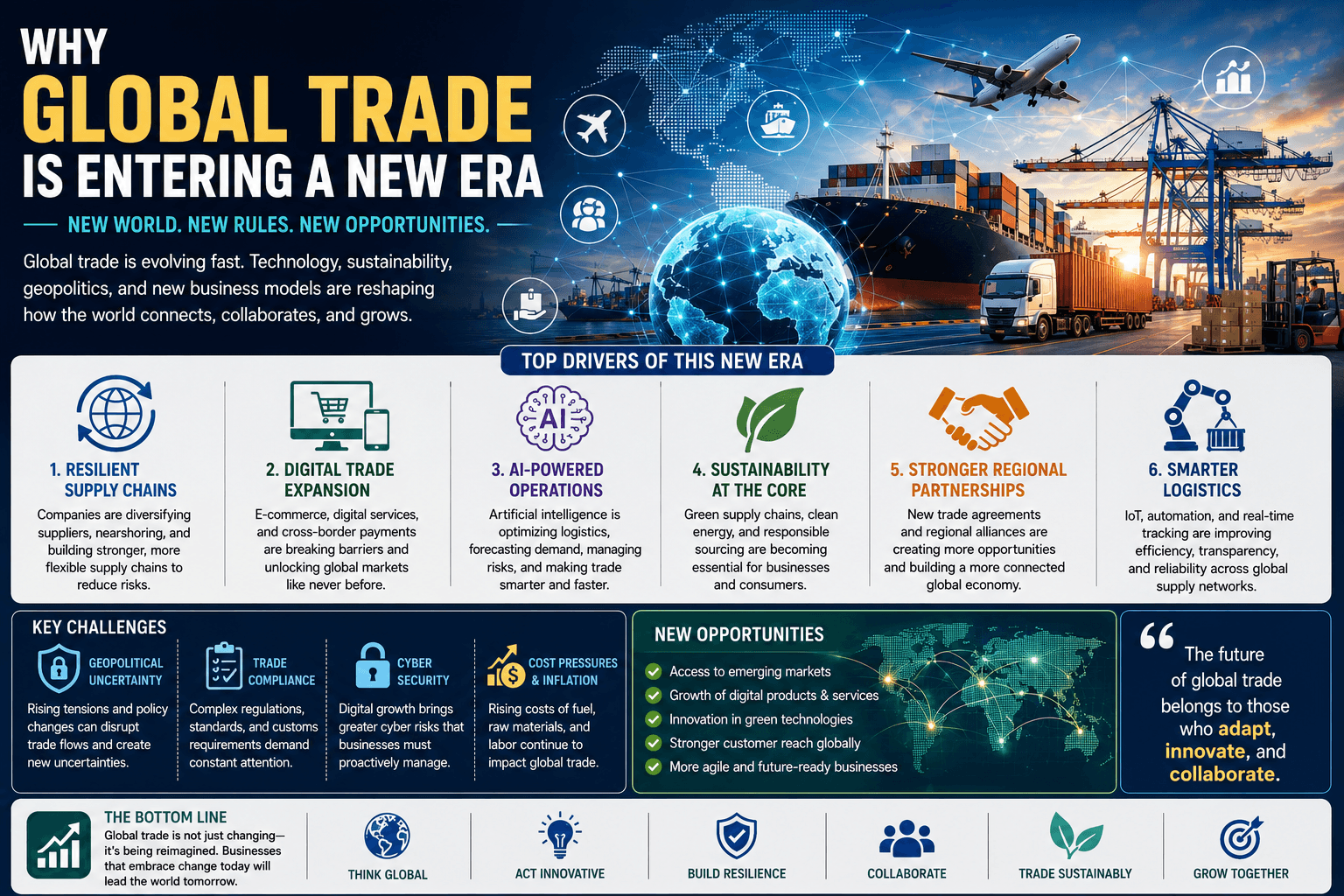
Global trade is undergoing one of its most significant transformations in decades. Rapid technological innovation, shifting geopolitical dynamics, supply chain restructuring, sustainability initiatives, and the rise of digital commerce are redefining how goods and services move across borders. In 2026, businesses are adapting to a new era where resilience, flexibility, and innovation are just as important as cost efficiency.
Companies that understand these changes will be better equipped to seize emerging opportunities while managing the risks of an increasingly interconnected global economy.
1. Supply Chains Are Becoming More Resilient
Recent global disruptions have encouraged businesses to rethink traditional supply chain strategies.
Instead of relying on a single supplier or country, companies are:
Diversifying suppliers
Expanding regional manufacturing
Increasing inventory flexibility
Investing in digital supply chain management
These strategies reduce risk and improve business continuity during unexpected disruptions.
2. Digital Trade Is Expanding Rapidly
E-commerce and digital services continue to reshape international trade.
Businesses now sell products and services globally through:
Online marketplaces
Cross-border e-commerce platforms
Digital payment systems
Cloud-based business services
Digital trade enables companies of all sizes to reach international customers with lower operating costs.
3. Artificial Intelligence Is Improving Trade Operations
Artificial intelligence is streamlining global trade by improving efficiency across logistics and supply chains.
AI helps businesses:
Forecast demand
Optimize shipping routes
Manage inventory
Detect supply chain risks
Automate customs documentation
These technologies reduce costs while improving delivery speed and operational accuracy.
4. Sustainability Is Influencing Trade Decisions
Environmental responsibility has become a major factor in international commerce.
Businesses are increasingly focusing on:
Low-carbon supply chains
Renewable energy
Sustainable sourcing
Green logistics
Circular economy practices
Companies that adopt sustainable operations often strengthen their reputation while meeting evolving regulatory requirements.
5. Regional Trade Partnerships Are Growing
Many countries are strengthening regional trade agreements to improve economic cooperation and reduce barriers to commerce.
These partnerships can:
Increase market access
Simplify customs procedures
Encourage investment
Improve supply chain integration
Support economic growth
Businesses should monitor regional developments to identify new expansion opportunities.
6. Technology Is Transforming Logistics
Modern logistics is becoming faster and more intelligent through technologies such as:
Internet of Things (IoT)
Blockchain
Robotics
Warehouse automation
Real-time shipment tracking
These innovations improve transparency, reduce delays, and enhance customer satisfaction.
7. Emerging Markets Offer New Opportunities
Rapid economic growth in emerging markets is creating demand for new products and services.
Businesses expanding into these regions can benefit from:
Growing consumer populations
Rising incomes
Expanding digital adoption
Infrastructure development
Careful market research and local partnerships remain essential for long-term success.
8. Cybersecurity Is More Important Than Ever
As global trade becomes increasingly digital, protecting business data is critical.
Companies should invest in:
Secure payment systems
Data encryption
Cybersecurity monitoring
Employee training
Risk management strategies
Strong cybersecurity helps protect supply chains, financial transactions, and customer information.
9. Trade Compliance Is Becoming More Complex
International businesses must navigate changing regulations involving:
Import and export controls
Product standards
Data protection
Environmental requirements
Tax and customs policies
Maintaining compliance reduces legal risks and supports smooth cross-border operations.
10. Innovation Drives Competitive Advantage
Organizations investing in innovation are better prepared for the future of global trade.
Key investment areas include:
Artificial intelligence
Automation
Cloud computing
Advanced analytics
Smart manufacturing
Digital collaboration tools
Innovation enables businesses to adapt quickly to changing market conditions and customer expectations.
Conclusion
Global trade is entering a new era defined by technology, sustainability, resilience, and digital transformation. Businesses that embrace innovation, diversify supply chains, strengthen cybersecurity, and remain adaptable will be better positioned to succeed in the evolving global marketplace.
As international commerce continues to evolve, organizations that invest in modern trade strategies today will gain a lasting competitive advantage and unlock new opportunities for growth in the years ahead.
FAQs: Why Global Trade Is Entering a New Era
1. Why is global trade entering a new era?
Global trade is evolving due to digital transformation, AI adoption, changing supply chains, geopolitical shifts, and sustainability initiatives.
2. What factors are driving changes in global trade?
Technology, automation, e-commerce growth, regional manufacturing, and new trade agreements are reshaping international commerce.
3. How is AI transforming global trade?
AI improves logistics, demand forecasting, customs processing, inventory management, and supply chain visibility.
4. Why are supply chains becoming more resilient?
Businesses are diversifying suppliers and manufacturing locations to reduce risks from disruptions and geopolitical uncertainties.
5. How does e-commerce impact international trade?
Cross-border e-commerce enables businesses to reach global customers more efficiently while lowering barriers to international expansion.
6. What role does automation play in global trade?
Automation increases productivity, reduces costs, speeds warehouse operations, and enhances logistics efficiency.
7. How is blockchain improving global trade?
Blockchain enhances transparency, secures transactions, reduces fraud, and simplifies international documentation.
8. Why is sustainability becoming important in global trade?
Governments and consumers increasingly expect environmentally responsible practices, encouraging companies to reduce emissions and improve supply chain sustainability.
9. How are geopolitical events affecting trade?
Trade restrictions, sanctions, tariffs, and political tensions can alter supply chains and global investment decisions.
10. What industries are benefiting most from new trade trends?
Technology, healthcare, manufacturing, agriculture, logistics, renewable energy, and retail are seeing significant growth.
11. How does digital transformation support international trade?
Cloud computing, AI, IoT, and data analytics improve collaboration, efficiency, and decision-making across global operations.
12. What are the biggest challenges in global trade today?
Supply chain disruptions, inflation, cybersecurity threats, regulatory compliance, and labor shortages remain major concerns.
13. Why is cybersecurity essential for global trade?
As trade becomes increasingly digital, protecting financial systems, customer data, and logistics platforms is critical.
14. How are emerging markets influencing global trade?
Emerging economies are driving manufacturing, consumption, innovation, and investment opportunities worldwide.
15. What is nearshoring, and why is it growing?
Nearshoring involves relocating production closer to target markets to reduce shipping costs, delivery times, and supply chain risks.
16. How do trade agreements support international business?
Trade agreements reduce tariffs, simplify regulations, and encourage cross-border investment and collaboration.
17. How can small businesses participate in global trade?
Small businesses can use digital marketplaces, international shipping services, online payment platforms, and AI-powered marketing tools.
18. What skills are important for the future of global trade?
Supply chain management, AI literacy, data analytics, international compliance, cybersecurity, and cross-cultural communication are highly valuable.
19. How will AI continue to shape global trade?
AI will enable smarter logistics, predictive analytics, autonomous supply chain management, and more efficient international operations.
20. What is the future outlook for global trade?
Global trade is expected to become more digital, resilient, sustainable, and technology-driven, creating new opportunities for businesses worldwide.
21. How is data analytics improving global trade?
Data analytics helps businesses forecast demand, optimize shipping routes, reduce operational costs, and make informed trade decisions using real-time insights.
22. Why are businesses investing in smart logistics?
Smart logistics uses AI, IoT, and automation to improve shipment tracking, warehouse efficiency, delivery speed, and overall supply chain performance.
23. How do changing consumer expectations affect global trade?
Consumers expect faster delivery, transparent tracking, sustainable products, and seamless cross-border shopping experiences, pushing businesses to innovate.
24. What role does innovation play in the future of global trade?
Innovation enables businesses to adopt advanced technologies, improve efficiency, enter new markets, and remain competitive in a rapidly evolving global economy.
25. Why should businesses prepare for the next generation of global trade?
Organizations that embrace digital transformation, AI, sustainable practices, and resilient supply chains will be better positioned to capitalize on future international growth opportunities.