
PFPersonal Finance in 2026: Smart Ways to Save Money & Build Wealth
Introduction
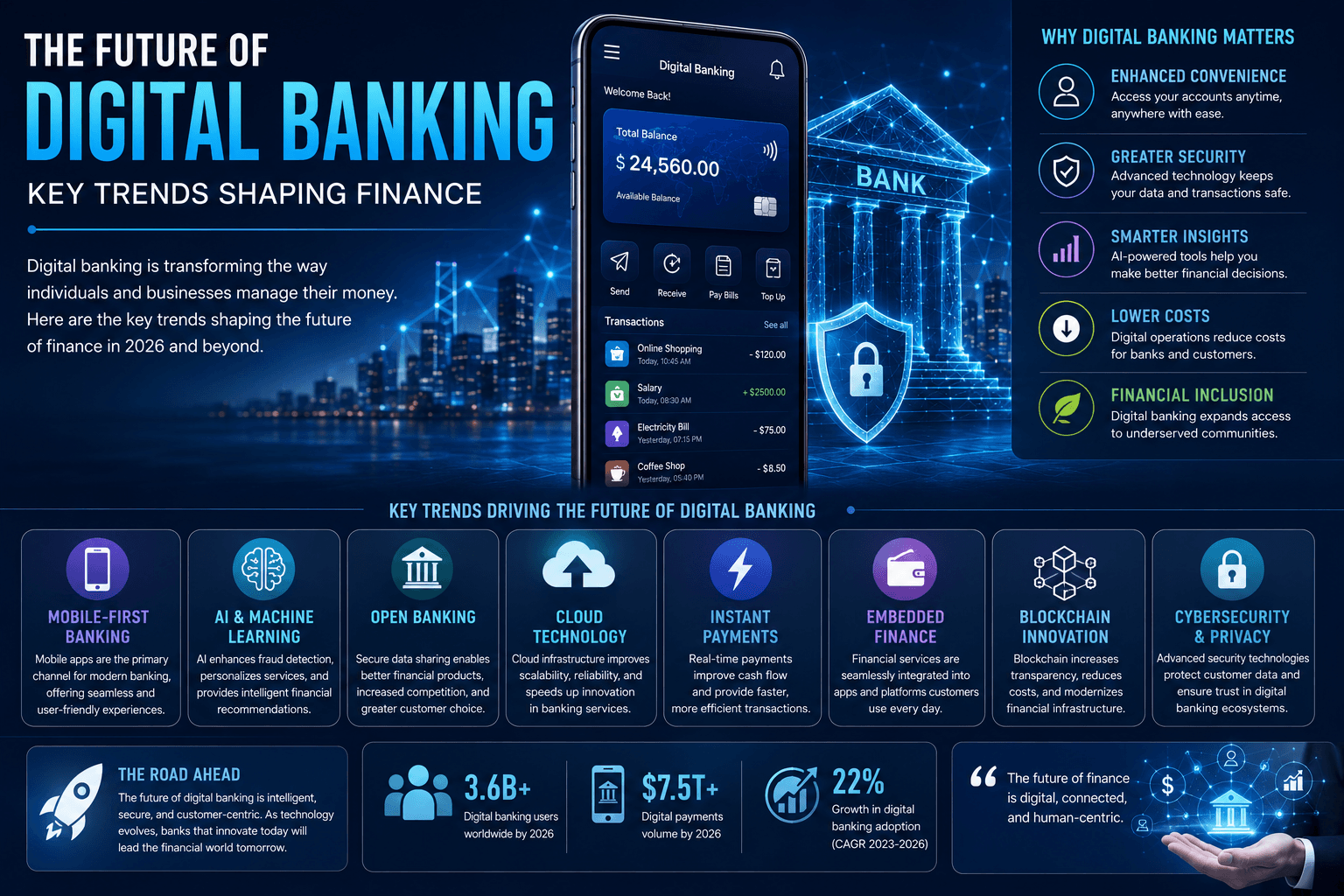
Digital banking has transformed from a convenient alternative to traditional banking into the foundation of modern financial services. In 2026, banks, fintech companies, and financial institutions are embracing advanced technologies to provide faster, safer, and more personalized banking experiences. Consumers increasingly expect instant payments, mobile-first services, AI-powered financial tools, and seamless digital experiences, encouraging financial institutions to accelerate innovation.
The future of digital banking extends beyond online transactions. Artificial intelligence, cloud computing, open banking, blockchain, cybersecurity, and embedded finance are reshaping how individuals and businesses manage money. As financial technology continues evolving, organizations that embrace innovation will be better positioned to compete in an increasingly digital economy.
The Rise of Mobile-First Banking
Smartphones have become the primary banking channel for millions of people worldwide.
Modern mobile banking applications now allow customers to:
Transfer funds instantly
Pay bills
Apply for loans
Open bank accounts
Manage investments
Monitor spending
Access financial advice
Mobile-first banking improves convenience while reducing dependence on physical bank branches.
Artificial Intelligence Is Transforming Financial Services
Artificial intelligence has become one of the biggest drivers of digital banking innovation.
Banks are using AI for:
Fraud detection
Customer service chatbots
Personalized financial advice
Credit risk analysis
Loan approvals
Spending insights
Predictive financial planning
AI helps financial institutions improve efficiency while providing customers with faster and more personalized services.
Open Banking Creates New Opportunities
Open banking is changing how financial institutions collaborate with technology companies.
Through secure data-sharing systems, customers can connect multiple financial accounts using authorized third-party applications.
Benefits include:
Better financial management
Improved budgeting tools
Personalized financial products
Faster payment solutions
Greater competition and innovation
Open banking encourages greater flexibility while giving consumers more control over their financial data.
Cloud Technology Improves Banking Operations
Cloud computing has become essential for modern financial institutions.
Cloud platforms enable banks to:
Improve scalability
Reduce operating costs
Enhance security
Accelerate software development
Process large volumes of transactions
Support remote banking services
Cloud infrastructure allows financial institutions to innovate more rapidly while maintaining service reliability.
Cybersecurity Remains a Top Priority
As digital banking expands, protecting customer information becomes increasingly important.
Banks continue investing in:
Multi-factor authentication
Biometric verification
AI-powered fraud detection
Real-time transaction monitoring
Data encryption
Advanced cybersecurity platforms
Strong security measures help build customer confidence while reducing financial crime.
Instant Payments Become Standard
Consumers increasingly expect payments to be processed within seconds rather than days.
Real-time payment systems provide:
Faster transfers
Improved business cash flow
Better customer experiences
Lower transaction delays
Enhanced financial efficiency
Instant payments are becoming a key competitive advantage for financial institutions.
Embedded Finance Continues Growing
Financial services are increasingly integrated into non-banking platforms.
Examples include:
Buy Now, Pay Later (BNPL)
In-app insurance
Digital wallets
Embedded lending
Retail payment solutions
Embedded finance allows customers to access financial products without leaving the applications they already use.
Blockchain Is Modernizing Financial Infrastructure
Blockchain technology is helping improve transparency and efficiency in financial transactions.
Potential applications include:
Cross-border payments
Digital identity verification
Smart contracts
Asset tokenization
Trade finance
Settlement systems
While adoption varies across regions, blockchain continues influencing the future of digital finance.
Personalized Banking Experiences
Banks are increasingly using customer data responsibly to deliver personalized financial services.
Personalization includes:
Customized savings plans
Spending insights
Investment recommendations
Credit product suggestions
Financial wellness tools
Personalized banking strengthens customer relationships while improving financial decision-making.
Sustainability in Digital Banking
Financial institutions are also supporting sustainability initiatives.
Many banks now offer:
Green financing
Sustainable investment products
Paperless banking
Carbon footprint tracking
ESG-focused financial solutions
Sustainability is becoming an important component of modern banking strategies.
Challenges Facing Digital Banking
Despite rapid innovation, digital banking faces several challenges.
These include:
Cybersecurity threats
Regulatory compliance
Data privacy concerns
Digital fraud
Technology integration
Customer trust
Financial institutions must balance innovation with strong governance and responsible risk management.
Future Outlook
Digital banking is expected to continue evolving through advances in artificial intelligence, cloud computing, embedded finance, blockchain, and cybersecurity. Financial institutions that invest in technology, prioritize customer experience, and maintain robust security standards will be better positioned to succeed in an increasingly competitive marketplace.
Consumers will benefit from faster services, greater financial accessibility, and more personalized banking experiences, while businesses will enjoy improved payment systems and innovative financing solutions.
Conclusion
The future of digital banking is being shaped by technology, innovation, and changing customer expectations. Artificial intelligence, mobile banking, open banking, instant payments, cloud computing, and cybersecurity are redefining financial services for both consumers and businesses.
As digital transformation accelerates, financial institutions that embrace innovation while maintaining trust, security, and regulatory compliance will lead the next generation of banking. For consumers and businesses alike, digital banking promises greater convenience, efficiency, and financial empowerment in the years ahead.
Frequently Asked Questions (FAQs)
1. What is digital banking?
Digital banking allows customers to access banking services such as payments, transfers, savings, and loans through online platforms and mobile applications without visiting a physical branch.
2. Why is digital banking important in 2026?
Digital banking is essential in 2026 because it provides faster transactions, improved customer experiences, enhanced security, and greater accessibility through AI-powered financial services.
3. What are the biggest digital banking trends in 2026?
Key trends include artificial intelligence, open banking, embedded finance, blockchain technology, biometric authentication, cloud banking, real-time payments, and personalised financial services.
4. How is artificial intelligence transforming digital banking?
AI automates customer support, detects fraud, provides personalised financial recommendations, streamlines loan approvals, and improves operational efficiency.
5. What is open banking?
Open banking enables banks to securely share customer financial data with authorised third-party providers through APIs, allowing customers to access innovative financial products and services.
6. How does blockchain benefit digital banking?
Blockchain improves transaction transparency, enhances security, reduces fraud, speeds up cross-border payments, and lowers operational costs.
7. What is embedded finance?
Embedded finance integrates banking services directly into non-financial platforms, allowing users to make payments, access loans, or purchase insurance without leaving the application.
8. How are mobile banking apps evolving?
Modern mobile banking apps offer AI-powered financial insights, biometric authentication, instant payments, digital wallets, budgeting tools, and investment management features.
9. What role does cloud computing play in digital banking?
Cloud technology enables banks to improve scalability, enhance security, reduce infrastructure costs, and deliver faster digital services.
10. How does digital banking improve customer experience?
Digital banking offers 24/7 account access, faster transactions, personalised recommendations, simplified account management, and seamless digital interactions.
11. How is cybersecurity changing in digital banking?
Banks are adopting multi-factor authentication, biometric verification, AI-driven fraud detection, encryption, and continuous threat monitoring to strengthen cybersecurity.
12. What is biometric authentication in banking?
Biometric authentication uses fingerprints, facial recognition, voice recognition, or iris scanning to securely verify customer identities.
13. How do real-time payments benefit consumers?
Real-time payment systems enable instant money transfers, improve cash flow, reduce payment delays, and enhance customer convenience.
14. What is the role of data analytics in digital banking?
Data analytics helps banks understand customer behaviour, improve risk management, personalise financial products, and optimise business performance.
15. How are fintech companies influencing digital banking?
Fintech companies drive innovation by introducing faster payment solutions, digital lending, AI-powered financial services, and customer-focused banking experiences.
16. Can small banks benefit from digital transformation?
Yes. Digital transformation enables smaller banks to improve efficiency, reduce costs, enhance customer engagement, and compete with larger financial institutions.
17. What challenges do digital banks face?
Common challenges include cybersecurity threats, regulatory compliance, data privacy, technology integration, fraud prevention, and maintaining customer trust.
18. How does digital banking support financial inclusion?
Digital banking expands access to financial services for underserved communities through mobile banking, digital payments, and low-cost online financial products.
19. What is the future of digital banking?
The future of digital banking includes greater AI adoption, hyper-personalised financial services, blockchain integration, embedded finance, digital identities, and fully automated banking experiences.
20. Why should businesses embrace digital banking?
Businesses benefit from digital banking through faster payments, improved cash flow management, enhanced financial insights, lower operating costs, stronger security, and more efficient financial operations.