PFPersonal Finance in 2026: Smart Ways to Save Money & Build Wealth
Enterprise legal teams manage thousands of contracts covering vendors, customers, employees, partners, intellectual property, compliance, and business operations. Traditionally, these contracts have been stored across shared drives, email inboxes, spreadsheets, and contract repositories, making it difficult to track obligations, deadlines, risks, and renewals.
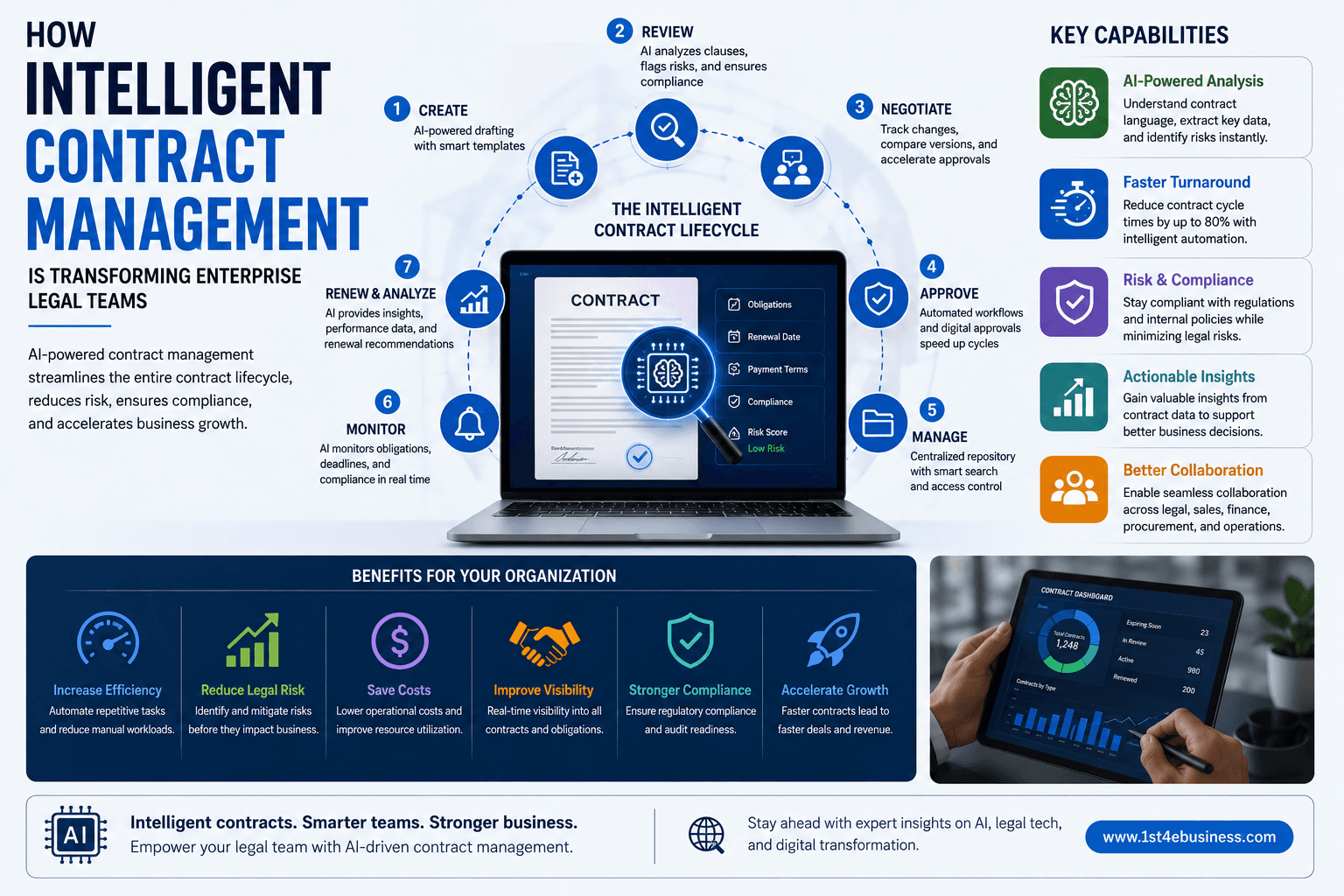
Intelligent contract management is changing that model. By combining contract lifecycle management (CLM), artificial intelligence, automation, analytics, and natural language processing, organizations can turn contracts from static documents into valuable sources of business intelligence.
What Is Intelligent Contract Management?
Intelligent contract management refers to the use of AI-powered technologies to manage contracts throughout their entire lifecycle.
Traditional contract management often depends heavily on manual work. Legal professionals may spend hours reviewing clauses, searching for information, tracking renewal dates, comparing versions, and responding to requests from business teams.
Intelligent systems can automate many of these activities.
Modern platforms can help organizations:
Extract important contract information
Identify key clauses and obligations
Compare contract versions
Detect potential risks
Track renewal and expiration dates
Automate approval workflows
Monitor compliance requirements
Search contracts using natural language
Generate summaries
Provide insights across large contract portfolios
The result is a shift from document administration toward proactive legal and business management.
Why Enterprise Legal Teams Need a New Approach
Contract volumes have grown as businesses become more complex. A large organization may have contracts spread across multiple departments, jurisdictions, subsidiaries, and systems.
This creates several challenges.
Contract Data Is Often Fragmented
Legal teams may not know exactly where every active agreement is stored. Contracts can exist in procurement platforms, email attachments, cloud storage, or legacy systems.
Without centralized visibility, organizations can miss important obligations or renewal deadlines.
Manual Review Takes Time
Lawyers frequently spend significant amounts of time performing repetitive tasks such as extracting dates, checking standard clauses, and comparing agreements.
These tasks are important, but they don't always require high-level legal judgment.
AI can help reduce the administrative burden and allow legal professionals to focus on more strategic work.
Risk Can Be Difficult to Identify
A company may have thousands of agreements containing different liability limits, termination provisions, data protection requirements, pricing structures, and renewal terms.
Manually identifying patterns across an entire contract portfolio is difficult.
Intelligent contract management can analyze contracts at scale and highlight provisions that deserve attention.
AI-Powered Contract Review
One of the most important applications of intelligent contract management is AI-assisted review.
AI systems can identify and extract clauses relating to areas such as:
Indemnification
Liability
Confidentiality
Data protection
Intellectual property
Insurance
Termination
Automatic renewal
Service levels
Pricing
Governing law
Instead of reading every document from beginning to end to locate specific information, lawyers can use AI to surface relevant sections quickly.
This does not eliminate the need for legal expertise. Instead, it helps lawyers spend more time interpreting risk and making decisions.
Faster Contract Drafting and Negotiation
Intelligent contract platforms can also accelerate contract creation.
Organizations can establish approved templates, clause libraries, fallback language, and predefined approval rules.
When a business user requests a new agreement, the system can guide them toward an appropriate template and workflow.
During negotiations, AI can help identify deviations from preferred language and highlight clauses that differ from company standards.
This gives legal teams greater visibility into negotiation risk while reducing unnecessary back-and-forth.
Turning Contracts Into Business Intelligence
Contracts contain enormous amounts of information about how a company operates.
They can reveal:
Supplier commitments
Customer obligations
Pricing arrangements
Renewal exposure
Payment terms
Regulatory requirements
Geographic risk
Vendor dependencies
Revenue opportunities
Intelligent contract management makes this information easier to analyze.
For example, an organization could ask a natural-language question such as:
"Which supplier contracts automatically renew within the next 90 days?"
Instead of manually searching multiple folders, the system can identify relevant agreements and provide a consolidated view.
This transforms contract repositories into searchable business intelligence systems.
Improving Compliance Management
Compliance requirements are becoming increasingly complex for global enterprises.
Contracts may contain obligations related to privacy, cybersecurity, data processing, industry regulations, environmental requirements, or reporting.
Intelligent systems can help legal teams monitor these obligations and identify agreements that contain specific compliance-related provisions.
Automated alerts can also remind responsible teams about important deadlines.
This can reduce the risk of obligations being overlooked.
Better Collaboration Between Legal and Business Teams
Legal departments are often viewed as bottlenecks when contract requests accumulate.
A major reason is that business teams frequently need legal assistance for routine questions.
Intelligent contract management can provide self-service capabilities.
For example, employees may be able to search approved contracts, check standard terms, submit contract requests, or determine the status of an agreement without sending multiple emails to the legal department.
This improves the experience for both lawyers and business users.
Improving Contract Lifecycle Visibility
Contracts typically move through several stages:
Request → Drafting → Review → Negotiation → Approval → Signature → Execution → Monitoring → Renewal or Termination
Without centralized systems, it can be difficult to know where an agreement currently sits.
Intelligent CLM platforms provide visibility across the lifecycle.
Legal leaders can monitor contract volumes, approval times, bottlenecks, renewal pipelines, and outstanding obligations from centralized dashboards.
This makes the legal function more measurable and easier to manage.
Reducing Missed Renewals and Obligations
Automatic renewal clauses can create significant financial and operational risks.
A company may unintentionally renew a contract because nobody noticed the required termination notice period.
Intelligent contract management can identify renewal dates and create automated alerts before critical deadlines.
The same approach can be applied to:
Price increases
Insurance certificates
Compliance reports
Service-level commitments
Payment milestones
Termination windows
This helps organizations move from reactive contract administration to proactive obligation management.
The Role of Generative AI
Generative AI is expanding what contract management systems can do.
Instead of simply locating a clause, AI can summarize its meaning in plain language.
For example, a business executive could ask:
"What are our termination rights under this agreement?"
The system could identify the relevant provisions and provide a concise explanation, while linking the response back to the original contract language.
Generative AI can also assist with contract summaries, negotiation preparation, clause explanations, and internal legal research.
However, legal teams should maintain appropriate human review, especially when AI outputs influence significant legal or commercial decisions.
Security and Governance Are Critical
The benefits of AI-powered contract management come with important responsibilities.
Contracts can contain highly sensitive information, including pricing, customer data, intellectual property, financial terms, and confidential business strategies.
Organizations should therefore evaluate:
Data security
Access controls
Encryption
Audit trails
Data retention
AI model governance
Vendor security
Privacy requirements
Human oversight
Legal teams should understand how a platform processes and stores contract information before deploying it at enterprise scale.
Measuring the Business Impact
Legal departments can use intelligent contract management to measure improvements using practical metrics.
Useful indicators include:
Contract cycle time
Review time
Approval time
Number of contracts processed
Missed renewal deadlines
Contract deviations
Outside counsel spending
Procurement savings
Obligation compliance
Legal request response time
These metrics can help legal leaders demonstrate how technology contributes to business performance.
Challenges of Implementation
Implementing intelligent contract management isn't simply a technology project.
Organizations may face challenges involving legacy contracts, inconsistent data, fragmented processes, employee adoption, integration requirements, and unclear ownership.
A successful implementation usually begins with a clearly defined use case.
Rather than attempting to automate every legal process immediately, organizations can start with areas such as contract search, renewal management, clause extraction, or standardized approvals.
Once the system delivers measurable value, additional workflows can be introduced.
The Future of Enterprise Legal Operations
Intelligent contract management is moving the legal department toward a more proactive role within the enterprise.
In the past, legal teams often became involved when a contract required review or a problem emerged.
In the future, legal technology can help identify potential issues before they become problems.
AI-powered systems may continuously analyze contract portfolios, identify unusual terms, monitor obligations, and provide business leaders with timely insights.
This creates a more strategic legal function—one that doesn't simply review contracts but helps the organization understand and manage commercial risk.
Conclusion
Intelligent contract management is transforming enterprise legal teams by reducing repetitive work, improving contract visibility, accelerating reviews, and turning contractual information into actionable intelligence.
AI won't replace legal judgment. Instead, its greatest value is likely to come from allowing lawyers to spend less time searching, organizing, and extracting information and more time on negotiation, strategy, risk management, and business partnership.
As contract volumes continue to grow, enterprises that combine AI, automation, strong governance, and human legal expertise will be better positioned to manage complexity and turn contracts into a strategic business asset.