
BABest AI Apps in 2026: 15 Smart Tools Everyone Should Try
Artificial intelligence has moved beyond simple chatbots and basic automation. In 2026, AI agents are becoming an important part of how businesses handle tasks, make decisions, analyze information, and interact with customers.
Unlike traditional AI tools that usually respond to a single prompt, AI agents can work through a series of steps to accomplish a goal. They can analyze information, use software tools, coordinate workflows, and adapt their actions based on results.
What Are AI Agents?
AI agents are software systems designed to pursue a specific goal with a degree of autonomy.
A typical AI agent can:
Understand a user's objective
Break a large task into smaller steps
Gather and analyze information
Use digital tools and applications
Make decisions within defined limits
Check results and adjust its approach
Complete multi-step workflows
For example, instead of asking an AI to write one email, a business could use an agent to identify customer inquiries, classify them, prepare responses, update a CRM, and notify a human employee when an issue requires attention.
Why AI Agents Are Growing in 2026
Businesses are increasingly interested in AI agents because many workplace processes involve repetitive, multi-step tasks.
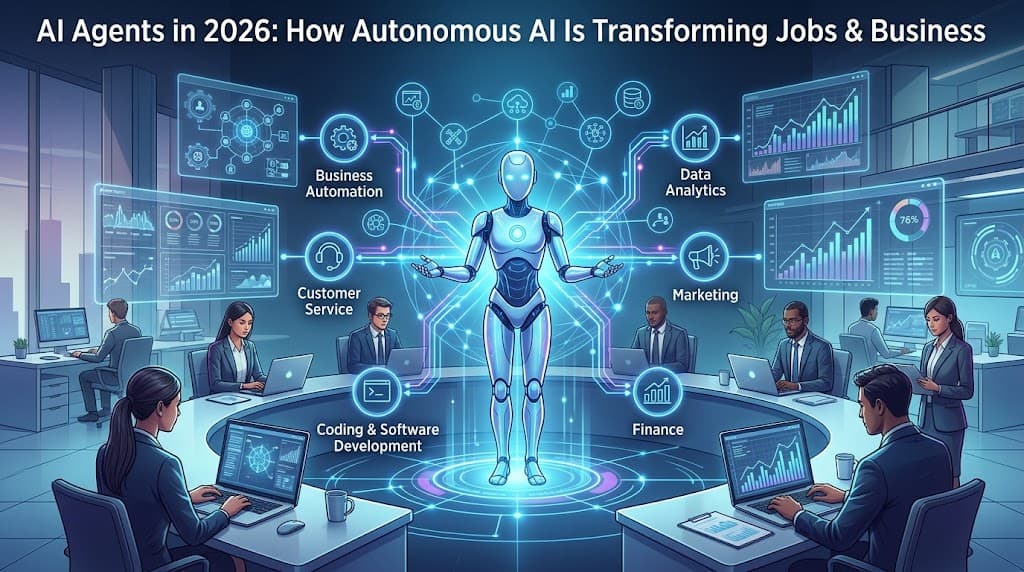
Companies can potentially use agents for areas such as:
Customer support
Sales operations
Marketing
Software development
Data analysis
Human resources
Finance administration
Research
Supply-chain management
The biggest change is the shift from AI as an assistant to AI as a workflow participant.
AI Agents and the Future of Jobs
AI agents are likely to change the way people perform many jobs, but the impact will vary significantly by occupation.
Some repetitive activities may become increasingly automated. At the same time, employees may spend more time on tasks requiring judgment, communication, creativity, relationship-building, and responsibility.
For example, a marketing employee might previously spend hours collecting campaign data manually. An AI agent could automate much of the collection and initial analysis, allowing the employee to focus more on strategy and creative decisions.
Skills That May Become More Valuable
As AI becomes more capable, workers can benefit from developing skills such as:
AI literacy
Critical thinking
Problem-solving
Communication
Creativity
Data interpretation
Project management
Domain expertise
AI-assisted workflow design
The ability to work effectively with AI systems is becoming an increasingly relevant workplace skill.
How Businesses Are Using AI Agents
1. Customer Service
AI agents can handle common customer questions, retrieve information, summarize conversations, and route complicated cases to human representatives.
This can help organizations manage large volumes of customer interactions while keeping human employees involved when necessary.
2. Sales
Sales teams can use AI agents to organize leads, research prospects, prepare summaries, draft follow-up messages, and update customer-management systems.
Human salespeople can then concentrate on conversations and relationship-building.
3. Software Development
AI coding agents can assist developers with tasks such as generating code, explaining existing code, identifying potential bugs, writing tests, and handling repetitive development work.
Human developers still need to review important changes and make architectural and security decisions.
4. Business Research
Research agents can gather information from multiple sources, organize findings, summarize documents, and prepare preliminary reports.
This can reduce the amount of manual research involved in some workflows.
5. Marketing
Marketing teams can use AI agents to assist with content planning, audience research, campaign analysis, and routine reporting.
However, human oversight remains important for brand voice, accuracy, originality, and strategic decisions.
AI Agents vs. Traditional Chatbots
Traditional chatbots generally follow predefined conversation paths or respond directly to user questions.
AI agents are designed for more complex workflows.
Traditional Chatbot | AI Agent |
|---|---|
Responds to questions | Pursues goals |
Usually handles individual interactions | Can handle multi-step workflows |
Limited tool use | Can use multiple tools |
Often rule-based | Can use AI-based reasoning and planning |
Primarily conversational | Can perform actions |
The exact capabilities vary by system, so not every product marketed as an "AI agent" has the same level of autonomy.
Challenges of AI Agents
The growth of autonomous AI also creates important challenges.
Accuracy
An AI agent can make incorrect decisions or act on inaccurate information. Businesses therefore need mechanisms for verification and human review.
Security
Agents that can access software, files, databases, or financial systems create additional security considerations.
Privacy
Organizations need appropriate controls when agents process personal, customer, or confidential business information.
Human Oversight
For high-impact decisions, organizations may need clear rules about when an AI system must stop and request human approval.
Cost and Complexity
Building and maintaining agent-based systems can require specialized infrastructure, monitoring, testing, and integration with existing software.
Will AI Agents Replace Humans?
The answer depends heavily on the type of work.
AI agents are particularly suited to structured and repetitive workflows. Jobs involving complex interpersonal relationships, physical environments, high-stakes judgment, and uniquely human responsibilities can be more difficult to automate completely.
In many workplaces, the more immediate change may be task automation rather than complete job replacement.
A single job can contain dozens of tasks, and AI may automate some while leaving others primarily human.
How Businesses Can Prepare
Companies considering AI agents can begin with clearly defined workflows rather than attempting to automate everything at once.
A practical approach includes:
Identify repetitive processes.
Determine which tasks are suitable for AI.
Establish security and access controls.
Start with a limited pilot.
Keep human review for important decisions.
Measure accuracy and productivity.
Monitor the system continuously.
Expand gradually when the results are reliable.
The Future of AI Agents
AI agents are moving toward increasingly integrated digital workflows. Future systems may be able to coordinate multiple applications, collaborate with other specialized agents, and handle longer sequences of tasks.
The important question for businesses may therefore shift from "Can AI answer this question?" to "Can AI safely complete this workflow?"
That shift could influence how companies organize teams, software, and workplace processes throughout the coming years.
Conclusion
AI agents represent an important development in artificial intelligence because they can move beyond generating information toward completing multi-step tasks.
For businesses, they offer opportunities to automate repetitive work and support employees. For workers, the rise of AI makes skills such as critical thinking, communication, creativity, domain expertise, and AI literacy increasingly useful.
The organizations that benefit from AI agents will need to balance automation with human oversight, security, accuracy, and responsible implementation.
🔥 10 FAQs About AI Agents in 2026
1. What is an AI agent?
An AI agent is a software system that can pursue a goal by planning and performing multiple actions.
2. How are AI agents different from chatbots?
Chatbots primarily respond to conversations, while AI agents can perform multi-step tasks and interact with external tools.
3. Can AI agents replace jobs?
They can automate some tasks within jobs, while the overall impact varies by occupation and workflow.
4. Which businesses can use AI agents?
Almost any industry with suitable digital workflows can potentially use them.
5. Are AI agents fully autonomous?
Not necessarily. Their level of autonomy depends on how the system is designed and what permissions it receives.
6. Can AI agents write software?
Some AI agents can assist with coding, testing, debugging, and related development tasks.
7. Are AI agents expensive?
Costs vary depending on the model, infrastructure, integrations, usage, and complexity of the workflow.
8. Are AI agents safe?
They can introduce risks involving inaccurate outputs, security, privacy, and unintended actions, making safeguards important.
9. What skills should workers learn?
AI literacy, critical thinking, communication, creativity, problem-solving, and domain-specific expertise are useful areas to develop.
10. What is the future of AI agents?
AI agents are likely to become increasingly integrated into digital business workflows, with the extent and pace of adoption varying across industries