
Global supply chains are becoming more complex, regulated, and data-driven. Businesses are under increasing pressure to understand where products come from, how they are manufactured, what materials they contain, and what happens to them at the end of their lifecycle.
Digital Product Passports (DPPs) are emerging as an important technology for addressing these challenges.
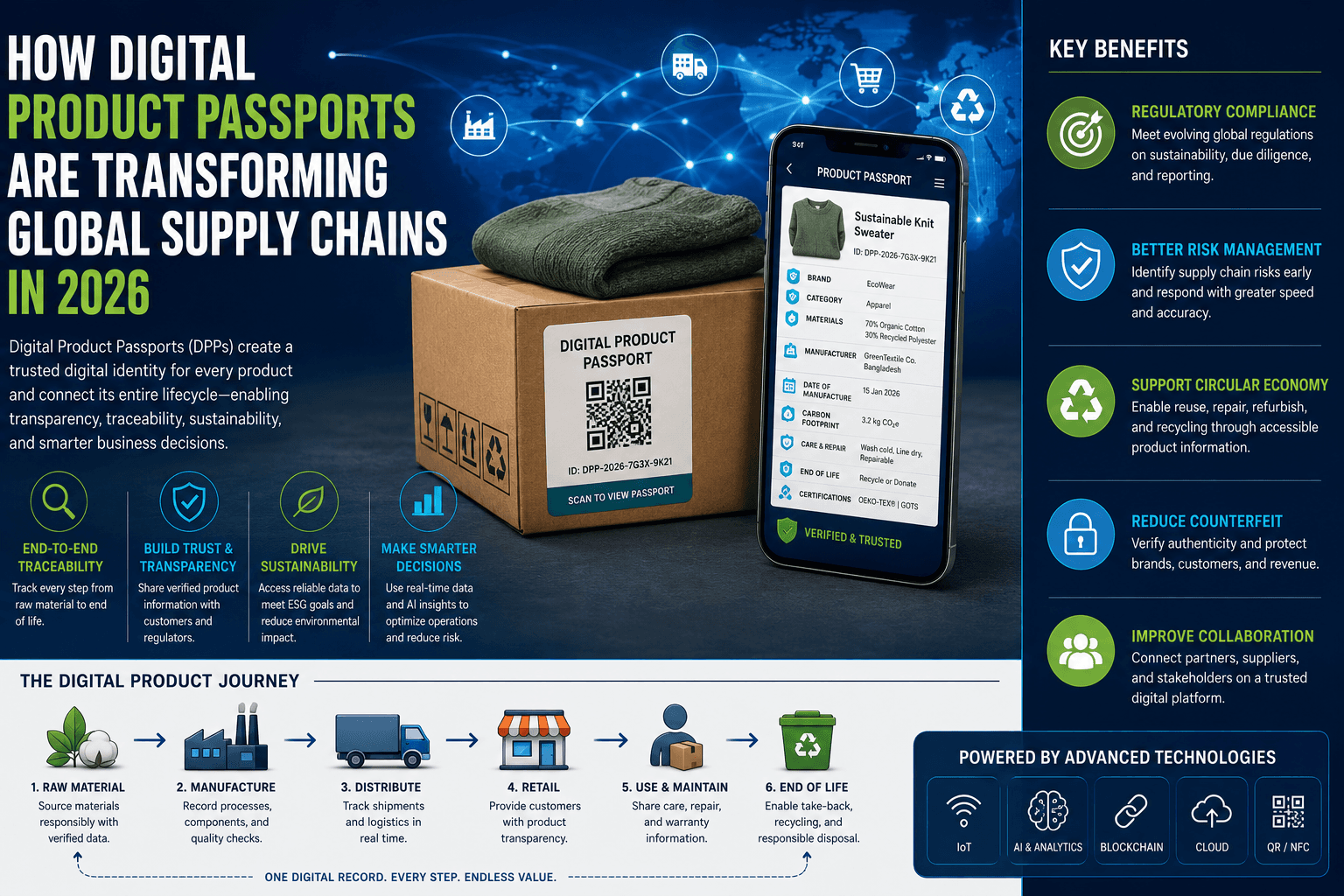
A Digital Product Passport creates a digital record containing relevant information about a product and its lifecycle. Depending on the product and regulatory requirements, this information can include materials, manufacturing details, environmental data, repair information, recycling instructions, and supply-chain information.
In 2026, DPPs are becoming increasingly important as businesses prepare for more transparent and circular supply chains.
What Is a Digital Product Passport?
A Digital Product Passport is a digital identity for a physical product.
It can connect a product to information stored digitally and accessed through technologies such as QR codes, NFC tags, barcodes, or other digital identifiers.
The information can potentially be accessed by different participants in the product lifecycle, including manufacturers, suppliers, distributors, retailers, consumers, repair businesses, recyclers, and regulators.
Instead of relying on disconnected documents and databases, companies can create a more structured digital record of a product.
Why Are Digital Product Passports Becoming Important?
Supply chains traditionally involve many organizations operating across different countries and information systems.
This can make it difficult to trace materials and verify product information.
DPPs can help create greater visibility by connecting product information across multiple stages of the supply chain.
Businesses can potentially use this information to improve:
Traceability
Compliance
Product transparency
Sustainability reporting
Inventory management
Quality control
Recycling
Product authentication
Supporting Supply-Chain Traceability
One of the biggest advantages of DPPs is improved traceability.
A product can be associated with information about its materials, manufacturing process, suppliers, and lifecycle.
If a problem occurs, businesses may be able to identify affected products more efficiently.
For example, if a component is discovered to have a quality issue, companies with better product-level traceability can potentially determine which products contain that component and where those products were distributed.
This can make supply-chain responses faster and more targeted.
Increasing Product Transparency
Consumers increasingly want to understand what they are purchasing.
A Digital Product Passport can provide information about a product's origin, materials, manufacturing, maintenance, and end-of-life options.
For companies, transparency can become a way to strengthen customer trust.
Instead of making broad sustainability claims, businesses can provide more detailed product information that customers can access digitally.
Supporting Circular Economy Models
DPPs can play an important role in the transition toward a circular economy.
A circular economy aims to keep products and materials in use for longer through reuse, repair, refurbishment, remanufacturing, and recycling.
Digital information can make these activities easier.
Repair providers, for example, could access information about product components and maintenance requirements. Recyclers could potentially obtain information about materials and disassembly.
This can help extend product lifecycles and reduce unnecessary waste.
Digital Product Passports and Sustainability
Sustainability is becoming increasingly connected to supply-chain management.
Businesses need better information about the environmental characteristics of their products and materials.
DPPs can provide a structured way to communicate relevant sustainability information throughout the product lifecycle.
Depending on the implementation, product records may contain information about materials, recycled content, environmental impacts, durability, repairability, or recycling options.
This can help businesses and other stakeholders make more informed decisions.
AI Can Make DPP Data More Valuable
Digital Product Passports can become even more powerful when combined with artificial intelligence.
AI systems can analyze product and supply-chain information to identify patterns, detect anomalies, predict demand, and support risk management.
For example, an AI system could analyze information from multiple products and suppliers to identify potential supply-chain disruptions or unusual material patterns.
This transforms DPPs from static information repositories into potential sources of business intelligence.
Improving Regulatory Compliance
Regulatory requirements are one of the major factors driving interest in Digital Product Passports.
Governments and regulatory bodies are increasingly focusing on product sustainability, traceability, materials, environmental impact, and circularity.
DPPs can help businesses organize the information needed to demonstrate compliance with applicable requirements.
However, companies should not assume that simply creating a DPP automatically satisfies every regulatory obligation. Requirements vary by product category, market, and jurisdiction.
Fighting Counterfeit Products
Digital product identities can also help businesses address counterfeiting.
A product can be connected to a unique digital identifier, allowing authorized parties to verify information about its origin or authenticity.
This can be particularly useful for industries where counterfeit products create significant financial, safety, or reputational risks.
Improving Product Lifecycle Management
Traditional product information is often fragmented across different departments and systems.
DPPs can create a more connected information layer around individual products.
Manufacturers can potentially use product data throughout the entire lifecycle, from design and production to distribution, maintenance, resale, and recycling.
This supports a more comprehensive approach to product lifecycle management.
Benefits for Manufacturers
Manufacturers can use Digital Product Passports to improve visibility into their products and supply chains.
Potential benefits include:
Better traceability
Easier documentation
Improved product quality
More efficient recalls
Better sustainability reporting
Stronger customer transparency
Improved lifecycle management
DPPs may also encourage manufacturers to design products with durability, repairability, and recyclability in mind.
Benefits for Retailers and Consumers
Retailers can use DPP information to provide customers with greater product transparency.
Consumers may be able to scan a product and access information about its materials, origin, care instructions, repair options, or recycling.
This can make sustainability information more accessible at the point of purchase.
Challenges of Implementing Digital Product Passports
Despite their potential, DPPs create significant implementation challenges.
Global supply chains involve numerous companies using different technologies and data standards.
Businesses need to determine how information will be collected, verified, shared, secured, and updated.
Other challenges include:
Data quality
Interoperability
Cybersecurity
Supplier participation
Implementation costs
Data ownership
Privacy
Standardization
Companies may also need to modernize legacy systems before they can effectively support DPP initiatives.
Supplier Collaboration Will Be Critical
A Digital Product Passport is only as useful as the information behind it.
Manufacturers often depend on suppliers for material and component information.
This means DPP implementation requires collaboration across the supply chain.
Businesses may need to establish common data requirements and verification processes so that information received from suppliers is accurate and consistent.
Supplier education and technology support may also become important.
Data Security Cannot Be Ignored
Digital product information can contain commercially sensitive information.
Companies need to determine which information should be publicly available and which should only be accessible to authorized supply-chain participants.
Strong authentication, encryption, access controls, and cybersecurity practices will be essential as DPP ecosystems expand.
The Future of Global Supply Chains
Digital Product Passports represent a broader shift toward data-driven supply chains.
Instead of viewing a product as simply a physical object, businesses can increasingly treat it as a combination of physical goods and continuously accessible digital information.
When combined with AI, IoT sensors, blockchain or other verification technologies, cloud platforms, and advanced analytics, DPPs could create more connected supply-chain ecosystems.
This could make global supply chains more transparent, traceable, and responsive.
Conclusion
Digital Product Passports are becoming an important part of the evolution of global supply chains in 2026.
They can help businesses improve traceability, support regulatory requirements, provide product transparency, strengthen circular-economy initiatives, and create better visibility across complex supply networks.
The biggest opportunity is not simply putting a QR code on a product. It is creating a reliable digital information layer that connects manufacturers, suppliers, retailers, consumers, repair providers, recyclers, and regulators.
As product transparency and sustainability requirements continue to grow, businesses that build strong digital product data capabilities early may be better prepared for the next generation of global commerce.