Urban populations are growing, and with them comes one of the biggest challenges facing modern cities: traffic congestion. Roads designed decades ago are struggling to handle increasing numbers of vehicles, while traditional traffic-management systems often rely on fixed schedules and limited data.
Artificial intelligence is changing this model.
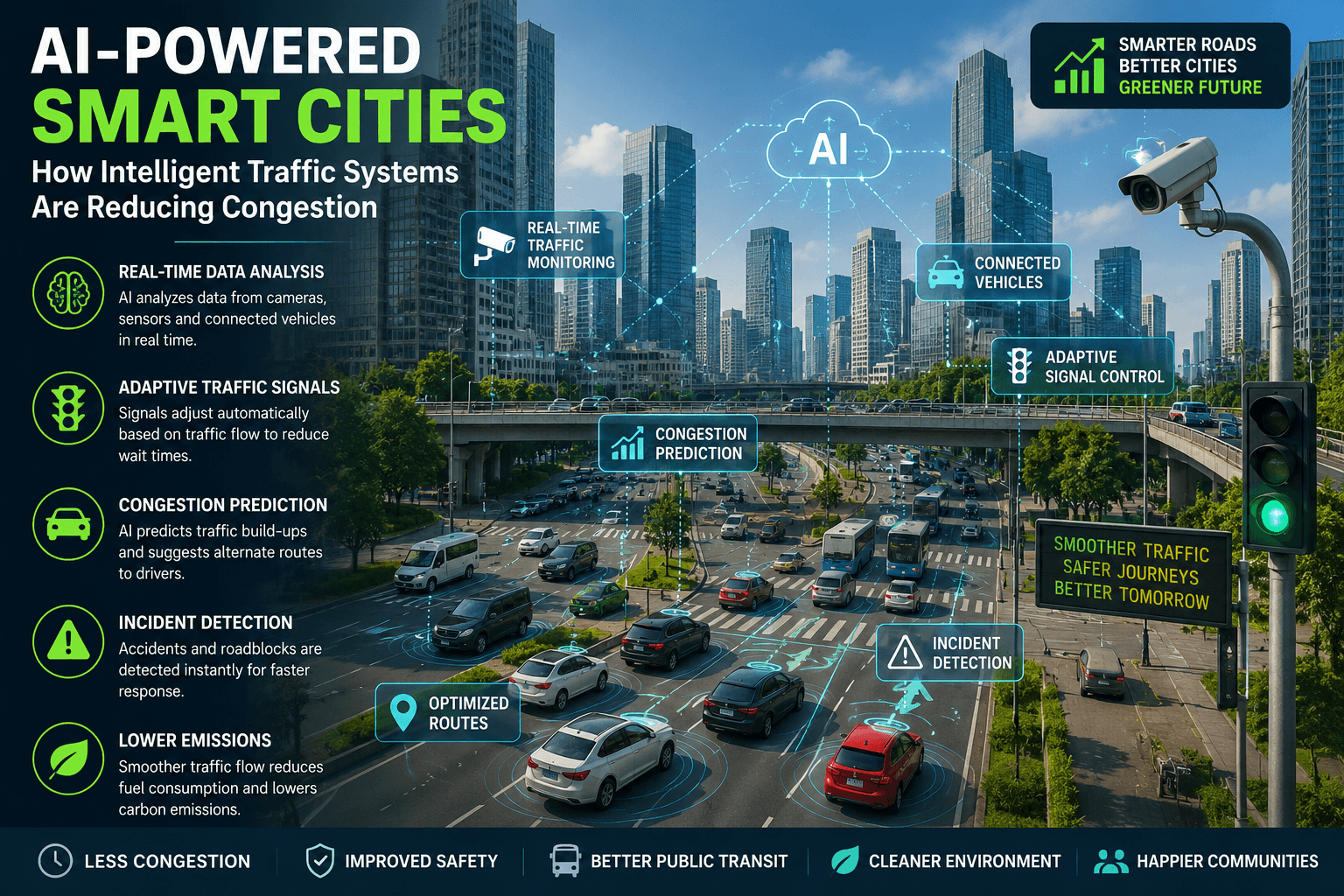
AI-powered intelligent traffic systems can analyze traffic conditions in real time, predict congestion, optimize signals, identify incidents, and help cities manage transportation networks more efficiently. As smart-city technology expands in 2026, intelligent traffic management is becoming an important tool for creating faster, safer, and more sustainable urban transportation systems.
What Are AI-Powered Traffic Systems?
Traditional traffic signals generally operate according to predefined schedules. While these schedules can be adjusted based on historical traffic patterns, they may not respond quickly to unexpected changes.
AI-powered systems can use data from cameras, sensors, connected vehicles, GPS systems, mobile applications, and other sources to understand current traffic conditions.
AI can then analyze this information and help determine:
Where congestion is developing
How traffic is moving through intersections
Which routes are experiencing delays
Whether an accident or obstruction has occurred
How traffic signals should respond
Where congestion is likely to appear next
This creates a more dynamic approach to traffic management.
Real-Time Traffic Signal Optimization
One of the most important applications of AI in smart cities is intelligent traffic signal control.
Instead of keeping a traffic light on a fixed schedule, AI systems can adjust signal timing based on current traffic demand.
For example, if one direction has significantly more vehicles than another, the system may allocate additional green-light time to that direction.
At another intersection, traffic conditions may require a different adjustment.
This ability to respond dynamically can help reduce unnecessary waiting and improve traffic flow.
AI Can Predict Congestion Before It Happens
AI is not limited to reacting to traffic problems.
Machine-learning systems can analyze historical and real-time information to identify patterns associated with congestion.
Factors such as:
Time of day
Weather
Road conditions
Events
Accidents
Construction
Traffic volume
Public holidays
can influence traffic patterns.
AI models can combine these variables to forecast where congestion may develop.
This allows transportation authorities to respond proactively rather than waiting until roads become heavily congested.
Computer Vision Is Transforming Traffic Monitoring
Computer vision allows AI systems to analyze video feeds from traffic cameras.
Instead of relying entirely on human operators, AI can identify traffic patterns and unusual events automatically.
Computer vision can potentially detect:
Vehicle queues
Accidents
Disabled vehicles
Pedestrian movement
Road obstructions
Illegal parking
Unusual traffic behavior
This can help transportation teams respond to incidents more quickly.
AI Helps Emergency Vehicles Move Faster
Traffic congestion can be particularly dangerous when emergency vehicles need to reach their destinations quickly.
Intelligent traffic systems can potentially support emergency response by coordinating signals along an emergency vehicle's route.
Traffic lights may be adjusted to create a clearer path for ambulances, fire trucks, or police vehicles.
Reducing delays of even a few minutes can be valuable during emergencies.
Connected Vehicles Can Provide More Data
The growth of connected vehicles is creating new opportunities for intelligent transportation.
Vehicles can potentially provide information about speed, location, road conditions, braking, and traffic flow.
When combined with infrastructure data, this information can give transportation systems a more detailed understanding of what is happening across a city.
As connected mobility expands, the relationship between vehicles and city infrastructure is likely to become increasingly important.
AI Can Improve Public Transportation
Intelligent traffic management is not only about private vehicles.
AI can also help cities improve buses and other forms of public transportation.
Traffic systems can prioritize buses at certain intersections, analyze delays, optimize routes, and predict passenger demand.
Better traffic flow can improve public transportation reliability, encouraging more people to use buses and other shared mobility options.
Reducing Fuel Consumption and Emissions
Traffic congestion creates environmental costs.
Vehicles stuck in traffic often consume fuel while moving slowly or idling. Improving traffic flow can reduce unnecessary stops and delays.
AI-powered traffic systems can potentially contribute to lower fuel consumption by optimizing signal timing and reducing congestion.
This makes intelligent traffic management relevant not only to transportation planning but also to sustainability goals.
Smart Parking Can Reduce Unnecessary Traffic
Searching for parking can contribute to urban congestion.
AI-powered parking systems can use sensors and data to identify available spaces and provide information to drivers.
Some systems can predict parking availability based on historical demand and current conditions.
By helping drivers locate parking more efficiently, cities can potentially reduce unnecessary driving around busy areas.
AI Can Help Manage Large Events
Concerts, sporting events, festivals, and conferences can cause sudden traffic surges.
Traditional traffic plans may struggle with these temporary changes.
AI can analyze traffic patterns during major events and help transportation authorities adjust signal timing, recommend alternative routes, coordinate public transportation, and manage road access.
This can make cities more resilient to temporary increases in traffic demand.
Data Privacy Must Remain a Priority
AI-powered traffic systems depend heavily on data.
Cameras, sensors, connected vehicles, and mobile technologies can generate significant amounts of information about movement patterns.
Cities therefore need strong privacy and security safeguards.
They should carefully consider:
What information is collected
Why it is collected
How long it is retained
Who can access it
How it is protected
Whether personally identifiable information is necessary
Smart-city innovation should not come at the expense of public privacy.
Cybersecurity Is Another Major Challenge
As transportation systems become connected, cybersecurity becomes increasingly important.
A cyberattack against traffic infrastructure could potentially disrupt transportation networks or create dangerous situations.
Cities need strong cybersecurity measures, continuous monitoring, access controls, system redundancy, and incident-response plans.
The more connected a transportation network becomes, the more important its security infrastructure becomes.
AI Does Not Replace Urban Planning
AI can provide valuable insights, but it does not eliminate the need for human decision-making.
Transportation authorities still need to consider urban development, public policy, accessibility, safety, environmental goals, and community needs.
AI should support planners rather than make every transportation decision independently.
Human oversight remains essential for determining how intelligent systems should be deployed.
The Future of Intelligent Transportation
The next generation of smart cities is likely to combine AI with connected vehicles, IoT sensors, edge computing, 5G and other high-speed networks, digital twins, and autonomous transportation technologies.
This could eventually create transportation networks capable of continuously sensing conditions, predicting demand, and adjusting infrastructure in near real time.
Instead of reacting to congestion after it occurs, cities could increasingly anticipate problems and intervene earlier.
Conclusion
AI-powered traffic systems are changing how cities approach congestion.
By combining real-time data, predictive analytics, computer vision, connected vehicles, and intelligent signal control, cities can build transportation networks that are more responsive to changing conditions.
The goal is not simply to move more cars faster. A truly intelligent transportation system should improve mobility for drivers, pedestrians, public transportation users, cyclists, and emergency services while supporting safety and sustainability.
As cities continue adopting AI technologies in 2026 and beyond, intelligent traffic management could become one of the most visible examples of how artificial intelligence is transforming everyday urban life.
FAQs
1. How does AI help reduce traffic congestion in smart cities?
AI analyzes real-time data from traffic cameras, sensors, GPS systems, and connected vehicles to identify congestion and adjust traffic signals, optimize routes, and predict traffic problems before they become severe.
2. Can AI-powered traffic systems reduce fuel consumption and emissions?
Yes. By reducing unnecessary stops, waiting times, and traffic delays, intelligent traffic systems can help vehicles move more efficiently, potentially lowering fuel consumption and transportation-related emissions.