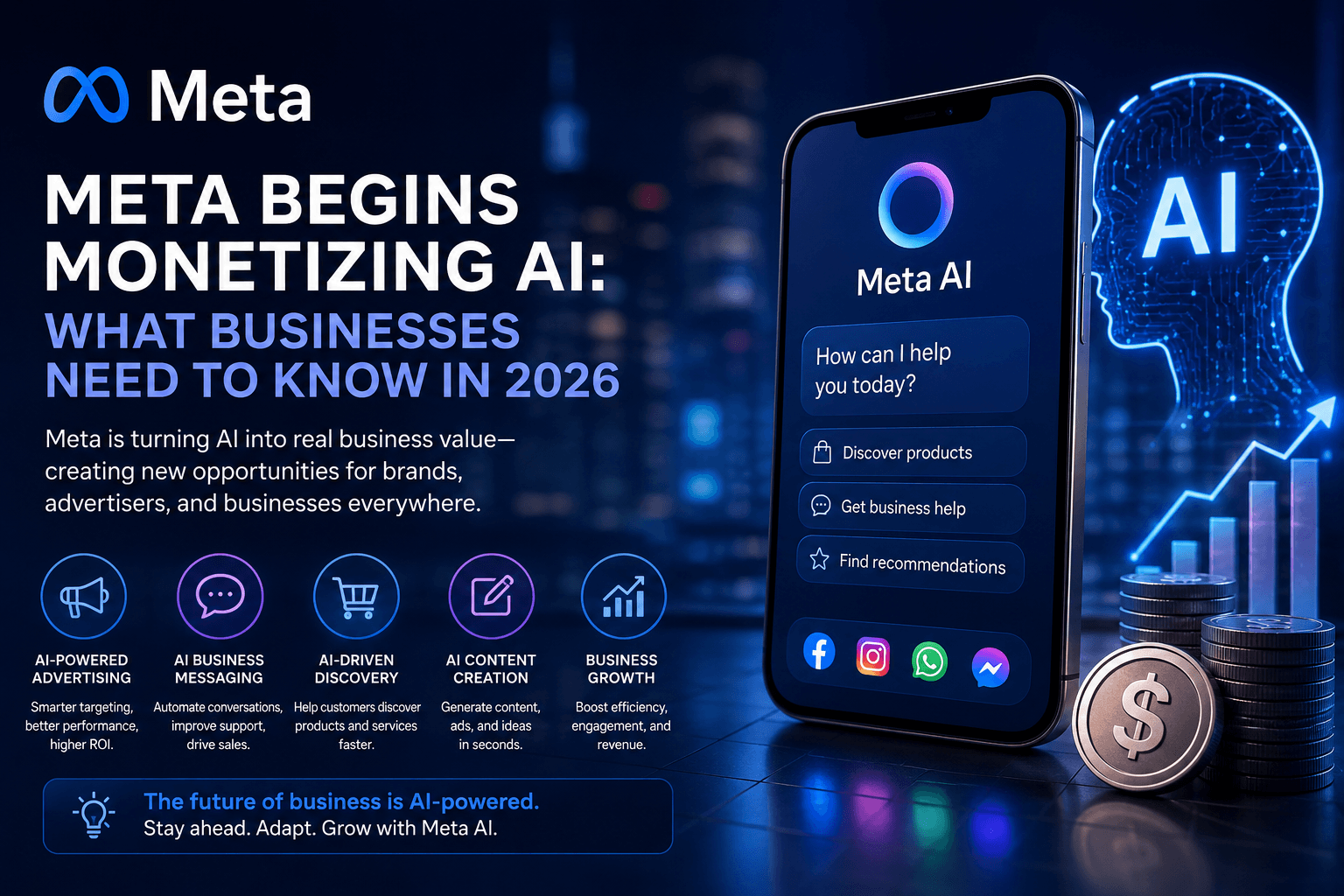

Meta is increasingly turning artificial intelligence from a major technology investment into a potential revenue engine. With AI becoming deeply integrated into Facebook, Instagram, WhatsApp, Messenger, advertising, business messaging, and its broader technology ecosystem, companies need to understand what Meta’s AI monetization strategy could mean for marketing, customer engagement, advertising costs, and digital commerce.
In 2026, businesses are entering a new phase of AI adoption. Instead of AI simply being a behind-the-scenes technology that improves recommendations or content moderation, AI is becoming something businesses can directly interact with, purchase services around, and use to reach customers.
Meta’s AI Strategy Is Expanding Beyond Chatbots
Meta has invested heavily in artificial intelligence for years, particularly in recommendation systems, advertising optimization, content ranking, and computer vision. However, generative AI has expanded the company's ambitions.
Meta AI is increasingly positioned as an assistant capable of answering questions, generating content, helping users discover information, and supporting interactions across Meta's platforms.
For businesses, this creates an important shift.
AI can potentially become another layer between companies and their customers. Instead of users manually searching for products, services, or information, they may increasingly ask AI assistants for recommendations.
This could change how businesses approach digital marketing.
AI Could Create New Advertising Opportunities
Advertising remains one of Meta's most important business models, and AI can make its advertising ecosystem more powerful.
AI can help businesses generate advertising variations, personalize creative content, optimize campaigns, identify audiences, and predict which combinations of messaging and creative assets are likely to perform well.
As these capabilities become more sophisticated, Meta could create additional premium AI-powered advertising products.
For businesses, the advantage is potentially better campaign performance. However, companies may also need to adapt to an environment where AI increasingly determines how advertisements are created, delivered, and optimized.
AI-Powered Business Messaging Could Become More Important
WhatsApp, Messenger, and Instagram messaging are particularly significant for businesses.
Many companies already use messaging platforms for customer inquiries, sales conversations, appointment scheduling, order updates, and support.
AI can transform these interactions by allowing businesses to deploy automated assistants that respond to customers at any time.
For small businesses, this could be especially valuable.
A company that cannot afford a large customer-service team may be able to use AI to handle common questions, recommend products, qualify leads, and assist customers before a human employee becomes involved.
Meta AI May Change Customer Discovery
Traditional online discovery often begins with a search engine. Consumers enter keywords, compare websites, read reviews, and eventually visit a business website or online marketplace.
AI assistants introduce another model.
A customer might instead ask an AI assistant:
“Find me affordable running shoes suitable for long-distance training.”
The assistant could potentially provide recommendations based on available information and user preferences.
This means businesses may increasingly need to think beyond traditional search engine optimization.
The goal could become not only appearing in search results but also becoming recognizable and trustworthy to AI-driven discovery systems.
Businesses Will Need Stronger Brand Data
As AI systems become more involved in customer discovery, accurate business information becomes increasingly important.
Companies should ensure that their product information, pricing, descriptions, reviews, policies, contact information, and other publicly available details are consistent and accurate.
AI systems depend on information to understand businesses and products.
Poor-quality or outdated information can make it harder for customers—or AI systems acting on their behalf—to understand what a company offers.
This makes structured, reliable digital information increasingly valuable.
AI Could Lower the Cost of Content Creation
Generative AI can dramatically accelerate content production.
Businesses can use AI to create initial drafts for:
Social media posts
Product descriptions
Advertising copy
Email campaigns
Video concepts
Images
Customer-service responses
Marketing ideas
However, mass-producing AI-generated content does not automatically create better marketing.
Businesses still need human creativity, brand consistency, fact-checking, and strategic oversight.
The competitive advantage may come from companies that use AI to increase creative capacity rather than simply producing more low-quality content.
Small Businesses Could Benefit Significantly
AI monetization is not only relevant to large corporations.
Small businesses could benefit from affordable AI tools that allow them to perform activities that previously required specialized teams.
For example, a small retailer could potentially use AI for customer conversations, advertising optimization, product recommendations, and content creation.
A local service provider could use AI to answer frequently asked questions, qualify potential customers, and schedule appointments.
This could reduce the technology gap between smaller companies and larger competitors.
Businesses Should Watch Their AI Costs
While AI can reduce some expenses, it can also introduce new costs.
Companies may pay for premium AI tools, advertising features, automated messaging, API usage, data services, or specialized business solutions.
Organizations should therefore evaluate AI based on measurable business outcomes rather than simply adopting every new feature.
Important questions include:
How much time does the AI save?
Does it generate additional revenue?
Does it improve customer satisfaction?
Does it reduce support costs?
Does it improve advertising performance?
What are the implementation and usage costs?
AI adoption should be connected to business objectives.
Privacy and Data Protection Remain Critical
AI-powered customer interactions can involve significant amounts of data.
Businesses need to understand what information is being collected, how it is processed, where it is stored, and what permissions apply.
Customer conversations may contain sensitive business or personal information. Companies should establish clear policies around what employees and automated systems can share with AI tools.
Privacy, security, and regulatory compliance should remain central to AI adoption.
Human Oversight Still Matters
One of the biggest risks of AI-powered business tools is assuming that automated systems are always correct.
AI can produce inaccurate information, misunderstand customer requests, misunderstand context, or generate inappropriate responses.
Businesses should establish clear escalation processes.
Simple questions can be handled automatically, while complex, sensitive, or high-value situations should be transferred to human employees.
This hybrid approach can combine AI efficiency with human judgment.
Meta's AI Monetization Could Reshape Digital Marketing
As Meta expands its AI ecosystem, businesses may need to rethink their digital strategies.
Advertising, social media content, messaging, customer service, commerce, and discovery could increasingly become connected through AI.
The companies that adapt early may have an advantage because they can experiment, collect performance data, and develop AI workflows before competitors fully catch up.
However, businesses should avoid treating Meta's AI tools as a replacement for strategy.
AI is a capability—not a complete marketing strategy.
What Businesses Should Do in 2026
Businesses can prepare for Meta's expanding AI ecosystem by focusing on several priorities.
First, experiment with AI-powered advertising and content tools while carefully tracking results.
Second, evaluate whether AI-powered messaging can improve customer service or lead generation.
Third, improve the accuracy and consistency of online business information.
Fourth, train employees to use AI responsibly and effectively.
Finally, establish clear privacy, security, and human-oversight policies.
The Bigger Picture
Meta's growing focus on AI monetization signals a broader transformation in digital business.
AI is moving from an experimental technology toward a core commercial infrastructure. Platforms such as Meta are finding ways to connect AI with advertising, messaging, content creation, recommendations, and commerce.
For businesses, the opportunity is substantial—but so is the need to adapt.
Companies that learn how to combine Meta's AI capabilities with strong branding, quality data, human creativity, and responsible governance will be better positioned to compete in an increasingly AI-driven digital economy.