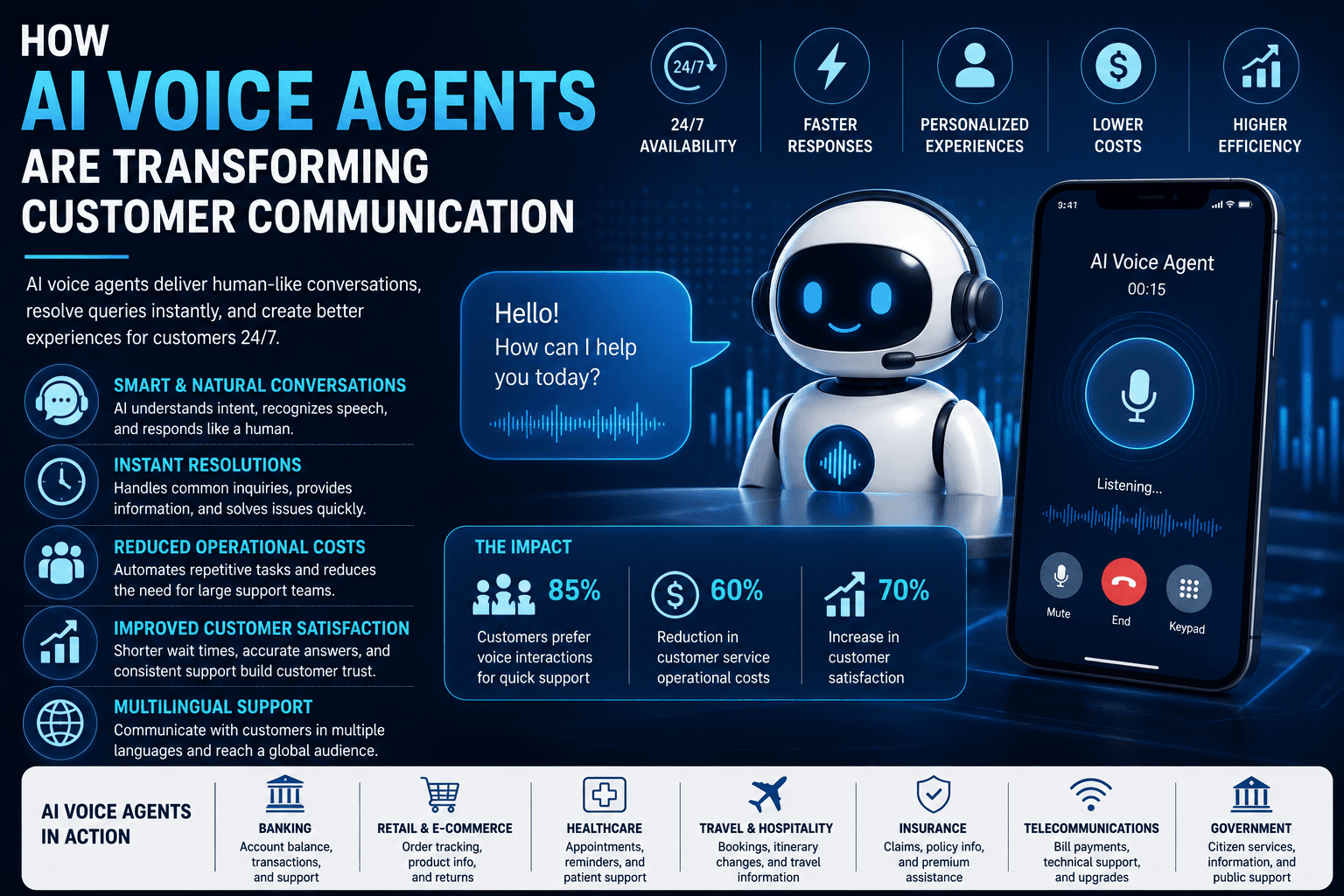
Customer communication is entering a new era as businesses adopt AI voice agents to handle conversations by phone. Unlike traditional automated phone systems that rely on rigid menus and predefined responses, modern AI voice agents can understand natural language, maintain conversational context, answer questions, and complete certain tasks in real time.
For businesses, this technology offers an opportunity to provide faster customer support, extend service availability, reduce repetitive workloads, and create more scalable communication operations.
What Are AI Voice Agents?
AI voice agents are artificial intelligence systems designed to communicate with people through spoken language.
They combine technologies such as:
Speech recognition
Natural language processing
Large language models
Text-to-speech technology
Conversational AI
Business-system integrations
A traditional phone system might ask:
"Press 1 for sales. Press 2 for support."
An AI voice agent can allow the customer to simply say:
"I need to change my delivery date."
The system can understand the request, retrieve relevant information, and potentially complete the required action.
Why AI Voice Agents Are Gaining Attention
Businesses receive large volumes of customer calls every day.
Many calls involve repetitive questions and predictable processes.
Examples include:
Order status
Appointment scheduling
Account information
Billing questions
Returns
Product information
Basic troubleshooting
Booking requests
AI voice agents can handle many of these interactions without requiring a human representative to answer every call.
This can help businesses scale customer communication without increasing staffing at the same rate.
24/7 Customer Communication
One of the biggest advantages is availability.
Human customer-service teams typically operate according to staffing schedules.
AI voice agents can potentially operate around the clock.
Customers can receive assistance outside traditional business hours, including evenings, weekends, and holidays.
This is especially valuable for global businesses serving customers across multiple time zones.
More Natural Conversations
Earlier automated phone systems were often frustrating because customers had to follow specific commands.
Modern AI voice agents are designed to understand conversational language.
A customer might say:
"My package was supposed to arrive yesterday, but I haven't received it yet."
Instead of requiring the customer to navigate several menus, the AI can interpret the request and determine what information is needed.
This can make automated interactions feel more natural.
AI Voice Agents Can Maintain Context
A major improvement is conversational context.
If a customer explains a problem, the AI can use information from the conversation rather than repeatedly asking the same questions.
For example:
Customer: "I want to change my appointment."
AI: "Sure. Which appointment would you like to change?"
Customer: "The one I booked for Friday morning."
The system can maintain the relevant context and continue the conversation.
This can reduce friction and improve the customer experience.
Integration With Business Systems
AI voice agents become much more useful when connected to enterprise systems.
They can potentially interact with:
CRM platforms
Order-management systems
Scheduling software
Payment platforms
Customer databases
Knowledge bases
Ticketing systems
For example, a voice agent could verify a customer's identity, retrieve an order, check its status, and provide an update during the same call.
With appropriate permissions, it may also initiate approved actions.
AI Voice Agents in Customer Service
Customer support is one of the strongest use cases.
AI voice agents can handle routine questions and escalate complex cases to human representatives.
A potential workflow is:
Customer calls → AI understands request → AI retrieves information → AI resolves issue → Human escalation if necessary
This allows customer-service employees to focus on more complicated problems.
AI Voice Agents in Sales
Voice AI can also support sales teams.
Agents can help with:
Lead qualification
Appointment scheduling
Follow-up calls
Product information
Customer outreach
Initial prospect conversations
For example, an AI agent could contact a qualified lead, ask predefined questions, determine whether the prospect meets certain criteria, and schedule a meeting with a sales representative.
Human sales professionals can then spend more time on high-value conversations.
AI Voice Agents in Healthcare
Healthcare organizations can potentially use voice AI for administrative communication.
Examples include:
Appointment scheduling
Reminders
Basic administrative questions
Follow-up communication
Patient information routing
However, healthcare applications require particularly strong privacy, security, and human oversight because of the sensitivity of health-related information.
AI Voice Agents in Financial Services
Banks, insurers, and financial companies can use voice AI for certain customer-service workflows.
Potential applications include:
Account inquiries
Appointment scheduling
Payment reminders
Basic policy information
Service requests
Financial organizations must apply strict authentication, security, privacy, and regulatory controls when deploying voice AI.
Reducing Customer-Service Costs
AI voice agents can potentially reduce the cost of handling repetitive interactions.
Instead of requiring human employees for every routine request, organizations can automate high-volume, predictable conversations.
However, cost reduction shouldn't be the only objective.
Poorly designed voice automation can frustrate customers and damage brand perception.
The real goal should be:
Lower operational friction while maintaining or improving customer experience.
Faster Response Times
Customers often dislike waiting in call queues.
AI voice agents can answer calls immediately, potentially reducing wait times.
For simple requests, customers may receive answers within seconds.
This can improve customer satisfaction and reduce pressure on human support teams during periods of high demand.
Multilingual Customer Communication
AI voice technology can also make multilingual support easier to scale.
Businesses serving international customers may be able to offer voice assistance across multiple languages without maintaining separate teams for every language.
However, organizations should carefully evaluate pronunciation, cultural nuances, accuracy, and customer expectations before deploying multilingual voice systems.
AI Voice Agents and Personalization
AI can use customer context to make conversations more personalized.
With appropriate permissions, a voice agent may access:
Customer history
Previous support interactions
Purchase information
Account preferences
Service history
This allows the system to provide more relevant responses.
For example, instead of asking a customer to explain their entire history, an AI agent can review previous interactions before responding.
The Rise of AI Voice Agents and AI Agents
Voice AI is increasingly becoming part of the broader AI-agent ecosystem.
A voice agent may not simply answer a question. It may be able to perform actions.
For example:
Customer request → Understand intent → Check account → Complete approved action → Confirm result
This moves voice AI from conversational automation toward action-oriented customer service.
Human Escalation Remains Important
AI voice agents should not attempt to handle every situation.
Customers may need human assistance when dealing with:
Complex complaints
Sensitive financial issues
Legal matters
High-value transactions
Emotional situations
Exceptions outside standard policies
A strong system should recognize when it has reached its limits and transfer the conversation smoothly to a human representative.
Security and Privacy Challenges
Voice AI creates new security considerations.
Businesses must protect:
Customer identities
Account information
Payment details
Conversation data
Authentication information
Personal information
Organizations should implement appropriate identity verification, access controls, encryption, monitoring, and data-retention policies.
Voice systems can also face risks such as impersonation and voice-based social engineering, making security especially important.
Measuring AI Voice-Agent Performance
Businesses should measure voice AI using meaningful customer and operational metrics.
Useful metrics include:
Call resolution rate
Average handling time
Customer satisfaction
Escalation rate
First-contact resolution
Call abandonment rate
Cost per interaction
Accuracy
Successful task completion
These metrics can help organizations determine whether voice AI is genuinely improving customer communication.
Challenges Businesses Should Consider
AI voice agents offer significant opportunities, but implementation requires careful planning.
Common challenges include:
Accuracy
AI may misunderstand accents, background noise, or unusual requests.
Customer Trust
Some customers may prefer knowing whether they're speaking with an AI.
Complex Conversations
AI can struggle with ambiguous or highly emotional situations.
Integration
Voice agents need reliable access to business systems to complete meaningful tasks.
Compliance
Certain industries have strict requirements regarding customer communications and data handling.
The Future of Customer Communication
AI voice agents are likely to become increasingly integrated with other customer-service technologies.
A customer might begin a conversation through a website, continue through messaging, and then speak with an AI voice agent without having to repeat the entire issue.
AI systems could maintain context across channels and provide a more connected customer experience.
The future may therefore move from isolated customer-service channels toward continuous, intelligent conversations across multiple platforms.
Conclusion
AI voice agents are transforming customer communication by making conversations more scalable, responsive, and automated.
They can handle routine requests, provide 24/7 assistance, retrieve information, schedule appointments, and complete approved tasks while allowing human employees to focus on complex customer needs.
The most successful businesses won't simply replace call-center employees with AI. Instead, they will create a hybrid customer-service model in which AI handles routine interactions and humans provide expertise, empathy, and judgment when they matter most.
As conversational AI and AI-agent technology continue to improve, voice-based customer communication could become one of the most important frontiers in enterprise automation.