
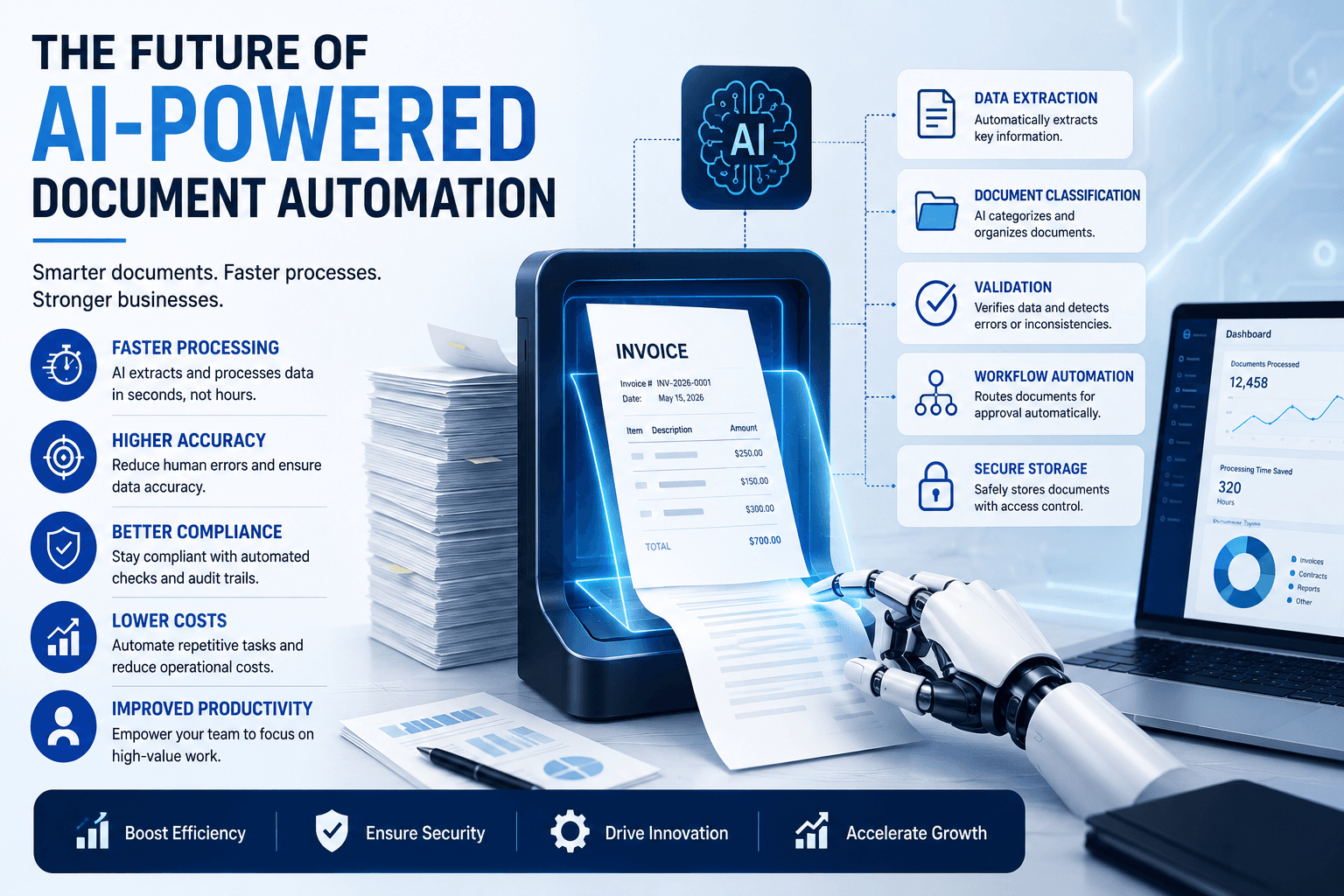
Documents remain at the center of modern business operations. Contracts, invoices, reports, forms, applications, purchase orders, compliance records, and customer files all contain information that organizations need to process every day.
Yet document management has traditionally involved significant manual work.
Employees spend hours reading documents, extracting information, entering data, searching for clauses, verifying details, and routing files between departments.
AI-powered document automation is changing this process.
By combining artificial intelligence, optical character recognition, natural language processing, machine learning, generative AI, and workflow automation, organizations can transform documents from static files into structured, actionable business information.
What Is AI-Powered Document Automation?
AI-powered document automation uses artificial intelligence to understand, process, classify, extract, summarize, and route information from documents.
Traditional document automation might rely on predefined templates and rules.
AI-powered systems can handle a much broader range of document types and formats.
They can potentially:
Read documents
Extract important information
Classify files
Summarize content
Identify missing information
Compare documents
Detect anomalies
Extract contract clauses
Route documents automatically
Enter information into business systems
This makes document processing more intelligent and adaptable.
Why Businesses Need Intelligent Document Processing
Organizations produce enormous volumes of documents.
A single enterprise may process thousands of invoices, contracts, purchase orders, claims, applications, and compliance documents every month.
Manual processing creates several problems.
Slow Processing
Employees must spend time reviewing and entering information.
Human Errors
Manual data entry can introduce mistakes.
High Operating Costs
Large document-processing teams can require substantial resources.
Limited Visibility
Important information may remain trapped inside unstructured files.
Compliance Risk
Missed information or deadlines can create regulatory and financial problems.
AI-powered automation can address many of these challenges.
From OCR to Intelligent Document Understanding
Optical character recognition has been used for years to convert scanned documents into machine-readable text.
But OCR alone doesn't truly understand a document.
Modern AI systems can go further by interpreting relationships between pieces of information.
For example, an intelligent system processing an invoice can identify:
Vendor name
Invoice number
Date
Line items
Tax
Total amount
Payment terms
Purchase order reference
The system can then transfer that information into an accounting or ERP platform.
This is a major step beyond simply converting an image into text.
AI-Powered Contract Processing
Contracts are one of the most valuable applications.
Legal and procurement teams may need to review thousands of agreements for important terms.
AI can help identify clauses relating to:
Renewal dates
Termination
Liability
Indemnification
Data protection
Intellectual property
Pricing
Service levels
Confidentiality
AI can also summarize agreements and compare them against organizational standards.
This allows legal professionals to spend more time on judgment and negotiation rather than searching through documents.
Automating Invoice Processing
Finance teams process enormous numbers of invoices.
Pp several steps:
Invoice received → Information extracted → Purchase order matched → Exceptions identified → Approval routed → Accounting system updated
If everything matches expected information, the invoice can follow an automated workflow.
If something doesn't match, the system can send it to an employee for review.
This exception-based approach can significantly reduce repetitive finance work.
AI in Healthcare Documentation
Healthcare organizations manage large amounts of documentation.
AI-powered document processing can help organize information from forms, reports, records, and administrative documents.
Potential applications include:
Patient documentation
Insurance claims
Referral forms
Medical billing
Administrative records
Because healthcare information is highly sensitive, privacy, security, and human oversight are essential.
AI-Powered Document Search
Traditional document repositories often require users to remember filenames, folders, or keywords.
AI can make document search more conversational.
Instead of searching for a filename, an employee could ask:
"Find all supplier contracts that expire within the next six months."
The system can identify relevant documents and extract the information needed to answer the question.
This turns document repositories into searchable knowledge systems.
Generative AI Is Changing Document Work
Generative AI is adding new capabilities to document automation.
It can help generate:
Document summaries
Executive briefings
Contract explanations
Report drafts
Email responses
Compliance summaries
Meeting preparation materials
For example, an executive could ask:
"Summarize the key financial risks mentioned in these documents."
AI can process relevant information and produce an initial summary for human review.
Document Automation and AI Agents
AI agents could take document automation even further.
Instead of simply extracting information, an agent could manage an entire workflow.
For example:
Receive a document.
Identify its type.
Extract relevant information.
Validate the information.
Check business rules.
Update an enterprise system.
Notify the appropriate employee.
Escalate exceptions.
This transforms document processing from a single automated task into an intelligent workflow.
Improving Compliance
Documents often contain important regulatory obligations.
AI can help organizations identify relevant provisions and monitor deadlines.
For example, a compliance team could use AI to identify contracts containing specific data-processing requirements.
The system could also flag documents that appear to lack required information.
This can help organizations manage compliance at scale.
However, AI outputs should be reviewed appropriately when regulatory or legal consequences are involved.
Reducing Manual Data Entry
One of the biggest benefits of document automation is reducing repetitive data entry.
Instead of employees copying information from documents into multiple systems, AI can extract and transfer data automatically.
This can:
Reduce errors
Save employee time
Accelerate workflows
Improve data consistency
Lower processing costs
Employees can then focus on exceptions and higher-value activities.
Connecting Documents to Enterprise Systems
Document automation becomes significantly more powerful when connected to existing business applications.
AI systems can potentially integrate with:
ERP platforms
CRM systems
Accounting software
HR platforms
Procurement systems
Legal technology
Customer-service platforms
This creates a workflow where information moves automatically from documents into operational systems.
Human-in-the-Loop Automation
AI should not necessarily make every document-related decision independently.
Human review is especially important for high-risk situations.
A practical workflow can be:
AI processes → AI identifies exceptions → Human reviews → Approved action executes
This allows businesses to automate routine cases while maintaining human oversight for complex or sensitive documents.
Security and Privacy Challenges
Documents can contain extremely sensitive information.
Examples include:
Customer data
Financial information
Employee records
Contracts
Intellectual property
Legal information
Organizations must therefore consider:
Encryption
Access controls
Data retention
Audit trails
Privacy regulations
AI model security
Vendor security
AI document systems should operate within clearly defined permissions.
The Importance of Document Data Quality
AI cannot completely solve poor-quality information.
Organizations with fragmented document repositories, inconsistent naming conventions, outdated files, and duplicate records may face challenges during implementation.
Before deploying advanced automation, companies should consider:
Centralizing important documents
Removing unnecessary duplicates
Establishing metadata standards
Defining access permissions
Creating document governance policies
Better document organization creates a stronger foundation for AI.
Measuring the Business Impact
Organizations should evaluate document automation based on measurable outcomes.
Useful metrics include:
Processing time
Cost per document
Data-entry errors
Automation rate
Exception rate
Approval time
Employee hours saved
Compliance issues
Workflow completion time
The goal isn't simply to process more documents.
It is to process them faster, more accurately, and with better visibility.
Challenges Businesses Need to Address
AI-powered document automation has enormous potential, but implementation can be difficult.
Common challenges include:
Unstructured Documents
Documents vary significantly in format and quality.
AI Accuracy
Systems can misunderstand ambiguous information.
Legacy Systems
Older applications may be difficult to integrate.
Data Privacy
Sensitive documents require strong security controls.
Employee Adoption
Teams need training and clear workflows.
Governance
Organizations need policies defining when AI can act independently and when human approval is required.
The Future of AI Document Automation
The future of document management is likely to move beyond simply storing and searching files.
Documents may increasingly become active sources of business intelligence.
AI systems could continuously monitor documents, identify important changes, extract obligations, update enterprise systems, and trigger workflows.
For example, when a contract is renewed, an AI system could automatically update relevant records, notify stakeholders, and schedule the next review.
This creates a more connected and intelligent document ecosystem.
Conclusion
AI-powered document automation is transforming how organizations handle information.
From contracts and invoices to reports, forms, compliance records, and customer documents, AI can reduce manual processing and turn unstructured information into actionable business data.
The next generation of document automation will go beyond extraction. AI agents will increasingly understand documents, reason about their contents, connect them to business processes, and help complete workflows.
Organizations that combine AI with strong data governance, security, enterprise integration, and human oversight will be better positioned to turn document-heavy processes into faster, smarter, and more efficient operations.