

Introduction
Artificial intelligence has already changed the way businesses operate. From customer support chatbots and predictive analytics to automated marketing campaigns, AI has become an essential part of digital transformation. However, the next major evolution is far more significant than automation alone. Businesses around the world are now preparing for the rise of AI employees—intelligent digital workers capable of completing complex tasks, collaborating with human teams, and continuously learning from experience.
Unlike traditional software, AI employees are designed to function much like human workers. They can understand natural language, analyze information, plan multiple steps ahead, communicate with customers, generate reports, manage workflows, and even make recommendations based on business goals. Instead of simply following pre-programmed instructions, these autonomous AI workers can adapt to changing situations, making them valuable assets for organizations of all sizes.
The concept of AI employees is rapidly moving from research labs into real-world business environments. Companies are experimenting with AI-powered project managers, marketing assistants, financial analysts, HR coordinators, and customer service representatives that can work around the clock without fatigue. While human expertise remains irreplaceable in areas such as creativity, emotional intelligence, leadership, and ethical decision-making, AI employees are becoming trusted partners that enhance productivity rather than replace it.
Industry analysts believe that by 2027, businesses will increasingly build hybrid workforces where humans and AI employees collaborate to achieve common objectives. Organizations that embrace this transition responsibly will gain a competitive advantage through faster operations, lower costs, improved decision-making, and better customer experiences. Those that ignore the shift may struggle to keep pace with more agile competitors.
This article explores what AI employees are, how they work, why businesses are investing in them, the industries leading adoption, the benefits and challenges they present, and what the future workplace may look like as intelligent digital workers become an integral part of everyday business operations.
What Are AI Employees?
AI employees are advanced software agents designed to perform tasks that traditionally require human workers. Unlike simple automation tools that follow fixed rules, AI employees combine reasoning, machine learning, memory, natural language processing, and workflow automation to complete complex assignments with minimal supervision.
These digital workers can understand instructions written in everyday language, gather information from multiple business systems, analyze data, produce reports, answer questions, and execute workflows across different departments. Because they continuously learn from previous interactions and organizational knowledge, they become more efficient over time.
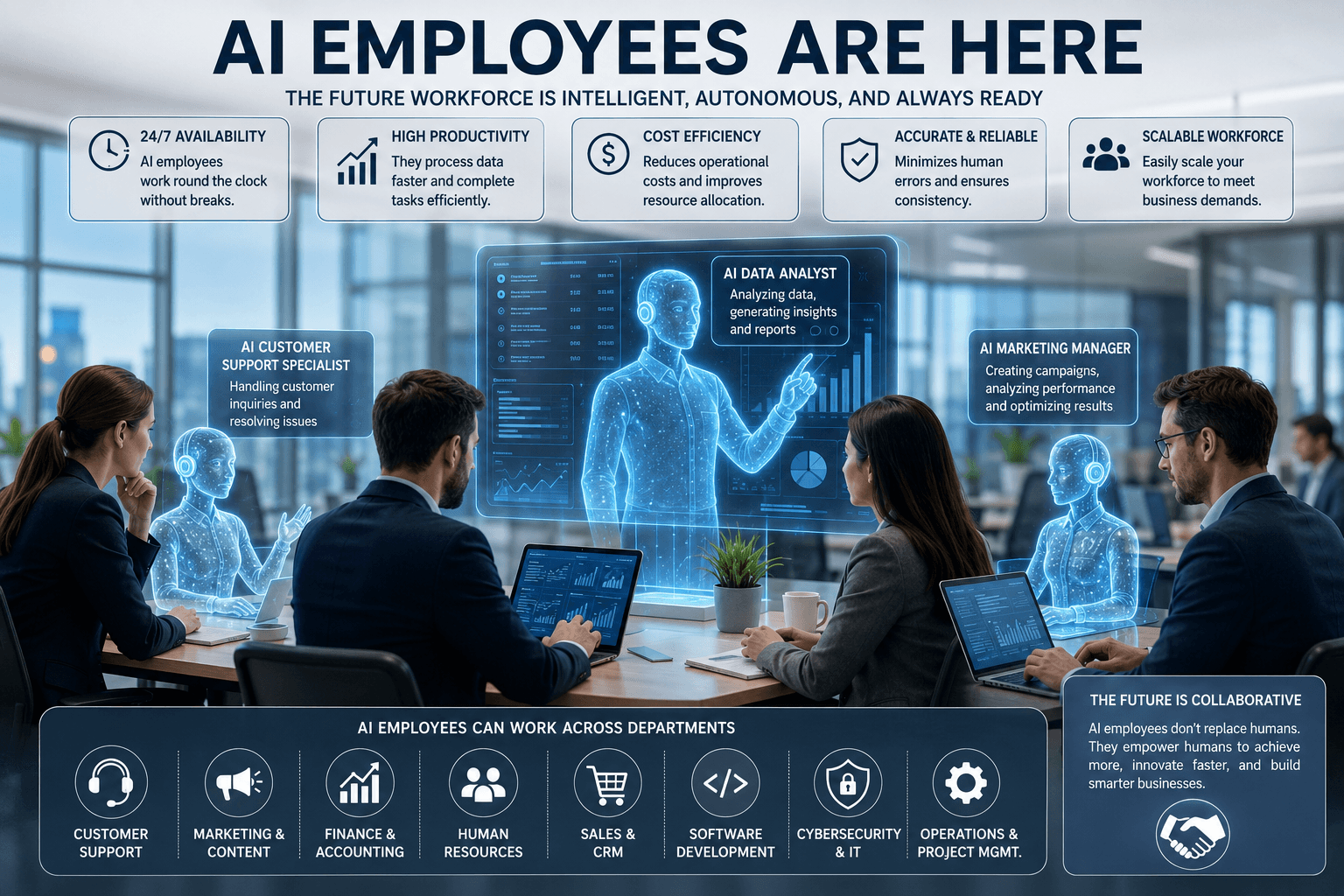
For example, an AI marketing employee can create campaign ideas, analyze customer engagement metrics, recommend advertising strategies, write content, and monitor performance without requiring constant human input. Similarly, an AI finance assistant can review expenses, generate financial summaries, detect unusual transactions, and forecast future revenue trends.
Rather than replacing human professionals, AI employees are designed to eliminate repetitive work so employees can focus on strategic planning, innovation, relationship building, and creative problem-solving.
Why Businesses Are Investing in AI Employees
The business environment is becoming increasingly competitive. Companies are expected to deliver faster services, reduce operational costs, personalize customer experiences, and make data-driven decisions in real time. Meeting these expectations using traditional workforce models alone is becoming increasingly difficult.
AI employees provide organizations with an opportunity to improve efficiency without sacrificing quality.
Some of the primary reasons businesses are adopting AI employees include:
Increased Productivity
AI employees can process enormous volumes of information in seconds. Tasks that might take a human employee several hours—such as preparing reports, organizing documents, or analyzing datasets—can often be completed by AI within minutes.
Twenty-Four-Hour Availability
Unlike human employees, AI workers do not require breaks, vacations, or sleep. They can continue operating around the clock, ensuring customer support, system monitoring, and business processes remain active regardless of time zones.
Lower Operational Costs
Hiring, training, and managing employees involves significant expenses. While AI implementation requires investment, businesses often reduce long-term administrative costs by automating repetitive workflows and allowing human teams to focus on higher-value activities.
Faster Decision-Making
Modern AI systems analyze historical data, current market conditions, and operational performance simultaneously. This enables managers to receive real-time recommendations supported by data rather than relying solely on intuition.
Improved Customer Experience
AI employees can respond instantly to customer inquiries, personalize recommendations, monitor customer satisfaction, and provide multilingual assistance, leading to higher engagement and improved service quality.
Key Technologies Behind AI Employees
Several advanced technologies work together to make AI employees effective in modern organizations.
Large Language Models
Large language models enable AI employees to understand conversations, summarize documents, answer questions, and generate high-quality written content.
Long-Term Memory
Persistent memory allows AI employees to remember previous interactions, customer preferences, project histories, and organizational knowledge. This creates more personalized and context-aware responses.
Machine Learning
Machine learning algorithms enable AI employees to improve performance over time by learning from new data and identifying patterns that humans may overlook.
Workflow Automation
AI employees integrate with enterprise software such as CRM platforms, accounting systems, project management tools, and communication applications to complete multi-step business processes automatically.
Predictive Analytics
By analyzing historical information, AI employees can forecast demand, identify risks, estimate future sales, and recommend proactive business decisions.
Types of AI Employees in Modern Organizations
Businesses are deploying specialized AI employees across nearly every department.
AI Customer Service Specialists
Customer service AI employees answer inquiries, process returns, recommend products, resolve billing questions, schedule appointments, and escalate complex cases to human representatives when necessary.
AI Marketing Managers
Marketing AI employees create blog articles, email campaigns, social media content, advertising copy, SEO recommendations, keyword research, and performance reports while continuously optimizing campaigns based on analytics.
AI Financial Analysts
Finance-focused AI employees review financial records, prepare monthly reports, detect anomalies, forecast budgets, monitor expenses, and assist with investment analysis.
AI Human Resources Coordinators
Human resources AI employees help recruit candidates, screen resumes, schedule interviews, prepare onboarding documents, answer employee questions, and monitor workforce trends.
AI Sales Representatives
Sales AI employees qualify leads, send personalized follow-up emails, recommend products, analyze customer behavior, and support account managers with detailed insights.
How AI Employees Improve Decision-Making
One of the greatest strengths of AI employees is their ability to process vast amounts of business data in real time. Instead of relying on assumptions or outdated reports, AI employees analyze customer behavior, financial performance, operational metrics, and market trends to provide actionable recommendations. Managers can use these insights to make faster and more accurate decisions. For example, an AI employee can identify declining sales in a specific region, recommend marketing adjustments, and forecast the potential impact before the business experiences significant losses.
AI Employees and the Future of Remote Work
Remote and hybrid work models have become permanent for many organizations, making collaboration more challenging. AI employees help bridge communication gaps by scheduling meetings, summarizing discussions, assigning tasks, tracking deadlines, and ensuring team members remain aligned regardless of location. They can also provide instant access to company knowledge, reducing delays and improving productivity across distributed teams.
Measuring the Return on Investment (ROI) of AI Employees
Businesses investing in AI employees should establish clear performance metrics to evaluate success. Key performance indicators include time saved, operational cost reductions, customer satisfaction scores, employee productivity, workflow completion speed, and revenue growth. By continuously measuring these metrics, organizations can optimize AI implementation and ensure long-term business value.
Skills Employees Need in the AI Workplace
As AI employees become common, human workers will need to develop complementary skills. Critical thinking, creativity, leadership, emotional intelligence, communication, and problem-solving will become increasingly valuable. Employees who understand how to collaborate with AI systems will be more productive and better prepared for future workplace demands. Continuous learning and digital literacy will become essential career advantages.
Common Myths About AI Employees
Many people believe AI employees will completely replace human workers, but this is one of the biggest misconceptions. In reality, AI is designed to automate repetitive and data-intensive tasks while allowing humans to focus on strategic and creative responsibilities. Another myth is that AI never makes mistakes. Although AI is highly capable, it still requires human oversight to ensure accuracy, fairness, and compliance with business policies.
Building Trust Between Humans and AI Employees
Successful AI adoption depends on trust. Employees need confidence that AI systems are transparent, secure, and designed to support rather than replace them. Organizations can build trust by clearly explaining how AI makes decisions, protecting sensitive business data, providing regular training, and maintaining human oversight for critical decisions. Transparent governance encourages greater acceptance and more effective collaboration.
Preparing Your Business for an AI Workforce
Companies should not wait until AI employees become standard across every industry. Preparing today begins with identifying repetitive processes, evaluating existing workflows, investing in secure AI platforms, training employees, and creating ethical AI policies. Starting with small pilot projects allows organizations to measure results, refine strategies, and expand AI adoption with minimal disruption.
AI Employees Beyond 2027
The next generation of AI employees will be significantly more intelligent and autonomous. Future systems may negotiate supplier contracts, coordinate complex business projects, manage digital supply chains, oversee regulatory compliance, and collaborate with AI employees from partner organizations. As AI reasoning, memory, and multimodal capabilities continue to improve, businesses will increasingly rely on digital employees as strategic partners rather than simple automation tools.
Final Thoughts
AI employees represent a new chapter in enterprise technology. They are transforming how businesses operate by improving efficiency, reducing repetitive work, enhancing decision-making, and enabling organizations to scale faster than ever before. While challenges related to ethics, security, and governance remain, the potential benefits far outweigh the risks when AI is implemented responsibly. Businesses that embrace AI employees today will be better positioned to innovate, compete, and thrive in the rapidly evolving digital economy. By combining human creativity with AI intelligence, organizations can build a smarter, more productive, and more resilient workforce for the future.