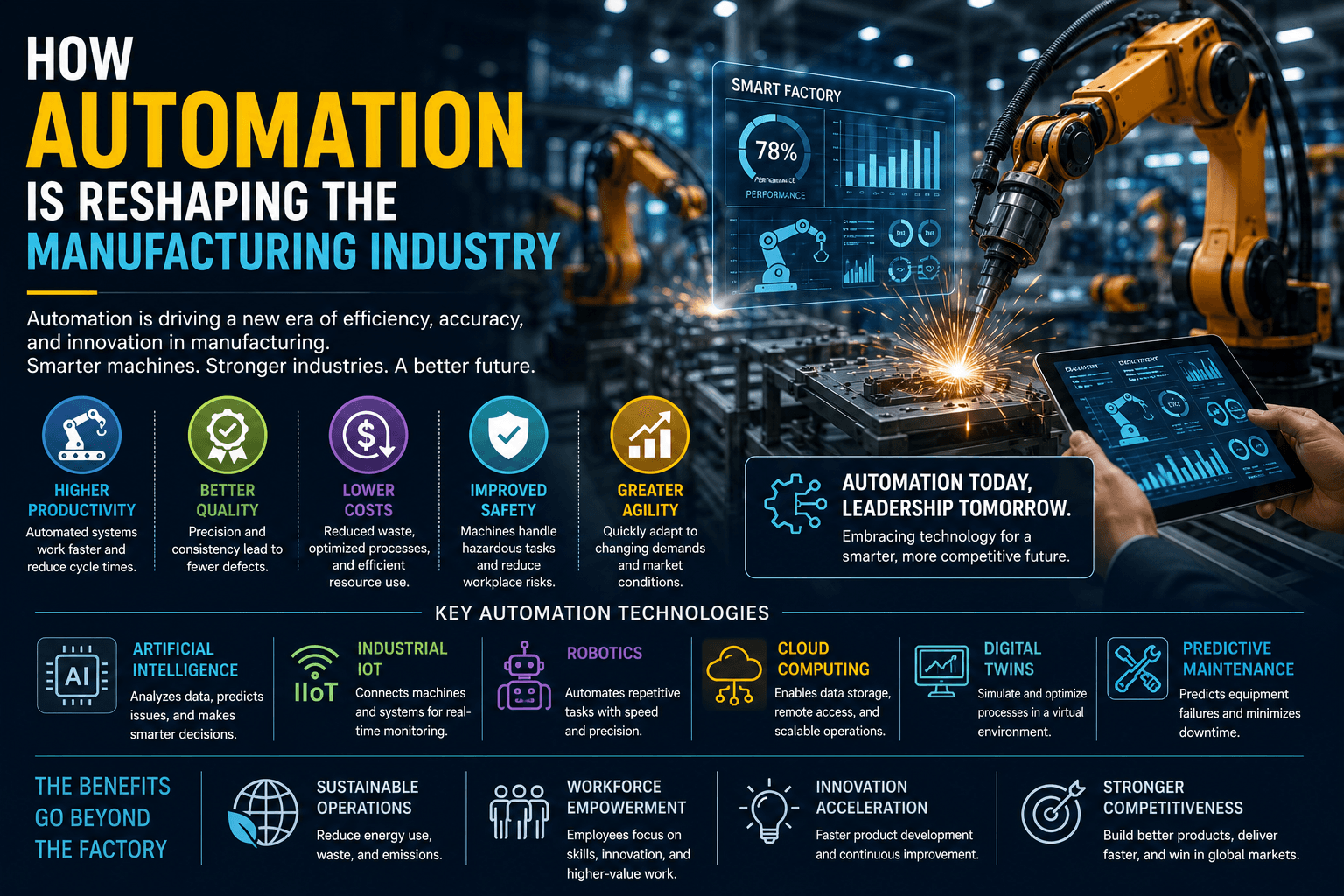

Automation has become one of the most powerful forces transforming the manufacturing industry. In 2026, manufacturers worldwide are embracing advanced technologies to improve productivity, enhance product quality, reduce operational costs, and respond more quickly to changing market demands. From robotic assembly lines and artificial intelligence to smart sensors and predictive maintenance, automation is driving a new era of industrial innovation.
As global competition intensifies, businesses are investing in intelligent manufacturing systems that combine automation with real-time data analysis. These technologies are helping organizations increase efficiency while building more resilient and sustainable operations.
The Rise of Smart Manufacturing
Traditional manufacturing relied heavily on manual labor and isolated production systems. Today, factories are becoming connected ecosystems where machines, software, and people work together seamlessly.
Smart manufacturing integrates technologies such as:
Artificial Intelligence (AI)
Industrial Internet of Things (IIoT)
Robotics
Cloud Computing
Machine Learning
Digital Twins
Edge Computing
Together, these technologies create intelligent production environments capable of making data-driven decisions with minimal human intervention.
Robotics Improve Productivity
Industrial robots continue to play a central role in modern manufacturing.
Robots can perform repetitive tasks with remarkable speed and precision, including:
Welding
Assembly
Painting
Packaging
Material handling
Quality inspection
By automating routine processes, manufacturers improve consistency, reduce errors, and allow employees to focus on higher-value responsibilities.
Artificial Intelligence Optimizes Production
AI is helping manufacturers analyze vast amounts of production data in real time.
Machine learning algorithms identify inefficiencies, predict equipment failures, optimize production schedules, and recommend process improvements.
Instead of reacting to problems after they occur, manufacturers can proactively address issues before they impact production.
Predictive Maintenance Reduces Downtime
Unexpected equipment failures can be extremely costly.
Predictive maintenance uses sensors and AI to continuously monitor machinery performance.
By detecting signs of wear before breakdowns occur, manufacturers can:
Schedule maintenance efficiently
Reduce downtime
Extend equipment lifespan
Lower repair costs
Improve operational reliability
This proactive approach significantly improves overall equipment effectiveness.
Digital Twins Transform Factory Operations
Digital twin technology creates virtual replicas of machines, production lines, and entire factories.
Manufacturers use these digital models to:
Simulate production changes
Test new processes
Identify bottlenecks
Improve efficiency
Reduce implementation risks
Digital twins allow companies to optimize operations before making physical modifications.
Better Quality Control
Automation is improving product quality through advanced inspection systems.
Computer vision technologies powered by AI can detect tiny defects that may be difficult for humans to identify consistently.
Automated quality control reduces waste, improves customer satisfaction, and strengthens brand reputation.
Supply Chain Integration
Modern manufacturing extends far beyond factory floors.
Automation enables seamless integration between suppliers, warehouses, logistics providers, and production facilities.
Real-time data sharing improves:
Inventory management
Demand forecasting
Supplier coordination
Delivery scheduling
Production planning
Greater visibility across the supply chain helps businesses respond more effectively to market changes.
Sustainability Through Automation
Manufacturers are increasingly using automation to reduce environmental impact.
Smart systems optimize:
Energy consumption
Water usage
Raw material efficiency
Waste reduction
Carbon emissions
Sustainable manufacturing practices help organizations lower operating costs while supporting environmental goals.
Workforce Transformation
Automation is changing the nature of manufacturing jobs rather than simply replacing workers.
Demand continues growing for employees with skills in:
Robotics programming
Data analytics
AI systems
Equipment maintenance
Industrial cybersecurity
Process optimization
Upskilling and continuous learning are becoming essential for manufacturing professionals.
Challenges of Automation
Despite its benefits, automation presents several challenges.
Manufacturers must consider:
High implementation costs
Cybersecurity risks
Employee training
Technology integration
Equipment upgrades
Data management
Successful digital transformation requires careful planning and long-term investment.
The Future of Manufacturing
Over the coming years, factories will become increasingly intelligent, connected, and autonomous.
Emerging technologies such as collaborative robots (cobots), generative AI, advanced analytics, and autonomous logistics systems will continue improving efficiency while creating new business opportunities.
Manufacturers that embrace innovation today will be better prepared for future market demands and global competition.
Conclusion
Automation is reshaping the manufacturing industry by increasing productivity, improving quality, reducing costs, and supporting sustainable operations. Technologies including robotics, artificial intelligence, predictive maintenance, digital twins, and smart factories are helping businesses build more agile and resilient production systems.
As manufacturing continues its digital transformation, organizations that invest in automation, workforce development, and innovation will strengthen their competitive advantage and drive long-term growth in the evolving global economy.