
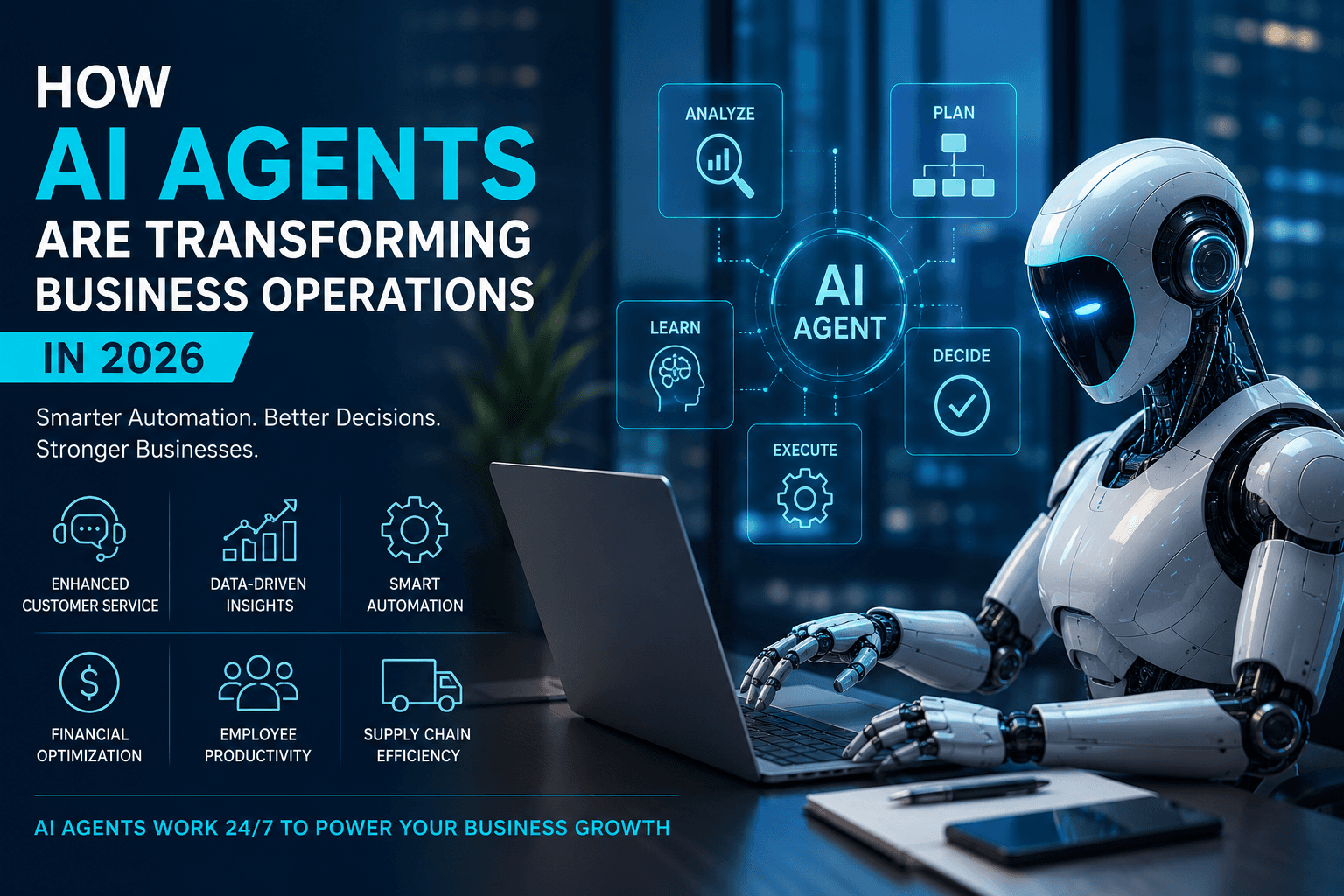

Artificial intelligence has evolved rapidly over the past few years, but 2026 marks a turning point. Businesses are no longer relying solely on AI chatbots or predictive analytics. Instead, they are deploying AI agents—autonomous systems capable of planning, reasoning, executing tasks, and collaborating with both humans and other AI systems. These intelligent agents are reshaping how organizations operate, helping companies improve efficiency, reduce costs, and unlock new opportunities for growth.
From customer service and finance to marketing, logistics, and software development, AI agents are becoming indispensable business partners. Organizations that embrace this technology early are positioning themselves to gain a significant competitive advantage in an increasingly digital economy.
What Are AI Agents?
AI agents are intelligent software systems designed to perform tasks with minimal human intervention. Unlike traditional automation tools that follow predefined rules, AI agents can analyze data, make decisions, adapt to changing conditions, and complete multi-step workflows independently.
Modern AI agents combine large language models, machine learning, workflow automation, and integrations with business applications to perform complex tasks such as:
Responding to customer inquiries
Managing calendars and scheduling
Conducting market research
Creating reports
Monitoring business performance
Generating marketing content
Analyzing financial data
Supporting software development
Instead of simply answering questions, AI agents actively help businesses achieve specific objectives.
Why AI Agents Are Gaining Momentum
Several technological advances have accelerated AI adoption in 2026.
First, AI models have become significantly more capable of understanding context and handling complex reasoning. Second, businesses now have easier access to cloud computing and AI infrastructure, reducing implementation costs. Finally, organizations have accumulated vast amounts of operational data, allowing AI agents to generate more accurate insights and recommendations.
These developments enable companies of all sizes—not just large enterprises—to integrate AI into everyday operations.
Transforming Customer Service
Customer support remains one of the most impactful areas for AI agents.
Instead of relying on scripted chatbots, businesses now use intelligent agents capable of understanding customer intent, accessing company knowledge bases, processing requests, and resolving issues across multiple channels.
Modern AI agents can:
Answer customer questions instantly
Handle returns and refunds
Track orders
Recommend products
Schedule appointments
Escalate complex cases when necessary
This results in faster response times, improved customer satisfaction, and reduced operational costs while allowing human representatives to focus on more complex interactions.
Revolutionizing Marketing
Marketing teams are increasingly using AI agents to streamline campaigns and improve decision-making.
AI agents can:
Analyze consumer behavior
Identify emerging trends
Generate personalized email campaigns
Optimize advertising budgets
Create SEO-friendly content
Suggest keywords
Monitor campaign performance
Produce actionable reports
Rather than replacing marketers, AI empowers them to focus on strategy, creativity, and brand building.
Improving Financial Operations
Finance departments are also benefiting from intelligent automation.
AI agents help organizations:
Process invoices
Detect unusual transactions
Forecast cash flow
Generate financial summaries
Monitor spending patterns
Assist with budgeting
Reduce manual data entry
These capabilities improve accuracy while enabling finance professionals to spend more time on strategic planning and business growth.
Enhancing Human Resources
Human resources teams are adopting AI agents to improve hiring and employee management.
Common applications include:
Screening resumes
Scheduling interviews
Answering employee questions
Supporting onboarding
Tracking training progress
Measuring employee engagement
Assisting with performance management
AI reduces administrative workloads while creating a smoother experience for both employees and job candidates.
Smarter Supply Chain Management
Supply chains have become increasingly complex due to global market fluctuations and changing customer expectations.
AI agents help businesses:
Predict demand
Optimize inventory levels
Monitor shipments
Detect supply disruptions
Recommend alternative suppliers
Improve delivery planning
With real-time data analysis, organizations can reduce delays, lower inventory costs, and improve operational resilience.
Supporting Business Decision-Making
Executives are increasingly relying on AI agents to analyze business performance.
Instead of manually reviewing spreadsheets and dashboards, decision-makers can ask AI agents questions such as:
Which products generated the highest profit this month?
Why did sales decline in a specific region?
Which customers are most likely to churn?
Where should marketing investments increase?
AI agents gather information from multiple systems and present clear, data-driven insights, allowing leaders to make faster and better-informed decisions.
Increasing Productivity Across Departments
One of the greatest strengths of AI agents is their ability to automate repetitive tasks.
Employees spend less time on activities such as:
Preparing reports
Organizing documents
Scheduling meetings
Searching for information
Updating databases
Drafting routine communications
This frees employees to focus on innovation, collaboration, and solving higher-value business challenges.
Challenges Businesses Must Address
While AI agents offer significant benefits, successful implementation requires careful planning.
Organizations should consider:
Data privacy and security
AI governance policies
Regulatory compliance
Employee training
Human oversight
Ethical AI usage
System integration
AI should complement human expertise rather than operate without appropriate supervision, particularly in high-stakes decisions.
Preparing for an AI-Driven Future
Businesses that invest in AI literacy, digital transformation, and workforce development will be better positioned for long-term success.
Rather than viewing AI as a replacement for employees, leading organizations see it as a productivity partner that enhances human capabilities. Employees who learn to collaborate effectively with AI agents will become increasingly valuable in the modern workplace.
Companies should begin with clearly defined business objectives, pilot projects, and measurable performance indicators before expanding AI initiatives across the organization.
Conclusion
AI agents are transforming business operations in 2026 by enabling organizations to automate complex workflows, improve customer experiences, enhance decision-making, and increase operational efficiency. As AI technology continues to advance, businesses that embrace intelligent automation responsibly will be better equipped to compete in a rapidly evolving global marketplace.
The future of business will not be driven by humans or AI alone—it will be shaped by effective collaboration between people and intelligent AI agents. Organizations that build this partnership today will be well positioned to lead tomorrow's economy.