Introduction
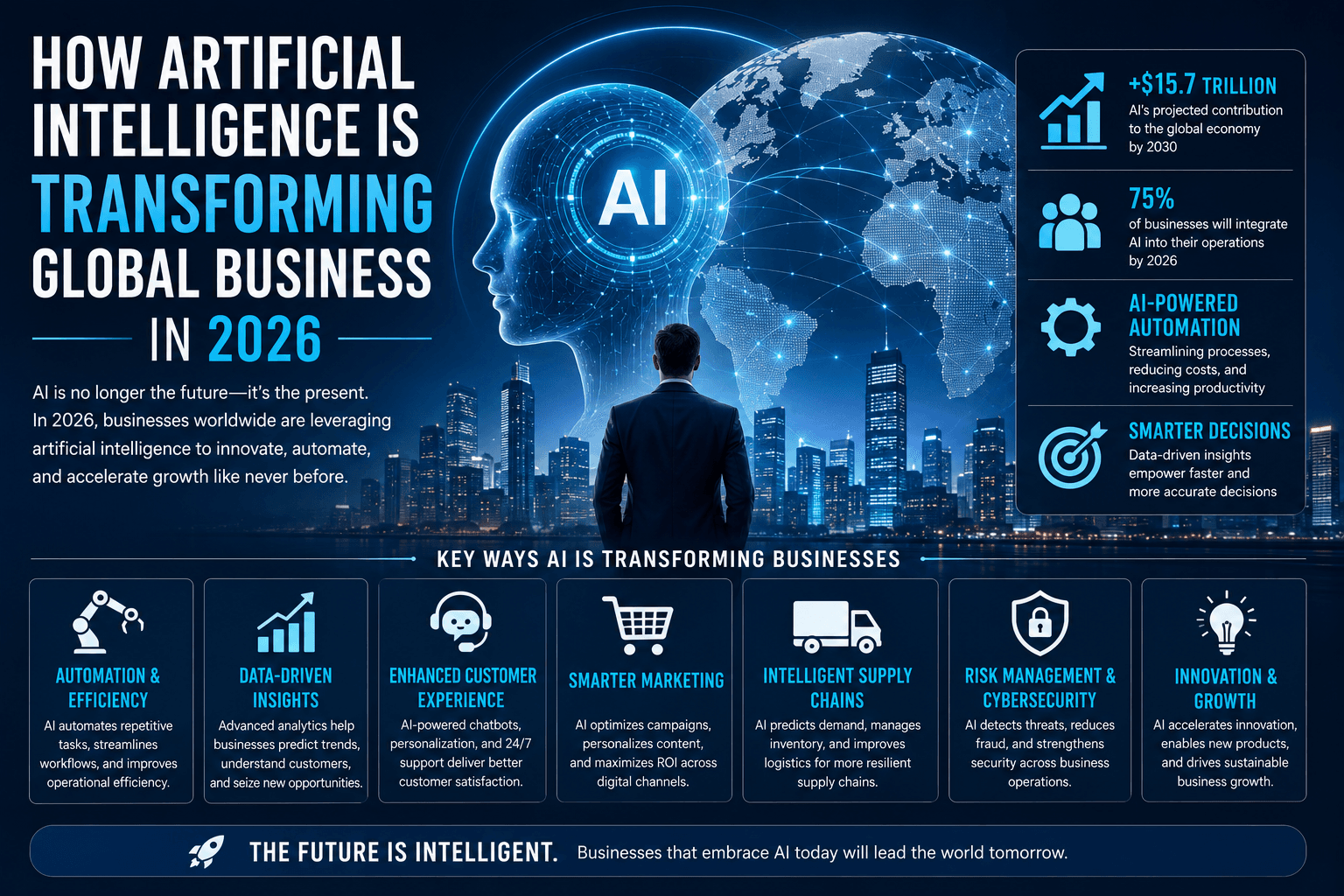
Artificial Intelligence (AI) has become one of the most influential technologies shaping the global business landscape in 2026. What was once considered an emerging innovation is now a core component of business strategy across industries. Organizations of all sizes are integrating AI into their operations to improve efficiency, reduce costs, enhance customer experiences, and gain a competitive advantage.
From automating repetitive tasks to analyzing massive datasets in real time, AI is helping businesses make smarter decisions and respond quickly to changing market conditions. Companies in finance, healthcare, manufacturing, retail, logistics, education, and professional services are embracing AI-powered solutions to accelerate growth and improve productivity.
As global competition intensifies and digital transformation continues, understanding the impact of AI has become essential for business leaders seeking sustainable success.
AI Is Revolutionizing Business Operations
One of the biggest advantages of AI is its ability to automate routine business processes. Administrative tasks that previously required significant human effort can now be completed more efficiently using intelligent software.
Businesses are using AI to:
Automate repetitive workflows
Process invoices and documents
Schedule meetings
Manage inventory
Monitor supply chains
Improve financial reporting
Automation allows employees to focus on strategic and creative work, increasing overall productivity while reducing operational costs.
Smarter Decision-Making Through Data Analytics
Modern businesses generate enormous amounts of data every day. AI-powered analytics platforms help organizations transform that information into actionable insights.
These systems can identify:
Customer purchasing patterns
Market trends
Sales opportunities
Financial risks
Operational inefficiencies
By analyzing data in real time, AI enables leaders to make faster, more informed decisions that improve business performance.
Enhancing Customer Experience
Customer expectations continue to evolve, and AI is helping businesses deliver more personalized and responsive service.
Common applications include:
AI chatbots providing 24/7 support
Personalized product recommendations
Automated customer service
Voice assistants
Predictive customer support
These technologies improve response times, increase customer satisfaction, and strengthen brand loyalty while reducing service costs.
Transforming Marketing Strategies
AI is reshaping digital marketing by enabling businesses to better understand customer behavior and optimize campaigns.
Marketing teams use AI to:
Segment audiences
Personalize email campaigns
Generate content ideas
Optimize advertising
Predict customer preferences
Analyze campaign performance
Data-driven marketing helps businesses improve return on investment while delivering more relevant experiences to customers.
Improving Supply Chain Management
Global supply chains have become increasingly complex, making efficiency more important than ever.
AI helps businesses:
Forecast demand
Optimize inventory
Improve logistics
Reduce delivery delays
Monitor supplier performance
Identify potential disruptions
Smarter supply chain management reduces waste, lowers costs, and improves customer satisfaction.
Supporting Financial Services
Financial institutions continue expanding their use of AI to improve security, efficiency, and customer service.
Applications include:
Fraud detection
Credit risk assessment
Investment analysis
Automated financial reporting
Personalized banking services
Regulatory compliance monitoring
AI enables financial organizations to process information more accurately while reducing operational risk.
Accelerating Innovation
Artificial intelligence is also helping businesses innovate faster.
AI-powered tools assist research and development teams by:
Simulating product designs
Analyzing customer feedback
Identifying emerging trends
Supporting software development
Improving product testing
Organizations that leverage AI for innovation can bring products to market more quickly while responding effectively to customer needs.
AI in Human Resources
Human resource departments are increasingly using AI to streamline recruitment and employee development.
AI supports HR through:
Resume screening
Candidate matching
Employee engagement analysis
Performance management
Learning recommendations
Workforce planning
These capabilities improve hiring decisions while creating better employee experiences.
Strengthening Cybersecurity
As cyber threats continue evolving, AI has become an important tool for protecting business systems.
AI-powered cybersecurity solutions can:
Detect unusual activity
Identify security threats
Respond to attacks quickly
Monitor network performance
Protect sensitive business data
Proactive security measures help businesses reduce financial losses and maintain customer trust.
Challenges Businesses Must Address
Although AI provides significant advantages, successful implementation requires careful planning.
Organizations should consider:
Data privacy
Cybersecurity risks
Ethical AI practices
Employee training
Regulatory compliance
System integration
Responsible AI adoption ensures businesses maximize benefits while minimizing potential risks.
Future Outlook
Artificial intelligence is expected to become even more integrated into business operations over the coming years.
Emerging trends include:
Advanced generative AI
Autonomous business processes
AI-powered decision support
Intelligent robotics
Predictive business analytics
Industry-specific AI platforms
Companies that invest strategically in AI today will be better positioned to adapt to future technological advances and evolving customer expectations.
Conclusion
Artificial intelligence is transforming global business in 2026 by improving operational efficiency, enhancing customer experiences, strengthening decision-making, and accelerating innovation. Businesses across every industry are discovering new ways to leverage AI to increase productivity, reduce costs, and create long-term value.
While successful AI adoption requires thoughtful planning, ethical governance, and ongoing investment in people and technology, its potential benefits are substantial. Organizations that embrace artificial intelligence as part of their broader digital transformation strategy will be better equipped to compete in a rapidly changing global marketplace and achieve sustainable growth in the years ahead.
FAQs
1. How is artificial intelligence transforming global business in 2026?
AI is improving productivity, automating repetitive tasks, enhancing customer experiences, and enabling smarter business decisions through advanced data analysis.
2. Which industries benefit the most from AI?
Healthcare, finance, retail, manufacturing, logistics, education, and marketing are among the industries seeing significant AI-driven transformation.
3. Why are businesses investing more in AI?
Companies invest in AI to reduce costs, improve efficiency, increase revenue, personalize customer experiences, and gain a competitive advantage.
4. How does AI improve customer service?
AI-powered chatbots, virtual assistants, and predictive analytics provide faster responses, personalized recommendations, and 24/7 customer support.
5. Can small businesses benefit from AI?
Yes. Affordable AI tools help small businesses automate workflows, improve marketing, manage inventory, and analyze customer data.
6. What role does AI play in business decision-making?
AI analyzes large datasets, identifies trends, predicts outcomes, and supports leaders with data-driven insights.
7. Is AI replacing human workers?
AI is automating repetitive tasks, but it is also creating new jobs that require creativity, strategy, technical expertise, and human oversight.
8. How does AI enhance cybersecurity?
AI detects threats in real time, identifies unusual activity, automates security monitoring, and helps prevent cyberattacks.
9. What are AI agents in business?
AI agents are intelligent systems that can perform complex tasks, make decisions, and collaborate with employees to improve productivity.
10. How is AI changing supply chain management?
AI improves demand forecasting, inventory management, route optimization, and operational efficiency across supply chains.
11. Can AI improve marketing performance?
Yes. AI personalizes campaigns, predicts customer behavior, optimizes advertising, and increases conversion rates.
12. What challenges do businesses face when adopting AI?
Common challenges include implementation costs, data privacy concerns, employee training, cybersecurity risks, and regulatory compliance.
13. How does AI support financial management?
AI automates accounting tasks, detects fraud, forecasts cash flow, and improves financial planning.
14. Why is AI important for global competitiveness?
Businesses using AI can innovate faster, operate more efficiently, and adapt quickly to changing market conditions.
15. What is generative AI?
Generative AI creates new content such as text, images, videos, software code, and business reports based on user prompts.
16. How does AI improve employee productivity?
AI automates routine work, summarizes information, assists with research, and enables employees to focus on strategic tasks.
17. Is AI secure for business operations?
AI can be secure when organizations implement strong cybersecurity measures, governance policies, and responsible AI practices.
18. What skills will businesses need in the AI era?
AI literacy, data analysis, cybersecurity, prompt engineering, digital leadership, and critical thinking are increasingly valuable skills.
19. What AI trends should businesses watch in 2026?
Key trends include autonomous AI agents, multimodal AI, predictive analytics, AI-powered cybersecurity, and industry-specific AI solutions.
20. What is the future of AI in global business?
AI is expected to become a core part of business strategy, driving innovation, automation, personalized customer experiences, and sustainable long-term growth.