
Artificial intelligence is revolutionizing how businesses operate. In 2026, companies are using AI workflow automation to eliminate repetitive tasks, reduce operational costs, and improve productivity. From processing invoices to managing customer support and employee onboarding, AI is helping organizations save millions while allowing employees to focus on high-value work.
Businesses that embrace AI automation are becoming faster, more efficient, and more competitive in today's digital economy.
What Is AI Workflow Automation?
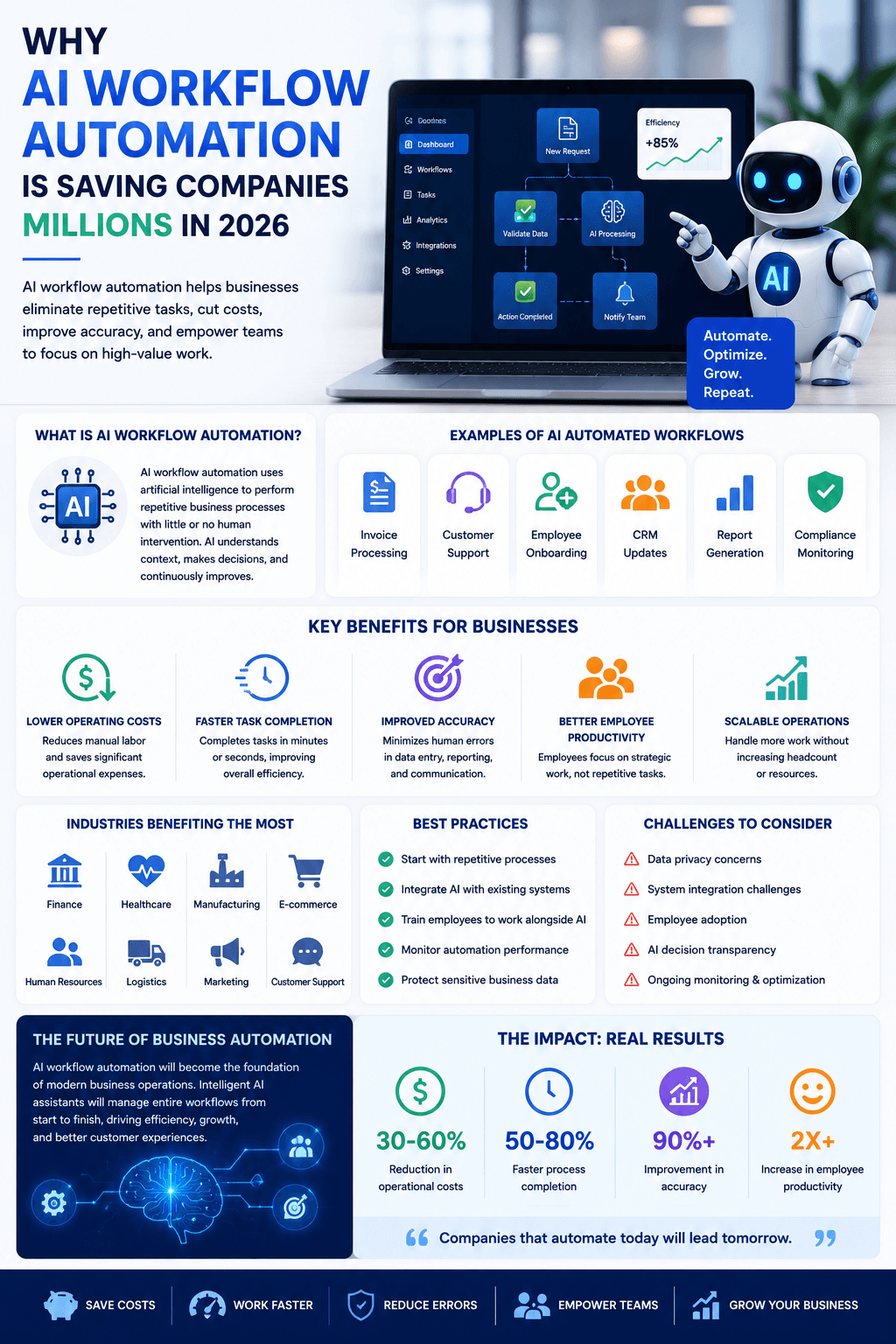
AI workflow automation uses artificial intelligence to perform repetitive business processes with little or no human intervention. Unlike traditional automation, AI can understand context, make decisions, and continuously improve its performance.
Examples include:
Automatically approving invoices
Processing customer service requests
Scheduling meetings
Managing employee onboarding
Updating CRM records
Generating reports
Monitoring compliance
AI handles these tasks quickly and accurately, reducing manual effort.
Why Businesses Are Adopting AI Automation
Companies face increasing pressure to improve efficiency while reducing costs. AI automation helps organizations streamline operations without sacrificing quality.
Businesses are investing in AI because it:
Reduces operational expenses
Improves productivity
Minimizes human errors
Speeds up business processes
Enhances customer satisfaction
Key Benefits
1. Lower Operating Costs
AI reduces the need for repetitive manual work, saving businesses significant labor costs.
2. Faster Task Completion
Processes that once took hours can now be completed in minutes or even seconds.
3. Improved Accuracy
AI minimizes errors in data entry, reporting, invoicing, and customer interactions.
4. Better Employee Productivity
Employees spend less time on routine tasks and more time solving complex business challenges.
5. Scalable Operations
Businesses can manage higher workloads without hiring large teams.
Industries Benefiting the Most
AI workflow automation is transforming:
Finance
Healthcare
Manufacturing
E-commerce
Human Resources
Logistics
Marketing
Customer Support
Organizations across nearly every industry are improving efficiency through automation.
Best Practices
Businesses should:
Start with repetitive processes.
Integrate AI with existing business systems.
Train employees to work alongside AI.
Monitor automation performance regularly.
Protect sensitive business data.
Human oversight remains important for critical business decisions.
Challenges to Consider
Businesses should also prepare for:
Data privacy concerns
System integration challenges
Employee adoption
AI decision transparency
Ongoing monitoring and optimization
Successful automation combines AI efficiency with human expertise.
The Future of Business Automation
Experts predict AI workflow automation will become the foundation of modern business operations. Instead of using multiple disconnected tools, companies will rely on intelligent AI assistants capable of managing complete business workflows from start to finish.
Organizations that adopt AI automation today will gain long-term advantages through lower costs, faster operations, and improved customer experiences.
Final Thoughts
AI workflow automation is no longer just a productivity tool—it is becoming a strategic business advantage. Companies that automate repetitive tasks can improve efficiency, reduce costs, and scale faster while allowing employees to focus on innovation and growth.
As AI continues to evolve, workflow automation will play an increasingly important role in the future of business.
FAQs: Why AI Workflow Automation Is Saving Companies Millions in 2026
1. How is AI workflow automation helping companies save money in 2026?
AI workflow automation helps companies reduce costs by automating repetitive tasks that previously required significant amounts of employee time. Businesses can use AI to process documents, respond to routine customer requests, analyze data, update records, manage invoices, route approvals, and coordinate processes between different software systems. By reducing manual administrative work, organizations can improve employee productivity and handle larger workloads without increasing staffing at the same rate.
2. What is AI workflow automation?
AI workflow automation combines artificial intelligence with automated business processes to perform tasks, make recommendations, process information, and coordinate activities with limited human intervention. Unlike traditional automation, which usually follows fixed rules, AI-powered workflows can interpret unstructured information, recognize patterns, understand natural language, and adapt to certain changing conditions.
3. Which business processes can AI workflow automation improve?
AI workflow automation can be applied to many areas, including customer service, finance, human resources, sales, marketing, procurement, document processing, IT support, and supply-chain operations. Common examples include invoice processing, employee onboarding, lead qualification, customer support, contract analysis, data entry, report generation, and approval workflows. Companies typically achieve the greatest value by automating high-volume, repetitive processes that consume substantial employee time.
4. Can AI workflow automation reduce employee workload?
Yes. AI can take over many repetitive and administrative activities, allowing employees to concentrate on more valuable work. For example, instead of manually reviewing every incoming document, employees can review only the cases that an AI system identifies as unusual or requiring human judgment. This approach can improve productivity while allowing organizations to maintain human oversight where it is most important.
5. How does AI workflow automation improve operational efficiency?
AI workflow automation can reduce delays by moving information between systems and departments automatically. It can identify the next step in a process, assign tasks, trigger notifications, update records, and escalate exceptions. This can eliminate unnecessary waiting between workflow stages and reduce the amount of time employees spend manually coordinating routine processes.
6. Does AI workflow automation replace human workers?
AI workflow automation does not necessarily mean replacing entire teams. In many cases, it changes how employees spend their time. AI can handle repetitive tasks while employees focus on problem-solving, decision-making, customer relationships, creativity, and strategic work. Businesses can therefore use automation to increase the productivity and capacity of existing employees rather than viewing AI solely as a workforce-reduction tool.
7. How does AI workflow automation reduce business errors?
Manual data entry and repetitive processes can produce mistakes such as incorrect numbers, missing information, duplicate records, or documents being sent to the wrong department. AI-powered workflows can automate data extraction, validation, classification, and routing. Businesses can also create rules that require human review when information is incomplete or unusual, reducing the likelihood that automated mistakes will move through an entire process unnoticed.
8. Why is AI workflow automation becoming more important in 2026?
Companies are facing pressure to control operating costs while improving speed, productivity, and customer service. At the same time, AI technologies have become more capable of understanding documents, natural language, business data, and complex workflows. This combination is encouraging organizations to move beyond simple task automation toward intelligent workflows that can analyze information and determine appropriate next steps within defined limits.
9. What challenges should companies consider before implementing AI workflow automation?
Businesses need to consider data quality, cybersecurity, privacy, software integration, AI accuracy, employee training, ai automation ,workflow design, and governance. Automating a poorly designed process can simply make an inefficient workflow operate faster. Companies should first understand the existing process, identify suitable automation opportunities, establish human-review requirements, and measure performance after implementation.
10. Will AI workflow automation continue generating major savings for businesses?
AI workflow automation is likely to remain an important source of efficiency as organizations expand its use across departments. The greatest long-term savings may come from combining multiple automated workflows rather than automating isolated tasks. As AI agents become better at coordinating activities across business applications, companies may be able to automate increasingly complex processes while allowing employees to focus on higher-value responsibilities. The actual financial impact will depend on implementation quality, process volume, technology costs, and how effectively organizations measure productivity and operational improvements.
11. Can small businesses benefit from AI workflow automation?
Yes. Small businesses can use AI automation to reduce repetitive work, improve productivity, lower administrative costs, and deliver faster customer service without requiring a large workforce.