
Artificial intelligence has dominated business discussions for several years. Companies have announced ambitious AI strategies, invested heavily in new tools, and experimented with generative AI across almost every department.
But in 2026, the conversation is changing.
Businesses are increasingly asking a more practical question: Is AI actually delivering measurable business value?
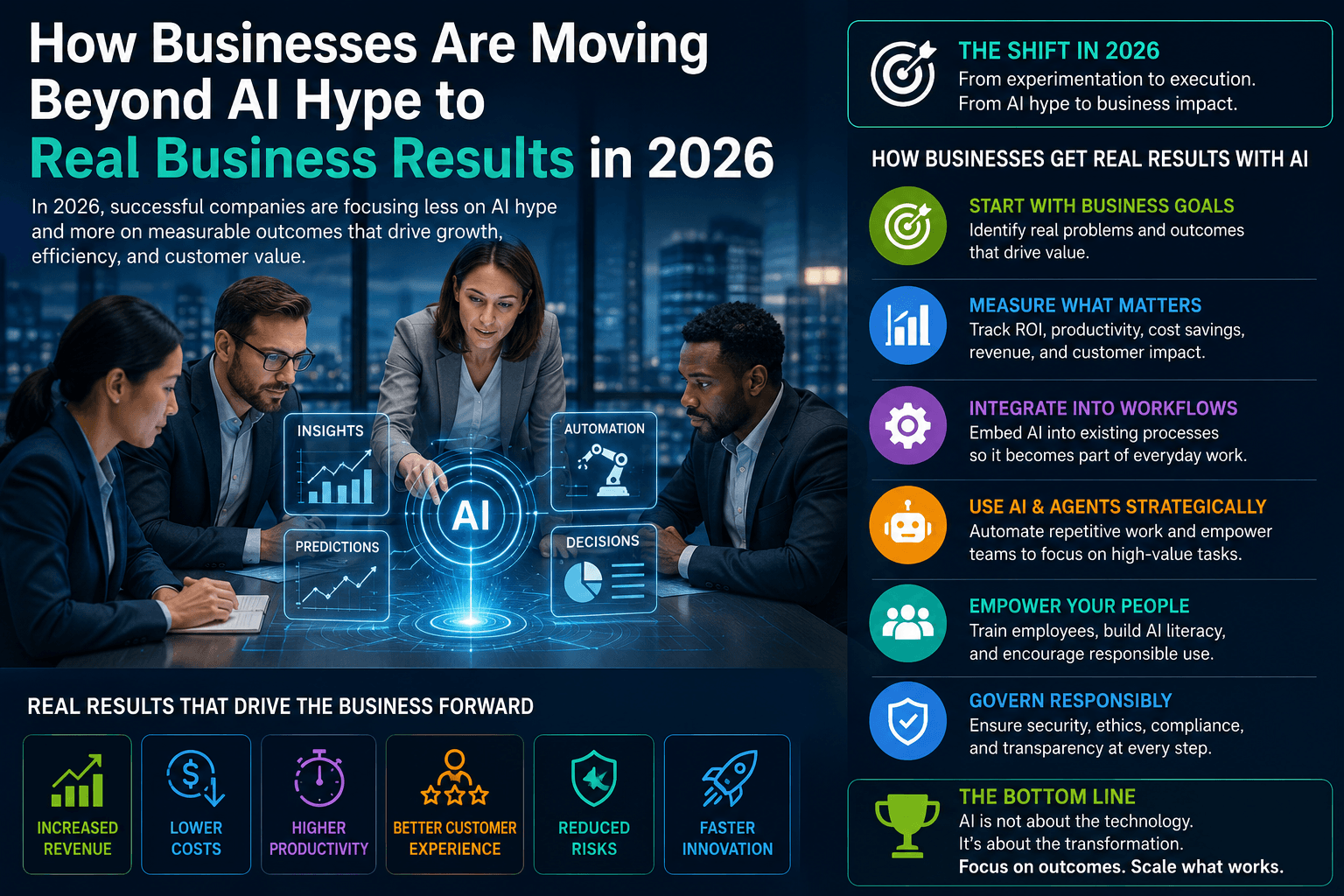
The shift from AI experimentation to measurable outcomes is creating a more mature approach to artificial intelligence. Instead of adopting AI simply because competitors are doing it, organizations are focusing on productivity, revenue, cost reduction, customer experience, risk management, and other measurable results.
The End of AI for AI's Sake
During the early stages of AI adoption, businesses often experimented with chatbots, content generators, image tools, and productivity assistants without clearly defining the business problem they wanted to solve.
That approach can produce impressive demonstrations without creating meaningful financial value.
In 2026, successful organizations are increasingly starting with business objectives rather than technology.
Instead of asking:
“Where can we use AI?”
companies are asking:
“Which business problem can AI solve better, faster, or more efficiently?”
This small change in thinking can significantly improve AI investment decisions.
Businesses Are Measuring ROI More Carefully
AI projects now face greater pressure to demonstrate return on investment.
Companies may track metrics such as:
Revenue generated
Operating costs reduced
Employee productivity
Customer satisfaction
Conversion rates
Processing time
Error rates
Customer retention
Support costs
These measurements help leadership determine whether an AI project should be expanded, redesigned, or discontinued.
An AI tool that saves employees several hours every week may have measurable value. An AI system that simply creates more content without improving business performance may not.
AI Is Being Integrated Into Existing Workflows
Another major shift is that businesses are moving beyond standalone AI experiments.
Instead of giving employees access to an AI chatbot and leaving them to figure out how to use it, organizations are integrating AI directly into existing workflows.
For example, AI can be connected to customer relationship management systems, help desks, enterprise search platforms, financial applications, development environments, and supply-chain systems.
This makes AI part of the process rather than an additional application employees must remember to use.
Automation Is Becoming More Strategic
AI-powered automation is one of the strongest opportunities for measurable business value.
Businesses can automate repetitive activities such as document processing, customer inquiries, data classification, reporting, scheduling, and administrative workflows.
The goal is not necessarily to eliminate jobs.
Instead, many companies are using automation to reduce repetitive workloads and allow employees to focus on activities requiring creativity, judgment, communication, and strategic thinking.
AI Agents Are Changing Business Automation
The rise of AI agents is making automation more sophisticated.
Traditional automation generally follows predefined rules.
AI agents can potentially interpret goals, reason through multiple steps, use software tools, retrieve information, and complete tasks with less human intervention.
For businesses, this could create opportunities to automate entire workflows rather than individual tasks.
However, companies need appropriate controls because autonomous systems can introduce new risks when they are allowed to take actions independently.
Customer Experience Is Becoming a Major AI Use Case
Businesses are also focusing on AI applications that directly affect customers.
AI-powered customer-service systems can provide faster responses, answer common questions, summarize customer histories, and route complex issues to human employees.
AI can also support personalization by helping companies understand customer preferences and deliver more relevant recommendations.
The key is to measure whether these systems actually improve customer outcomes rather than simply reducing human involvement.
AI Is Improving Decision-Making
AI can analyze large amounts of information faster than traditional manual processes.
Companies are using AI and advanced analytics to identify trends, forecast demand, detect anomalies, evaluate risks, and support strategic decisions.
However, businesses are increasingly recognizing that AI should support decision-making rather than automatically replace human judgment.
The most effective approach often combines machine intelligence with human experience and contextual understanding.
Data Quality Is Becoming a Competitive Advantage
AI systems are only as useful as the information they can access.
Businesses that invested heavily in AI without improving their underlying data infrastructure may discover that poor-quality, fragmented, outdated, or inaccessible data limits AI performance.
As a result, companies are paying greater attention to:
Data quality
Data governance
Data integration
Data security
Enterprise knowledge management
Real-time data availability
Strong data foundations can make AI investments significantly more valuable.
Employees Are Becoming Part of the AI Strategy
Technology alone cannot transform a business.
Employees need to understand how AI fits into their jobs and how to use it effectively.
Organizations are increasingly investing in AI training, internal guidelines, and practical workflows that help employees move beyond basic experimentation.
AI fluency is becoming particularly important because employees who understand how to evaluate AI outputs and integrate AI into their work can often achieve greater productivity than those who simply have access to the technology.
Businesses Are Becoming More Selective About AI Projects
Not every business process needs AI.
A mature AI strategy recognizes that some problems are better solved through traditional software, process improvements, or organizational changes.
Companies are therefore evaluating AI projects based on factors such as:
Business impact
Implementation complexity
Cost
Data availability
Security
Regulatory risk
Scalability
Employee adoption
This helps prevent organizations from wasting resources on AI projects that sound impressive but have limited practical value.
AI Governance Is Becoming Essential
As businesses move AI into critical workflows, governance becomes increasingly important.
Organizations need to know:
Which AI systems are being used
Who owns each system
What data the systems access
What decisions AI can influence
How outputs are monitored
When human approval is required
How AI incidents are handled
Strong governance can help businesses scale AI while maintaining security, compliance, and accountability.
The AI Leaders of 2026 Are Focusing on Outcomes
The biggest difference between AI hype and AI maturity is measurement.
Companies moving beyond the hype are not necessarily using the most advanced AI models. They are using AI where it produces clear business outcomes.
They ask whether AI:
Saves money.
Makes employees more productive.
Generates revenue.
Improves customer experiences.
Reduces risk.
Accelerates decision-making.
These outcomes matter more than simply being able to say that a company “uses AI.”
From AI Experiments to AI Operating Models
The next stage of AI adoption involves embedding artificial intelligence into the way businesses operate.
AI can become part of everyday processes across sales, marketing, finance, operations, customer service, human resources, cybersecurity, and product development.
This represents a major shift from isolated experiments toward an AI-enabled operating model.
Companies that successfully make this transition may gain advantages that are difficult for competitors to replicate because AI becomes deeply connected to their processes, data, people, and organizational knowledge.
Conclusion
In 2026, businesses are increasingly moving beyond the excitement surrounding artificial intelligence and focusing on what it can actually accomplish.
The winners will not necessarily be the organizations that deploy the greatest number of AI tools. They will be the businesses that identify meaningful problems, integrate AI into practical workflows, measure outcomes, train employees, improve their data foundations, and establish responsible governance.
The future of enterprise AI is therefore less about AI hype and more about AI performance.
The most important question for businesses is no longer whether they should use AI. It is whether their AI investments are producing results that can be measured, improved, and scaled.