
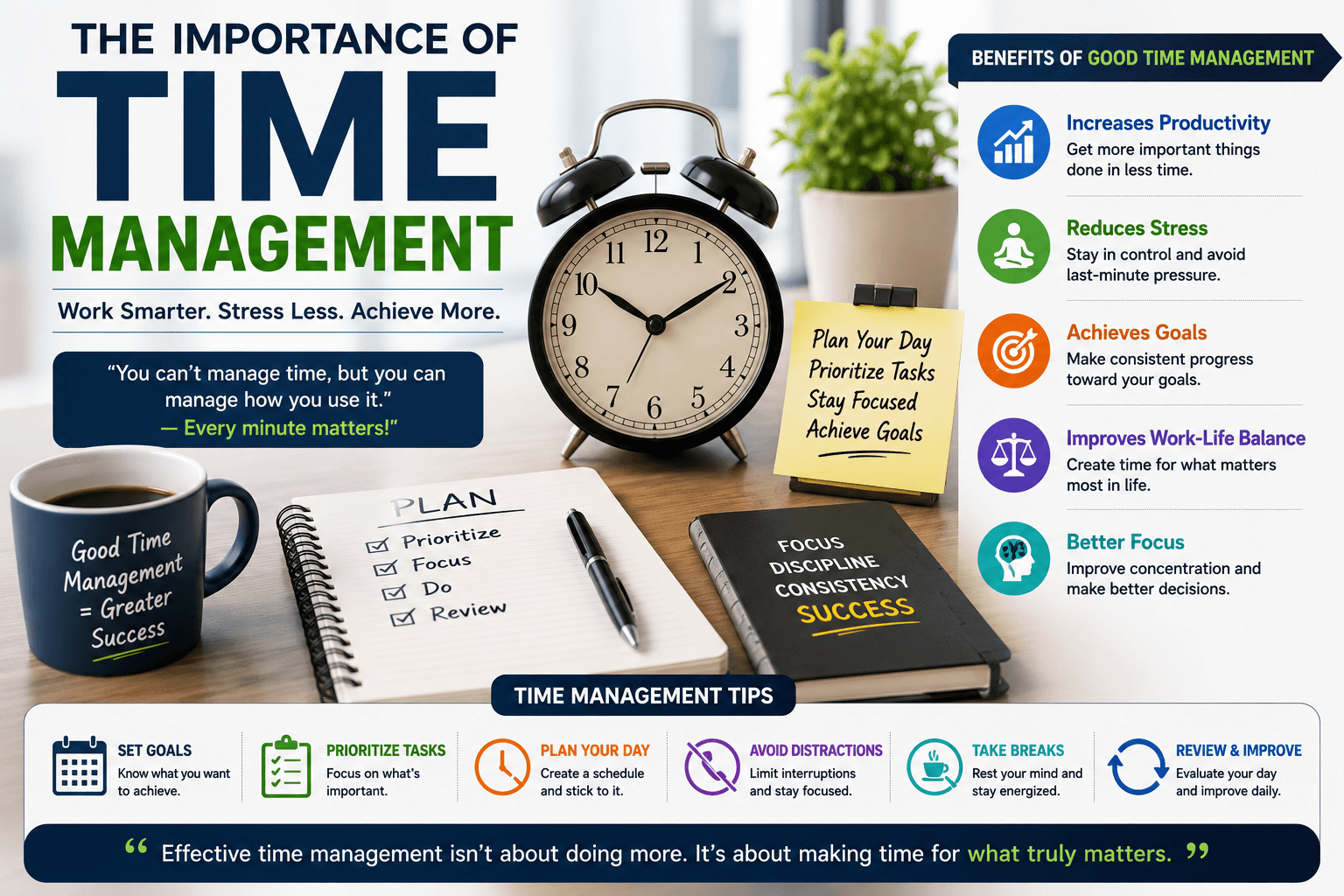

Time is one of the most valuable resources we have. Unlike money or other resources, lost time cannot be recovered. Whether you are a student, employee, entrepreneur, freelancer, or professional, learning how to manage time effectively can help you accomplish more while reducing unnecessary stress.
Time management is not about filling every minute of the day with work. It is about deciding what deserves your attention, organizing your responsibilities, avoiding distractions, and creating enough space for rest and personal life.
What Is Time Management?
Time management is the process of planning and organizing how you spend your available time. It involves setting priorities, creating schedules, establishing deadlines, and controlling distractions.
Effective time management allows people to focus on important activities instead of constantly reacting to whatever task appears next.
The goal is not simply to become busy. The goal is to make better decisions about where your time and energy should go.
Why Time Management Matters
Poor time management can lead to missed deadlines, unfinished projects, stress, and reduced productivity. When people constantly feel rushed, they may also make more mistakes or struggle to maintain a healthy work-life balance.
Good time management can provide several benefits, including:
Better productivity
Reduced stress
Improved focus
More consistent progress
Better decision-making
Greater work-life balance
More time for personal goals
Managing time effectively can also create a sense of control because you have a clearer understanding of what needs to be done.
Set Clear Goals
One of the first steps toward better time management is establishing clear goals.
Instead of saying, "I want to be more productive," create a specific objective such as completing a project by Friday or studying for a certain number of hours during the week.
Breaking larger goals into smaller tasks makes them easier to manage. Small achievements can also create momentum and motivation.
Prioritize Your Tasks
Not every task deserves the same amount of attention.
Some activities have a significant impact on your goals, while others may have little importance. Learning to identify high-priority tasks allows you to use your most productive hours effectively.
A simple approach is to divide tasks into four categories:
Urgent and important
Important but not urgent
Urgent but less important
Neither urgent nor important
Focus on important work instead of spending the entire day responding to minor interruptions.
Create a Daily Schedule
A daily schedule can provide structure and reduce decision fatigue.
At the beginning or end of each day, identify the tasks you want to accomplish. Estimate how much time each task will require and assign suitable periods to them.
However, avoid filling every minute of your schedule. Unexpected tasks and delays are normal, so leaving some flexibility can make your plan more realistic.
Use Time Blocking
Time blocking is a popular technique that involves assigning specific periods to different activities.
For example, you might dedicate the morning to focused work, reserve an hour for communication, and use the afternoon for meetings or administrative tasks.
Time blocking can help protect important work from distractions and prevent small tasks from consuming your entire day.
Avoid Multitasking
Multitasking may appear efficient, but constantly switching between activities can make it harder to concentrate.
Instead, try focusing on one important task at a time. When you finish it or reach an appropriate stopping point, move to the next task.
This approach can improve concentration and reduce mistakes, particularly when working on complex projects.
Control Digital Distractions
Smartphones, social media, email notifications, and entertainment platforms can consume significant amounts of time.
You do not necessarily need to eliminate technology. Instead, use it intentionally.
Turn off unnecessary notifications, use focus modes, and establish specific times for checking email or social media.
Even short interruptions can make it difficult to return to deep concentration, so protecting uninterrupted work periods can be valuable.
Learn to Say No
Effective time management also involves knowing what not to do.
Accepting every request, meeting, invitation, or project can leave you with little time for your most important responsibilities.
Before accepting a new commitment, consider whether it supports your goals and whether you realistically have enough time to complete it.
Saying no to low-priority activities can create more space for meaningful work.
Take Regular Breaks
Productivity does not mean working continuously.
Regular breaks can help you recover mentally and physically. Standing up, stretching, walking, drinking water, or simply stepping away from a screen can provide a useful reset.
Short breaks may actually help maintain concentration over longer working periods.
Avoid Procrastination
Procrastination is one of the biggest obstacles to effective time management.
People often postpone tasks because they seem difficult, boring, or overwhelming.
A useful strategy is to break the task into a very small first step. Instead of thinking about completing an entire project, focus on opening the document, writing the first paragraph, or completing the first item.
Starting is often easier once the task feels manageable.
Use Technology Wisely
Technology can be a powerful time-management tool when used correctly.
Calendars, task-management applications, reminders, note-taking tools, project-management platforms, and automation can help organize responsibilities.
AI tools can also assist with brainstorming, summarizing information, drafting content, organizing tasks, and handling repetitive workflows.
However, using too many tools can create unnecessary complexity. Choose systems that make your work simpler rather than adding more things to manage.
Make Time for Rest
Rest is an important part of effective time management.
Without adequate recovery, productivity and concentration can decline. Sleep, exercise, hobbies, family time, and relaxation should not automatically be treated as wasted time.
A sustainable schedule should allow you to work effectively while also maintaining your physical and mental well-being.
Review Your Time Usage
Many people underestimate how much time they spend on low-value activities.
Tracking your time for several days can reveal patterns. You may discover that social media, unnecessary meetings, excessive email checking, or frequent task switching consumes more time than expected.
Once you understand where your time goes, you can make more informed adjustments.
Build Consistent Habits
Time management becomes easier when useful behaviors become habits.
You do not need to completely redesign your life in one day. Start with simple changes such as planning tomorrow's priorities before going to bed, checking your schedule each morning, or setting aside dedicated focus periods.
Over time, these habits can become a natural part of your routine.
Balance Work and Personal Life
Effective time management should not be limited to professional responsibilities.
Personal goals, relationships, hobbies, exercise, and relaxation are also important.
Creating boundaries between work and personal time can help prevent burnout and make your schedule more sustainable.
A successful life is not measured only by how much work you complete. Quality of life matters too.
Conclusion
Time management is a skill that can improve nearly every area of life. By setting clear goals, prioritizing important tasks, creating realistic schedules, reducing distractions, avoiding procrastination, and making time for rest, you can use your days more effectively.
The purpose of managing time is not to work every minute. It is to spend your limited time on the things that matter most.
Start with one small change today. Plan your priorities, protect your focus, and build consistent habits. Over time, better time management can help you achieve your goals while creating a healthier and more balanced lifestyle.
FAQs: The Importance of Time Management
1. What is time management?
Time management is the process of planning and organizing how you use your available time. It helps you prioritize important tasks, meet deadlines, reduce distractions, and make consistent progress toward your goals.
2. Why is time management important?
Effective time management can improve productivity, reduce stress, increase focus, and create more time for personal activities. It also helps people avoid last-minute work and missed deadlines.
3. How can I improve my time management skills?
Start by setting clear goals, prioritizing tasks, creating a realistic schedule, reducing distractions, and reviewing your progress regularly. Small improvements practiced consistently can make a significant difference.
4. What is the best way to prioritize tasks?
Identify tasks based on their importance, urgency, and impact. Complete high-priority work first and schedule less important activities around your main responsibilities.
5. What is time blocking?
Time blocking is a technique where you assign specific periods of your day to particular activities. It can help protect focused work time and reduce unnecessary task switching.
6. How can I stop procrastinating?
Break large or difficult tasks into smaller steps and focus on completing the first step. Setting a short period to begin working can also make a task feel less overwhelming.
7. Does multitasking affect productivity?
Constantly switching between tasks can reduce concentration and increase mistakes. Focusing on one important task at a time can often lead to better-quality work.
8. How can I manage digital distractions?
Turn off unnecessary notifications, use focus or do-not-disturb settings, limit social media during work periods, and establish specific times for checking messages and email.
9. How can students improve time management?
Students can create study schedules, break assignments into smaller tasks, prioritize deadlines, avoid distractions, and schedule adequate time for sleep and recreation.
10. How can professionals manage a busy schedule?
Professionals can prioritize high-impact tasks, use calendars and task-management tools, delegate where appropriate, reduce unnecessary meetings, and create dedicated periods for focused work.
11. How do breaks improve productivity?
Regular breaks can help reduce mental fatigue and restore concentration. Short periods of movement, stretching, or relaxation can make it easier to return to work with renewed attention.
12. How does sleep affect time management?
Insufficient sleep can affect concentration, energy, memory, and decision-making. A consistent sleep routine can support better performance and help you use your working hours more effectively.
13. Can technology improve time management?
Yes. Calendars, reminders, task-management apps, automation tools, and AI assistants can help organize schedules and reduce repetitive work. The key is choosing tools that simplify rather than complicate your routine.
14. How can I manage unexpected tasks?
Leave some flexibility in your schedule instead of planning every minute. When an unexpected task appears, assess its urgency and importance before deciding whether to handle it immediately or schedule it for later.
15. How can I avoid spending too much time on low-value tasks?
Track how you spend your time and identify activities that provide little value. Reduce, automate, delegate, or eliminate tasks that do not contribute meaningfully to your goals.
16. Why is saying no important for time management?
Accepting too many commitments can overload your schedule. Learning to politely decline activities that do not align with your priorities can protect your time for more important responsibilities.
17. How often should I review my schedule?
A quick daily review can help you stay organized, while a weekly review can help you evaluate larger goals and identify areas for improvement.
18. Is working longer hours a good time-management strategy?
Not necessarily. Working longer can lead to fatigue and reduced concentration. Effective time management focuses on completing important work efficiently while allowing sufficient time for rest.
19. How long does it take to develop good time-management habits?
There is no fixed timeframe. Some habits may become easier quickly, while others require consistent practice. Starting with small, realistic changes can make new habits easier to maintain.
20. What is the most important time-management habit?
One of the most valuable habits is prioritizing important tasks and protecting focused time for them. When combined with realistic planning, regular breaks, and consistent routines, this can significantly improve productivity.