
PFPersonal Finance in 2026: Smart Ways to Save Money & Build Wealth
Introduction
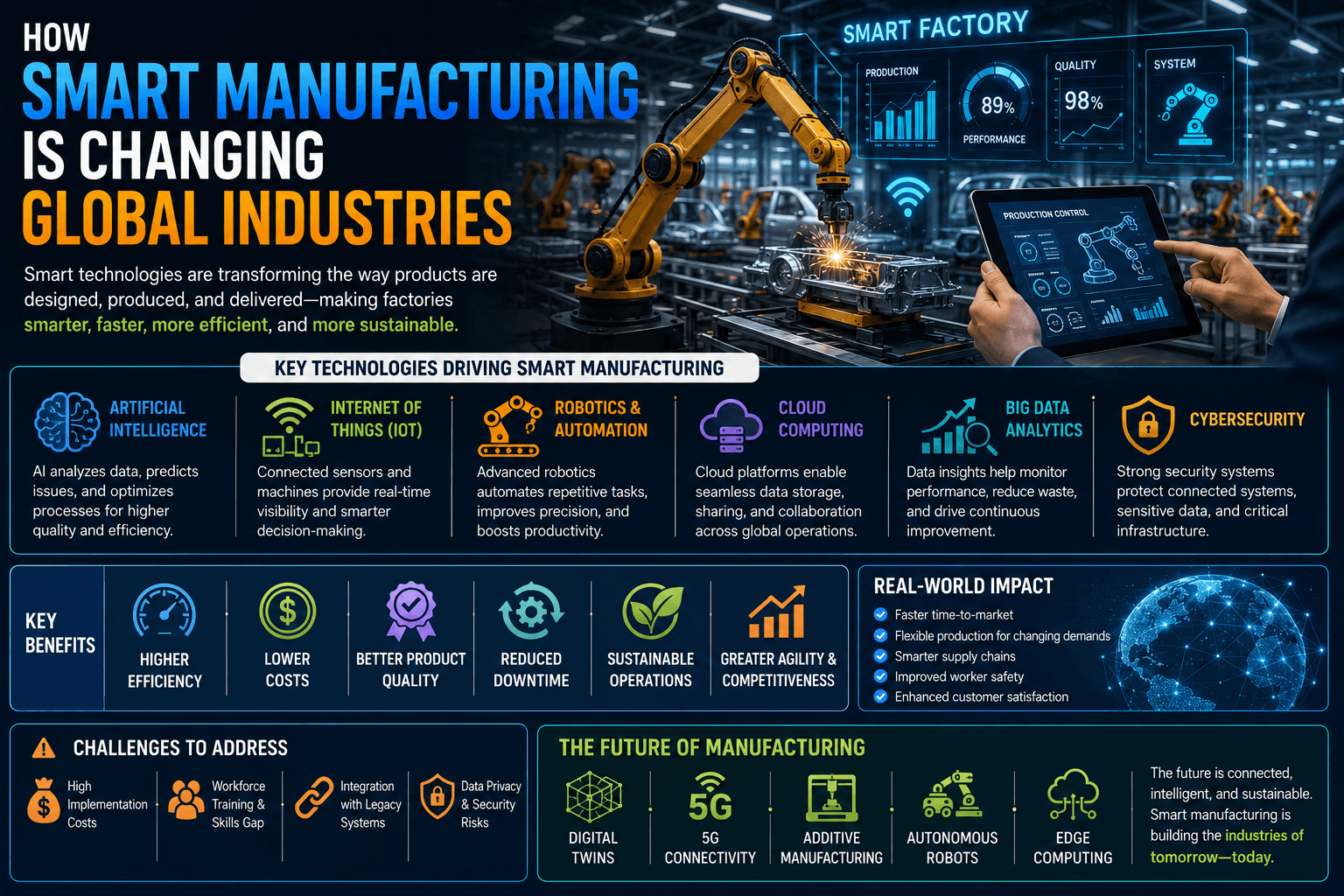
Smart manufacturing is revolutionizing the way products are designed, produced, and delivered across the globe. By combining technologies such as artificial intelligence (AI), the Internet of Things (IoT), robotics, cloud computing, and big data analytics, manufacturers are creating highly efficient, connected, and intelligent production systems.
In 2026, smart manufacturing is no longer limited to large industrial companies. Businesses of all sizes are embracing digital transformation to improve productivity, reduce costs, enhance product quality, and remain competitive in an increasingly global marketplace.
What Is Smart Manufacturing?
Smart manufacturing uses advanced digital technologies to automate and optimize every stage of the production process.
These technologies enable manufacturers to:
Monitor equipment in real time
Automate repetitive tasks
Predict maintenance needs
Improve production efficiency
Reduce waste and energy consumption
The result is a more flexible, data-driven manufacturing environment capable of responding quickly to changing customer demands.
Artificial Intelligence Is Driving Smarter Production
Artificial intelligence plays a central role in modern manufacturing.
AI helps businesses:
Detect production defects
Optimize manufacturing schedules
Predict equipment failures
Improve quality control
Forecast customer demand
By analyzing large amounts of operational data, AI enables faster and more accurate decision-making.
The Internet of Things (IoT) Connects Factories
IoT devices collect and share real-time information from machines, sensors, and production lines.
Connected factories benefit from:
Real-time equipment monitoring
Improved asset management
Faster issue detection
Better production planning
Reduced downtime
This connectivity allows manufacturers to operate more efficiently while improving product consistency.
Robotics and Automation Increase Productivity
Modern factories increasingly rely on advanced robotics to perform repetitive and precision-based tasks.
Benefits include:
Faster production
Higher accuracy
Lower labor costs
Improved workplace safety
Consistent product quality
Collaborative robots, or cobots, are also working alongside employees to improve efficiency without replacing human expertise.
Predictive Maintenance Reduces Downtime
Unexpected equipment failures can be costly.
Using sensors and AI, manufacturers can predict when machines require maintenance before breakdowns occur.
Advantages include:
Lower repair costs
Reduced production interruptions
Longer equipment lifespan
Improved operational efficiency
Predictive maintenance helps businesses maximize productivity while minimizing costly disruptions.
Data Analytics Improves Decision-Making
Smart manufacturing generates vast amounts of operational data.
Advanced analytics helps companies:
Track production performance
Monitor energy consumption
Identify inefficiencies
Improve inventory management
Optimize supply chains
Data-driven insights allow businesses to make faster and more informed decisions.
Sustainability in Manufacturing
Manufacturers are increasingly using smart technologies to achieve sustainability goals.
Smart manufacturing supports:
Lower energy consumption
Reduced carbon emissions
Efficient use of raw materials
Waste reduction
Environmentally responsible production
These improvements help companies meet environmental regulations while reducing operating costs.
Supply Chain Optimization
Digital technologies improve visibility across global supply chains.
Businesses can:
Track shipments in real time
Predict supply disruptions
Improve inventory planning
Coordinate suppliers more effectively
Respond quickly to market changes
Greater transparency leads to stronger and more resilient supply chain operations.
Challenges of Smart Manufacturing
Despite its many advantages, smart manufacturing presents several challenges.
Organizations must address:
High implementation costs
Cybersecurity risks
Workforce training requirements
Integration with older systems
Data privacy concerns
Careful planning and continuous investment are essential for successful digital transformation.
The Future of Smart Manufacturing
The future of manufacturing will be shaped by continued advances in:
Artificial intelligence
Industrial IoT
Digital twins
5G connectivity
Autonomous robots
Cloud manufacturing
3D printing
Edge computing
These innovations will create smarter, faster, and more sustainable production systems across industries.
Conclusion
Smart manufacturing is transforming global industries by improving efficiency, reducing costs, enhancing product quality, and supporting sustainable growth. Companies that embrace AI, automation, IoT, and data analytics are building more resilient and competitive manufacturing operations.
As digital technologies continue to evolve, smart manufacturing will play an increasingly important role in shaping the future of global industry, enabling businesses to innovate, adapt, and thrive in a rapidly changing world.
FAQs: How Smart Manufacturing Is Changing Global Industries
1. What is smart manufacturing?
Smart manufacturing is the use of advanced technologies such as artificial intelligence (AI), the Internet of Things (IoT), robotics, cloud computing, and real-time data analytics to improve manufacturing processes. It enables factories to operate more efficiently, reduce waste, increase productivity, and make faster, data-driven decisions.
2. How does smart manufacturing differ from traditional manufacturing?
Traditional manufacturing relies heavily on manual labor, scheduled maintenance, and fixed production processes. Smart manufacturing uses connected machines, sensors, automation, and predictive analytics to optimize operations continuously, making production more flexible, efficient, and responsive to market demands.
3. Why is smart manufacturing becoming important globally?
Global manufacturers face rising labor costs, supply chain disruptions, increased customer expectations, and sustainability goals. Smart manufacturing helps companies improve efficiency, reduce costs, enhance product quality, and remain competitive in an increasingly digital economy.
4. What technologies power smart manufacturing?
Smart manufacturing combines several advanced technologies, including:
Artificial Intelligence (AI)
Internet of Things (IoT)
Industrial IoT (IIoT)
Machine Learning
Cloud Computing
Edge Computing
Robotics
Digital Twins
Big Data Analytics
5G Connectivity
Predictive Maintenance Systems
5. How does AI improve manufacturing operations?
AI analyzes large volumes of production data to identify patterns, predict equipment failures, optimize production schedules, improve quality control, reduce downtime, and automate complex decision-making processes that were previously handled manually.
6. What role does the Internet of Things (IoT) play in smart factories?
IoT connects machines, equipment, sensors, and software systems, allowing them to exchange real-time data. This connectivity enables manufacturers to monitor operations remotely, detect problems early, optimize production, and improve overall equipment effectiveness.
7. What is predictive maintenance, and why is it valuable?
Predictive maintenance uses sensors and AI to monitor equipment health continuously. Instead of waiting for machinery to fail, manufacturers receive early warnings about potential issues, reducing unexpected downtime, lowering repair costs, and extending equipment lifespan.
8. How does automation improve manufacturing productivity?
Automation handles repetitive, dangerous, and time-consuming tasks with greater speed and accuracy than manual processes. Automated systems increase production capacity, reduce human error, improve consistency, and allow employees to focus on higher-value responsibilities.
9. Which industries benefit the most from smart manufacturing?
Smart manufacturing is transforming industries such as automotive, aerospace, electronics, pharmaceuticals, healthcare, food and beverage, consumer goods, industrial machinery, chemicals, energy, and logistics.
10. How does smart manufacturing improve product quality?
Connected sensors, AI-powered inspections, and real-time quality monitoring identify defects during production instead of after completion. Manufacturers can quickly adjust production parameters to maintain consistent quality and reduce waste.
11. Can small and medium-sized manufacturers adopt smart manufacturing?
Yes. Cloud-based platforms, affordable IoT devices, subscription software, and scalable automation solutions have made smart manufacturing accessible to businesses of all sizes. Small manufacturers can implement digital technologies gradually based on their budgets and operational needs.
12. How does smart manufacturing support supply chain management?
Real-time visibility into inventory, production, shipping, and supplier performance enables manufacturers to forecast demand more accurately, reduce inventory costs, minimize delays, and respond quickly to disruptions in global supply chains.
13. What is a digital twin in manufacturing?
A digital twin is a virtual replica of a physical machine, production line, or factory. Manufacturers use digital twins to simulate operations, test improvements, predict failures, and optimize performance before implementing changes in the real environment.
14. How does smart manufacturing contribute to sustainability?
Smart factories reduce energy consumption, optimize raw material usage, minimize waste, lower carbon emissions, improve recycling processes, and support environmentally responsible production practices through data-driven optimization.
15. What cybersecurity challenges do smart factories face?
As manufacturing systems become increasingly connected, they become more vulnerable to cyberattacks. Manufacturers must implement strong cybersecurity measures such as network monitoring, encryption, employee training, access controls, and regular software updates to protect sensitive data and production systems.
16. How does data analytics improve manufacturing decision-making?
Advanced analytics transform production data into actionable insights. Manufacturers can identify bottlenecks, improve resource allocation, forecast demand, optimize inventory, enhance equipment utilization, and make strategic business decisions based on real-time information.
17. What skills are required for the future smart manufacturing workforce?
Modern manufacturing increasingly requires skills in automation, robotics, AI, data analytics, cybersecurity, programming, industrial networking, cloud computing, and digital system management. Continuous workforce training is becoming essential as technology evolves.
18. What challenges do companies face when implementing smart manufacturing?
Common challenges include high initial investment costs, integrating legacy equipment, workforce training, cybersecurity risks, data management complexity, organizational resistance to change, and ensuring compatibility between different digital systems.
19. What is the future of smart manufacturing?
The future includes fully autonomous factories, AI-driven production optimization, collaborative robots (cobots), advanced digital twins, quantum computing applications, 5G-enabled manufacturing, sustainable production systems, and highly personalized manufacturing powered by real-time customer demand.
20. Why should businesses invest in smart manufacturing today?
Companies that invest in smart manufacturing can improve operational efficiency, reduce production costs, enhance product quality, strengthen supply chain resilience, accelerate innovation, achieve sustainability goals, and build a long-term competitive advantage in the rapidly evolving global industrial landscape.