
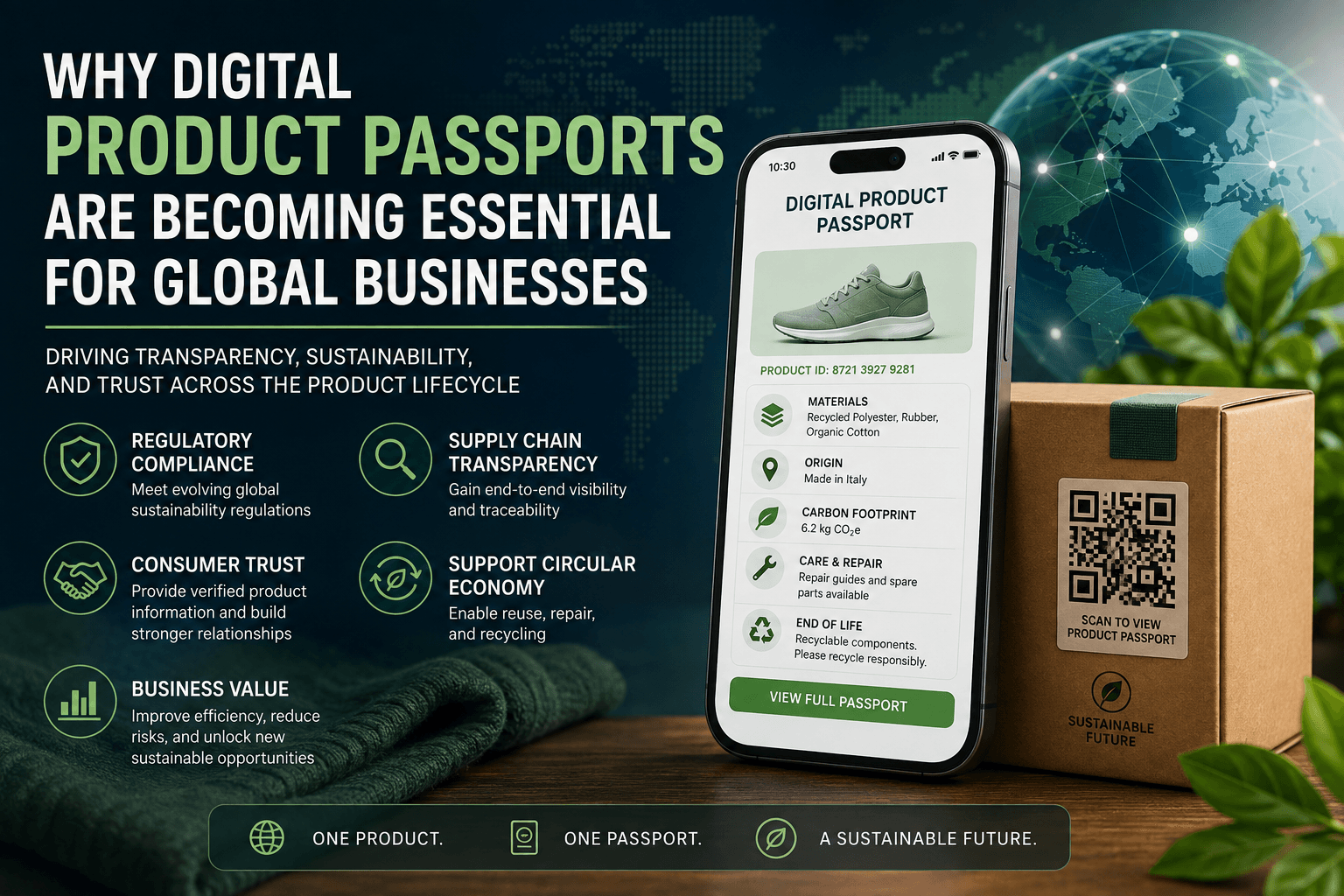

Digital Product Passports (DPPs) are quickly becoming an important part of how global businesses manufacture, sell, track, and manage products. As governments introduce stricter sustainability regulations and consumers demand greater transparency, companies are under increasing pressure to provide reliable information about where products come from, how they are made, what materials they contain, and what happens to them at the end of their useful life.
A Digital Product Passport provides a structured digital record containing important information about a product throughout its lifecycle. Depending on the industry and regulatory requirements, this information can include materials, manufacturing details, environmental impact, repair instructions, ownership history, recycling information, and supply-chain data.
For businesses operating across international markets, DPPs are becoming more than a sustainability initiative. They are emerging as a strategic tool for regulatory compliance, supply-chain transparency, customer trust, circular economy strategies, and long-term competitiveness.
What Is a Digital Product Passport?
A Digital Product Passport is a digital identity for a physical product. It connects a product with information that can be accessed electronically, often through a QR code, NFC tag, barcode, or another digital identifier.
The passport can contain information from different stages of a product's lifecycle. Manufacturers can use it to document materials and production processes, while retailers, consumers, repair companies, recyclers, and regulators can use the information for their respective needs.
For example, a product passport for an electronic device could provide details about its components, battery, energy efficiency, repairability, manufacturer, and recycling instructions.
This creates a shared information layer around the product instead of keeping important data isolated within individual companies.
Why Are Digital Product Passports Becoming Important?
Several major forces are accelerating the adoption of Digital Product Passports.
First, sustainability regulations are becoming more demanding. Governments and regulatory bodies are increasingly asking businesses to demonstrate the environmental characteristics and lifecycle impacts of products.
Second, global supply chains have become more complex. Companies often depend on multiple suppliers, manufacturers, logistics providers, and distributors. Maintaining accurate information across these networks can be difficult without standardized digital systems.
Third, consumers are becoming more interested in product origin, sustainability, durability, and ethical production. Digital product information can help companies respond to these expectations.
Finally, businesses are increasingly exploring circular economy models. Products designed for reuse, repair, refurbishment, and recycling require accurate lifecycle information, making digital product records particularly valuable.
Digital Product Passports and Regulatory Compliance
One of the biggest drivers behind DPP adoption is regulation.
The European Union has been developing policies designed to improve product sustainability, resource efficiency, and circularity. The EU's Ecodesign for Sustainable Products Regulation (ESPR) establishes a framework for sustainability requirements and introduces the concept of Digital Product Passports for relevant product categories.
For international companies selling products into regulated markets, this creates an important consideration: product information may increasingly become part of market-access requirements.
Businesses that begin preparing their product data infrastructure early can potentially avoid costly last-minute changes. Instead of treating compliance as a separate administrative exercise, companies can integrate product information management into their normal operations.
Improving Supply Chain Transparency
Modern businesses frequently lack complete visibility into their extended supply chains.
A company may know its direct supplier but have limited information about the suppliers several levels further upstream. This can make it difficult to verify the origin of raw materials, environmental claims, labor practices, or manufacturing processes.
Digital Product Passports can help create a more connected information system.
When suppliers contribute standardized product and material information, businesses can develop a clearer picture of how products move through the supply chain. This can improve traceability and make it easier to identify potential risks.
Better visibility can also support faster responses to product recalls, quality problems, sustainability concerns, and regulatory inquiries.
Building Consumer Trust
Consumers increasingly want evidence rather than general sustainability claims.
Statements such as "eco-friendly," "responsibly sourced," or "recyclable" may not provide enough information to increasingly informed buyers. A Digital Product Passport can give consumers access to more detailed product information.
For example, scanning a product's QR code could provide information about its materials, manufacturing location, certifications, repair options, expected lifespan, and recycling instructions.
This level of transparency can help companies establish stronger relationships with customers.
It can also reduce the risk of misleading sustainability claims because businesses have a stronger incentive to support environmental statements with documented information.
Supporting the Circular Economy
The traditional business model often follows a linear path: extract resources, manufacture products, sell them, and eventually dispose of them.
The circular economy aims to keep products and materials in use for as long as possible.
Digital Product Passports can support this transition by making products easier to repair, refurbish, reuse, and recycle.
A repair company, for example, could access information about a product's components and maintenance requirements. A recycler could identify the materials inside a product more efficiently. A second-hand buyer could potentially verify product information before purchasing.
This makes product data useful even after the original sale.
Benefits for Manufacturers
Manufacturers can gain several operational advantages from DPPs.
Accurate digital product information can help businesses improve inventory management, supplier coordination, quality control, compliance reporting, and product lifecycle management.
DPPs can also support product differentiation. Companies that provide detailed and trustworthy information may be able to distinguish themselves from competitors that provide limited transparency.
In addition, digital product records can create opportunities for new services. Manufacturers could use lifecycle data to develop maintenance programs, refurbishment services, subscription models, trade-in programs, and other circular business models.
The Role of Technology
Technology is critical to making Digital Product Passports practical at scale.
Cloud platforms can store and manage product information, while APIs can connect passport systems with enterprise software, supplier platforms, logistics systems, and ecommerce websites.
Artificial intelligence can also help companies organize large volumes of product data, identify inconsistencies, classify materials, and automate parts of compliance reporting.
Blockchain and other distributed ledger technologies may be used in certain applications where businesses require additional mechanisms for verifying data provenance. However, DPP systems do not necessarily require blockchain. The most important requirement is reliable, standardized, accessible, and appropriately governed product information.
Challenges Businesses Need to Consider
Despite their potential, Digital Product Passports are not without challenges.
The first challenge is data quality. A passport is only useful if the information inside it is accurate, current, and trustworthy.
The second challenge is supply-chain coordination. Companies may need suppliers to provide detailed information that they have not historically collected or shared.
Data security and privacy are also important. Businesses must determine which information should be publicly accessible, which should be available only to authorized partners, and which should remain confidential.
Another challenge is interoperability. Global businesses operate across multiple software platforms and markets, so DPP systems need to work with different technologies and data standards.
Finally, implementation can require investment in software, employee training, data management, supplier onboarding, and process redesign.
How Businesses Can Prepare for Digital Product Passports
Companies should not wait until regulatory deadlines arrive before preparing.
The first step is to identify which products and markets are likely to be affected by DPP requirements.
Next, businesses should map the product information they already collect and identify missing data. This includes materials, suppliers, manufacturing processes, environmental information, repairability, recycling, and lifecycle data.
Companies should then establish clear data ownership and governance policies. Each category of information should have a responsible owner who can ensure that the data remains accurate.
Businesses should also evaluate technology platforms capable of connecting product information across internal systems and supply-chain partners.
Starting with a pilot project can be an effective approach. Companies can select one product category, build a digital passport, test the system, collect feedback, and gradually expand it across their portfolio.
The Future of Digital Product Passports
Digital Product Passports are likely to become increasingly important as global commerce moves toward greater transparency and circularity.
In the future, product passports could become a standard digital layer connecting manufacturers, suppliers, retailers, consumers, regulators, repair businesses, and recyclers.
Instead of treating product information as static documentation, businesses will increasingly treat it as a strategic asset.
Companies that invest early can potentially gain advantages beyond compliance. Better product data can support stronger customer relationships, more resilient supply chains, improved sustainability reporting, and new circular business models.
Ultimately, Digital Product Passports represent a broader shift in the global economy: products are becoming digitally connected throughout their entire lifecycle. For businesses competing internationally, understanding and preparing for this transition could become an important part of long-term strategy.
FAQs
1. What is a Digital Product Passport?
A Digital Product Passport is a digital record containing important information about a physical product. Depending on the product and regulatory requirements, it can include information about materials, manufacturing, sustainability, repairability, durability, supply-chain data, and recycling. The information can typically be accessed through a digital identifier such as a QR code or NFC tag.
2. Why are Digital Product Passports important for businesses?
Digital Product Passports can help businesses improve transparency, product traceability, regulatory compliance, supply-chain visibility, and sustainability management. They can also help companies provide consumers with more detailed product information and support circular economy initiatives such as repair, reuse, refurbishment, and recycling.
3. Are Digital Product Passports mandatory?
Requirements depend on the product category, market, and applicable regulations. The European Union is introducing a regulatory framework that includes Digital Product Passport requirements for relevant products under its sustainability legislation. Businesses selling products in regulated markets should monitor applicable requirements and prepare their data systems accordingly.
4. What information can a Digital Product Passport contain?
A passport can contain different types of information depending on the product. Examples include product identification, material composition, manufacturing information, environmental characteristics, durability, repair instructions, spare-part information, certifications, supply-chain information, and end-of-life or recycling guidance.
5. How do Digital Product Passports help consumers?
DPPs can give consumers easier access to detailed information about products before or after purchase. Instead of relying solely on marketing claims, consumers may be able to review information about materials, origin, sustainability characteristics, durability, repair options, and recycling. This can support more informed purchasing decisions.
6. Can Digital Product Passports improve supply-chain management?
Yes. DPPs can improve visibility by connecting product information across different stages of the supply chain. When suppliers and manufacturers provide standardized data, businesses can more easily trace materials, identify potential risks, verify information, and respond to quality or compliance issues.
7. Do Digital Product Passports require blockchain?
No. Blockchain can be used in certain implementations, particularly where businesses want additional mechanisms for data verification or provenance. However, a Digital Product Passport does not inherently require blockchain. Effective DPP systems can be built using cloud databases, APIs, digital identifiers, and other technologies.
8. What challenges do companies face when implementing DPPs?
Common challenges include incomplete product data, inconsistent information between suppliers, technology integration, data governance, cybersecurity, interoperability, employee training, and implementation costs. Companies with complex international supply chains may also need significant coordination with suppliers and business partners.
9. Which industries could benefit from Digital Product Passports?
Industries with complex products and supply chains can particularly benefit from DPPs. These include fashion and textiles, electronics, batteries, automotive products, industrial equipment, consumer goods, and other sectors where material traceability, sustainability, repair, reuse, or recycling information is important.
10. How should businesses prepare for Digital Product Passports?
Businesses should begin by identifying relevant regulatory requirements and product categories. They should then audit existing product data, identify information gaps, establish data governance, engage suppliers, assess technology options, and consider launching a pilot DPP project. Early preparation can make future compliance and large-scale implementation significantly easier.