
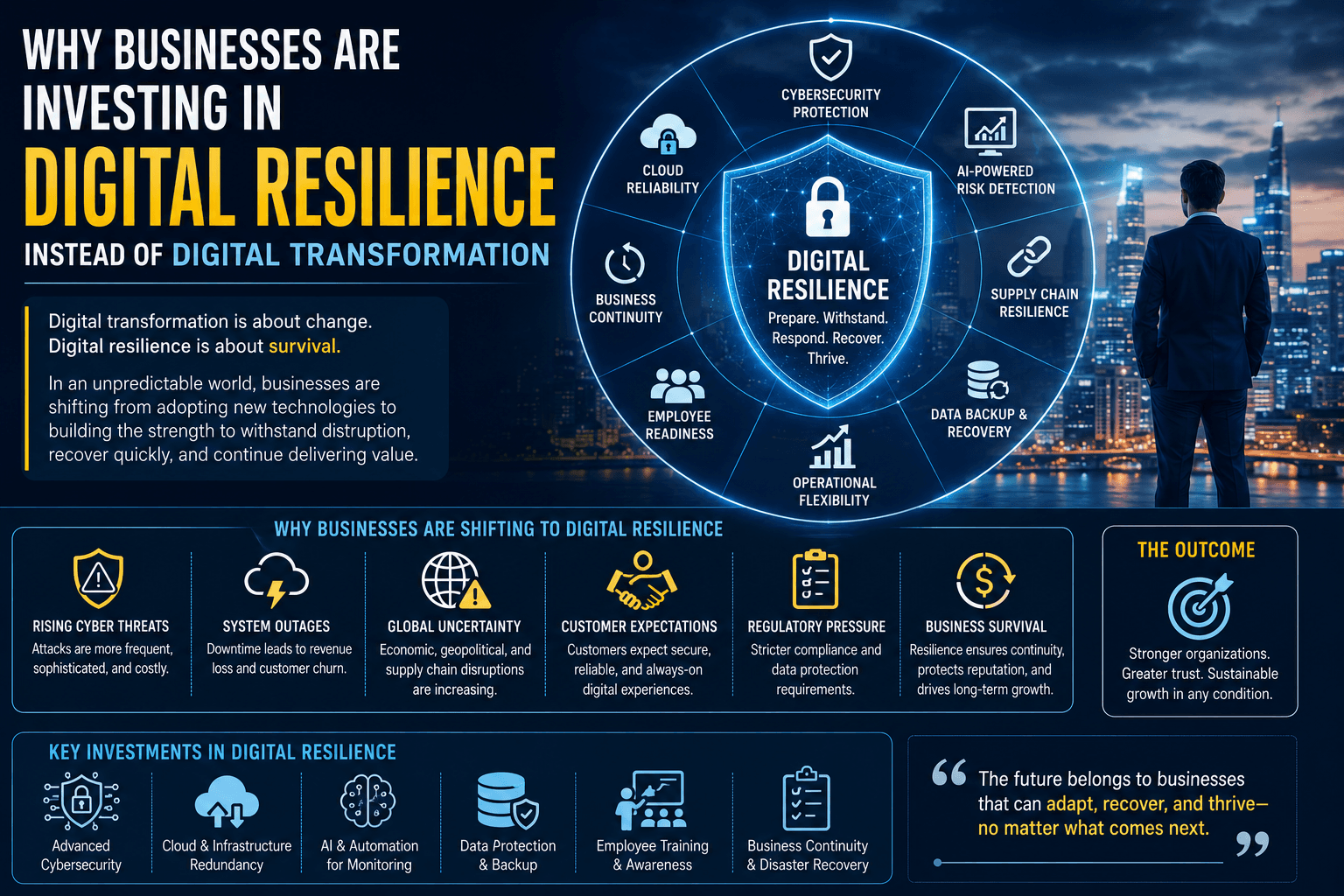

For years, digital transformation was at the center of business strategy. Organizations invested heavily in cloud computing, artificial intelligence, automation, data analytics, and digital customer experiences to improve efficiency and maintain competitiveness.
But the business environment has changed.
Cyberattacks are becoming more sophisticated, technology dependencies are increasing, supply chains remain vulnerable, and economic uncertainty continues to challenge organizations across industries. As a result, simply becoming more digital is no longer enough.
In 2027 and beyond, organizations that combine innovation with resilience will be better positioned to protect operations, maintain customer trust, and achieve sustainable growth.
What Is Our Digital Resilience Strategy?
Our digital resilience strategy is built around creating organizations that can continue operating even when unexpected disruptions occur.
Digital resilience goes beyond traditional disaster recovery. It combines technology, cybersecurity, operational continuity, risk management, employee preparedness, and organizational adaptability into one coordinated approach.
Our strategy focuses on:
Cybersecurity preparedness
Reliable cloud infrastructure
Data protection and recovery
Business continuity
AI-powered monitoring
Employee readiness
Supply chain resilience
Risk management
Operational flexibility
Continuous resilience testing
The objective is not simply to prevent every disruption. No organization can eliminate every risk.
Instead, our strategy is designed to reduce the impact of disruptions and accelerate recovery when they occur.
Why Digital Transformation Alone Is No Longer Enough
Digital transformation has helped organizations modernize their operations, but technology adoption alone does not guarantee business continuity.
A company may have sophisticated cloud systems, AI applications, automated workflows, and digital customer platforms. However, if a cyberattack takes those systems offline or a critical technology provider experiences an outage, business operations can still be severely affected.
Organizations now face multiple risks, including:
Ransomware and cyberattacks
Cloud service outages
AI-related security vulnerabilities
Technology failures
Supply chain disruptions
Regulatory changes
Economic volatility
Remote workforce challenges
Our strategy therefore treats resilience as a core business capability rather than an isolated IT function.
Our Cybersecurity Resilience Strategy
Cybersecurity is one of the most important pillars of digital resilience.
Traditional security strategies often focus on preventing unauthorized access. Our approach also considers what happens when an attack succeeds.
Organizations should be prepared to detect threats quickly, isolate affected systems, restore operations, and continue critical services.
Our cybersecurity strategy includes:
Zero Trust security
Multi-factor authentication
Identity and access management
AI-powered threat detection
Endpoint protection
Continuous security monitoring
Employee security awareness
Incident response planning
This approach creates multiple layers of protection while improving an organization's ability to respond to security incidents.
Building Resilient Cloud Infrastructure
Cloud technology has become fundamental to modern business operations. However, increased dependence on cloud platforms also creates new resilience requirements.
Our strategy emphasizes cloud architectures that can maintain availability and recover quickly from failures.
Key elements include:
Automated backups
Geographic redundancy
High-availability systems
Disaster recovery environments
Continuous monitoring
Scalable infrastructure
Tested recovery procedures
Organizations may also consider hybrid-cloud and multi-cloud approaches when appropriate to reduce excessive dependence on a single environment.
The objective is to ensure that a technology failure does not automatically become a business failure.
Using AI to Predict and Manage Risks
Artificial intelligence is becoming an important component of our resilience strategy.
AI can analyze large volumes of data and identify patterns that may indicate emerging problems. Instead of waiting for disruptions to occur, organizations can use intelligent systems to identify warning signals earlier.
AI can support:
Cybersecurity threat detection
Predictive maintenance
Network monitoring
Fraud detection
Operational risk analysis
Supply chain forecasting
Automated incident response
The strategic value of AI is therefore not limited to productivity. It can also help organizations become more proactive and responsive.
Our Business Continuity Strategy
Business continuity should be treated as an ongoing strategic process rather than a document created for compliance purposes.
Our strategy emphasizes practical plans that define how critical operations will continue during disruptions.
Business continuity planning should address:
Data recovery
Emergency communication
Remote work
Alternative suppliers
Crisis management
Critical system restoration
Customer communication
Recovery priorities
Organizations should also test these plans regularly.
A plan that has never been tested may not work effectively when a real crisis occurs.
Protecting Customer Trust
Customers increasingly expect digital services to be available whenever they need them.
Banking applications, e-commerce platforms, healthcare portals, communication services, and business software all depend on reliable digital infrastructure.
A prolonged outage or significant security incident can quickly damage customer confidence.
Our resilience strategy therefore places customer experience at the center of operational continuity.
Organizations should be prepared not only to restore systems but also to communicate transparently with customers during disruptions.
Reliable digital experiences can become an important competitive advantage.
Making Employees Part of the Strategy
Technology cannot create resilience by itself.
Employees play an important role in identifying threats, responding to incidents, communicating during crises, and adapting to changing circumstances.
Our strategy includes continuous employee development in areas such as:
Cybersecurity awareness
Incident response
Digital collaboration
Crisis communication
Risk management
Operational flexibility
Regular training and simulations can help employees understand their responsibilities before a disruption occurs.
A resilient workforce strengthens the resilience of the entire organization.
Strengthening Supply Chain Resilience
Modern organizations depend on increasingly complex global supply chains.
A disruption affecting one supplier, logistics provider, technology vendor, or critical component can create consequences throughout the organization.
Our supply chain strategy focuses on improving visibility and reducing unnecessary dependency.
Organizations can use:
AI-powered forecasting
Predictive analytics
Real-time monitoring
Supplier diversification
Inventory visibility
Alternative sourcing
Risk assessment
The objective is to identify vulnerabilities before they become major operational problems.
Measuring Digital Resilience
A successful resilience strategy requires measurable objectives.
Organizations can track indicators such as:
System uptime
Recovery Time Objective (RTO)
Recovery Point Objective (RPO)
Incident response time
Threat detection time
System recovery time
Customer service availability
Supply chain performance
Backup success rates
Resilience testing results
These measurements allow leadership teams to identify weaknesses and continuously improve their resilience capabilities.
Our Strategy for a More Adaptive Organization
Digital resilience should not be viewed as a one-time technology project.
Threats evolve. Customer expectations change. Technology platforms become more complex. Supply chains shift. New regulations emerge.
Our strategy therefore emphasizes continuous adaptation.
Organizations should regularly review their infrastructure, cybersecurity controls, business continuity plans, supplier relationships, employee training, and risk management processes.
This creates a culture in which resilience becomes part of everyday decision-making.
Why Digital Resilience Will Become a Competitive Advantage
Resilience is increasingly becoming more than a defensive strategy.
Organizations that can recover faster can maintain customer relationships, protect revenue, reduce operational losses, and continue innovating while competitors struggle with disruptions.
Strong digital resilience can contribute to:
Lower operational downtime
Faster recovery
Stronger cybersecurity
Greater customer confidence
Improved regulatory readiness
Better employee preparedness
Stronger investor confidence
More sustainable growth
The companies that succeed in an uncertain digital economy will not simply be the organizations that adopt the newest technologies.
They will be the organizations that know how to protect, operate, recover, adapt, and continue innovating when those technologies face unexpected challenges.
Conclusion
Digital transformation helped organizations become faster, smarter, and more connected. But the next stage of digital business requires something more: resilience.
By combining cybersecurity, cloud reliability, artificial intelligence, business continuity, supply chain management, employee preparedness, and continuous testing, organizations can create stronger foundations for long-term growth.
In 2027 and beyond, digital resilience will increasingly separate organizations that simply adopt technology from those that are truly prepared for the future.
The goal is not to eliminate uncertainty.
Frequently Asked Questions
1. What is digital resilience?
Digital resilience is an organization's ability to anticipate, withstand, respond to, and recover from technology-related disruptions while maintaining essential business operations.
2. Why is digital resilience important for businesses?
Digital resilience helps organizations reduce downtime, protect critical systems, respond to cyber threats, recover from failures, and maintain customer services during unexpected disruptions.
3. How is digital resilience different from digital transformation?
Digital transformation focuses on adopting technology to improve business operations, while digital resilience focuses on ensuring those digital operations remain secure, reliable, adaptable, and recoverable during disruptions.
4. What are the main pillars of digital resilience?
Key pillars include cybersecurity, cloud reliability, data protection, business continuity, AI-powered monitoring, employee preparedness, supply chain resilience, risk management, and recovery planning.
5. How does cybersecurity contribute to digital resilience?
Cybersecurity helps organizations prevent, detect, contain, and recover from threats such as ransomware, phishing, unauthorized access, malware, and data breaches.
6. Can artificial intelligence improve digital resilience?
Yes. AI can analyze large volumes of data to identify unusual activity, predict potential failures, detect cybersecurity threats, monitor systems, and support faster incident response.
7. Why is cloud infrastructure important for resilience?
Cloud infrastructure can provide scalability, automated backups, redundancy, monitoring, and disaster recovery capabilities that help organizations maintain operations during technology disruptions.
8. Should businesses use multi-cloud strategies?
Multi-cloud strategies can reduce dependency on a single cloud provider and may improve resilience, but they also introduce additional management and security complexity. Organizations should evaluate whether the benefits justify the operational requirements.
9. What is the role of business continuity in digital resilience?
Business continuity ensures that critical business functions can continue during disruptions. It defines recovery priorities, communication procedures, alternative processes, and responsibilities during emergencies.
10. How can companies prepare employees for digital disruptions?
Organizations can provide cybersecurity training, incident-response exercises, crisis communication training, digital collaboration skills, and regular resilience simulations.
11. How does digital resilience protect customer trust?
Reliable systems reduce service interruptions and help businesses respond effectively to security incidents. Transparent communication and rapid recovery can also reduce the reputational impact of disruptions.
12. What is supply chain resilience?
Supply chain resilience is an organization's ability to anticipate and respond to supplier, logistics, production, or distribution disruptions while maintaining essential operations.
13. How can AI improve supply chain resilience?
AI can analyze demand, inventory, supplier performance, transportation data, and market conditions to identify potential disruptions and improve forecasting and decision-making.
14. What is Recovery Time Objective (RTO)?
RTO is the target amount of time an organization determines is acceptable for restoring a system or business function after a disruption.
15. What is Recovery Point Objective (RPO)?
RPO defines how much data loss an organization can tolerate following a disruption, typically expressed as a period of time.
16. How often should organizations test resilience plans?
Resilience and business continuity plans should be tested regularly. The frequency should depend on the organization's risk profile, technology environment, regulatory requirements, and operational complexity.
17. Is digital resilience only an IT responsibility?
No. Digital resilience is an organization-wide responsibility involving IT, cybersecurity, operations, management, human resources, finance, supply chain teams, and other critical business functions.
18. How can businesses measure digital resilience?
Businesses can measure resilience through system uptime, recovery times, incident response performance, threat detection times, backup success rates, customer availability, and results from resilience testing.
19. Can small businesses benefit from digital resilience strategies?
Yes. Small businesses can adopt practical resilience measures such as secure backups, multi-factor authentication, employee cybersecurity training, vendor assessments, incident-response procedures, and basic continuity planning.
20. Why will digital resilience become more important in 2027?
As businesses become increasingly dependent on connected technologies, AI, cloud infrastructure, and digital services, the consequences of technology disruptions are becoming greater. Digital resilience will help organizations remain operational, adaptable, and competitive in an increasingly uncertain digital environment.