
Introduction
In today's digital economy, data has become one of the most valuable assets a business can possess. Every customer interaction, website visit, purchase, social media engagement, and operational process generates valuable information that can help organizations make smarter decisions. However, collecting data alone is not enough. The real advantage comes from analyzing that data and turning it into meaningful insights.
Data analytics has evolved from a specialized business function into a strategic driver of growth. Companies across industries are using advanced analytics to understand customer behavior, improve operational efficiency, reduce costs, identify new market opportunities, and gain a competitive advantage.
As businesses navigate an increasingly competitive marketplace in 2026, organizations that effectively leverage data analytics are positioning themselves for sustainable, long-term success.
What Is Data Analytics?
Data analytics is the process of collecting, organizing, analyzing, and interpreting data to uncover patterns, trends, and actionable insights. Businesses use various analytical techniques—including descriptive, diagnostic, predictive, and prescriptive analytics—to improve decision-making.
Modern analytics platforms combine artificial intelligence (AI), machine learning, cloud computing, and business intelligence tools to transform large volumes of raw data into valuable business intelligence.
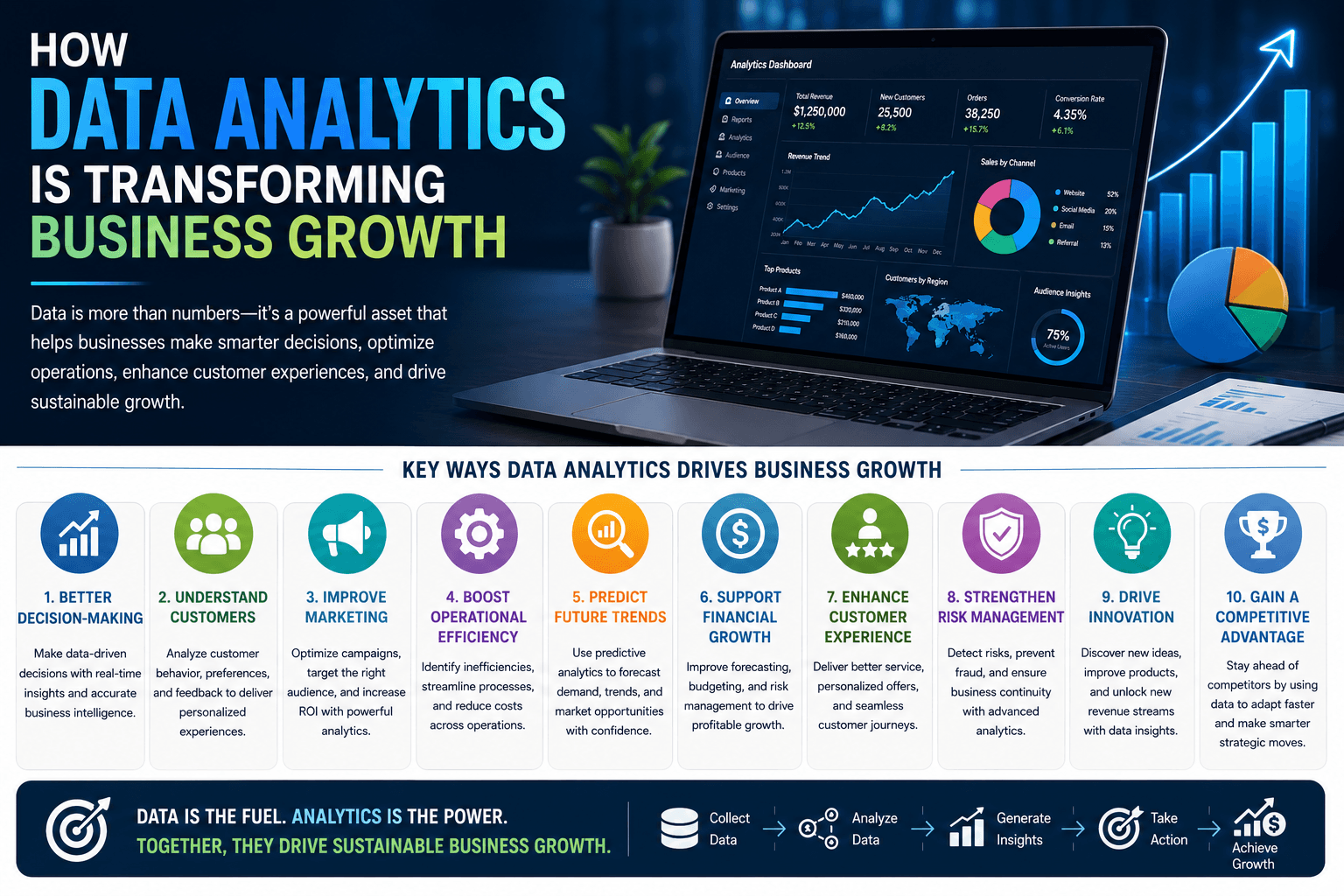
1. Better Decision-Making
One of the greatest benefits of data analytics is improved decision-making.
Instead of relying on assumptions or intuition, business leaders can make evidence-based decisions using real-time insights. Analytics helps organizations identify market trends, evaluate performance, forecast demand, and measure business outcomes more accurately.
This reduces uncertainty while increasing confidence in strategic planning.
2. Understanding Customer Behavior
Customers leave digital footprints throughout their buying journey.
Businesses analyze customer data to understand:
Purchasing habits
Browsing behavior
Product preferences
Customer demographics
Engagement patterns
Feedback and reviews
These insights help companies personalize experiences, improve customer satisfaction, and strengthen long-term loyalty.
3. Improving Marketing Performance
Marketing campaigns generate enormous amounts of data.
Analytics enables businesses to measure:
Website traffic
Conversion rates
Advertising performance
Email engagement
Social media effectiveness
Customer acquisition costs
By identifying which campaigns produce the highest return on investment, organizations can optimize marketing budgets and improve overall performance.
4. Increasing Operational Efficiency
Data analytics helps organizations identify inefficiencies across business operations.
Companies use analytics to:
Streamline workflows
Optimize inventory
Improve supply chain management
Reduce production waste
Forecast demand
Manage resources more effectively
These improvements reduce operating costs while increasing productivity and profitability.
5. Predicting Future Trends
Predictive analytics allows businesses to anticipate future outcomes using historical and real-time data.
Organizations can forecast:
Customer demand
Sales trends
Inventory requirements
Seasonal buying patterns
Equipment maintenance needs
Market opportunities
Accurate forecasting enables businesses to prepare for change rather than simply reacting to it.
6. Supporting Financial Growth
Finance teams increasingly rely on data analytics to improve business performance.
Analytics supports:
Revenue forecasting
Budget planning
Cost management
Cash flow analysis
Profitability measurement
Risk assessment
These insights help organizations allocate resources more effectively and make sound financial decisions.
7. Enhancing Customer Experience
Delivering exceptional customer experiences has become a major competitive advantage.
Businesses use analytics to:
Personalize product recommendations
Improve customer support
Identify service issues
Reduce response times
Deliver targeted promotions
Understanding customer needs enables companies to create more meaningful relationships and increase customer retention.
8. Strengthening Risk Management
Businesses face numerous risks, including cybersecurity threats, fraud, operational disruptions, and changing market conditions.
Data analytics helps organizations detect unusual patterns, identify vulnerabilities, and respond to potential risks before they become major problems.
This proactive approach improves resilience and business continuity.
9. Driving Innovation
Analytics helps businesses identify new opportunities for innovation.
By studying customer feedback, emerging trends, and market demand, companies can develop new products, improve existing services, and enter new markets with greater confidence.
Innovation supported by data is often more successful because it reflects genuine customer needs rather than assumptions.
10. Creating a Competitive Advantage
Organizations that effectively use data analytics make faster, smarter decisions than competitors relying solely on traditional business methods.
Data-driven businesses can:
Respond more quickly to market changes
Improve operational efficiency
Deliver personalized experiences
Reduce unnecessary costs
Discover new revenue opportunities
These advantages help businesses remain competitive in rapidly evolving markets.
Challenges of Data Analytics
Although analytics offers significant benefits, businesses also face challenges.
Common obstacles include:
Poor data quality
Data privacy concerns
Cybersecurity risks
Integration across multiple systems
Skills shortages
Compliance with evolving regulations
Addressing these challenges requires strong governance, secure technology, and ongoing employee training.
Best Practices for Data-Driven Growth
Organizations looking to maximize the value of analytics should:
Establish clear business objectives.
Collect accurate and reliable data.
Invest in modern analytics platforms.
Protect customer information with robust cybersecurity.
Encourage a data-driven culture across departments.
Train employees to interpret and use insights effectively.
Continuously measure performance and refine strategies.
These practices help businesses transform data into measurable business value.
Conclusion
Data analytics has become one of the most powerful tools for driving business growth in 2026. From understanding customer behavior and improving operational efficiency to predicting future trends and supporting innovation, analytics empowers organizations to make informed decisions with greater confidence.
Companies that embrace data-driven strategies are better equipped to adapt to changing market conditions, deliver exceptional customer experiences, and uncover new opportunities for growth.
As digital transformation continues to accelerate, businesses that invest in analytics, artificial intelligence, and data-driven decision-making will be well positioned to lead their industries and achieve sustainable success in the years ahead.
20 FAQs: How Data Analytics Is Transforming Business Growth
1. What is data analytics in business?
Data analytics is the process of collecting, organizing, and analyzing business data to uncover patterns, trends, and insights. Companies use these insights to make informed decisions, improve operations, reduce costs, and increase revenue.
2. How does data analytics help businesses grow?
Data analytics helps businesses identify customer preferences, optimize marketing campaigns, improve operational efficiency, forecast demand, and discover new revenue opportunities. These improvements lead to sustainable business growth.
3. Why is data analytics important in 2026?
In 2026, businesses generate more data than ever from websites, mobile apps, social media, IoT devices, and AI systems. Analytics transforms this data into actionable insights, giving companies a competitive advantage in rapidly changing markets.
4. What are the main types of data analytics?
The four primary types are:
Descriptive Analytics (What happened?)
Diagnostic Analytics (Why did it happen?)
Predictive Analytics (What will happen?)
Prescriptive Analytics (What should be done?)
5. How does data analytics improve customer experience?
Businesses analyze customer behavior, purchase history, browsing patterns, and feedback to personalize recommendations, improve products, enhance customer support, and create better shopping experiences.
6. Can small businesses benefit from data analytics?
Yes. Affordable cloud-based analytics tools allow small businesses to monitor sales, understand customer behavior, optimize marketing budgets, and make smarter business decisions without significant investments.
7. How does data analytics support marketing strategies?
Analytics measures campaign performance, identifies high-converting audiences, tracks customer journeys, analyzes ROI, and helps marketers optimize advertisements for better engagement and higher conversions.
8. What industries benefit most from data analytics?
Nearly every industry benefits, including:
Retail
Healthcare
Banking
Manufacturing
E-commerce
Logistics
Education
Telecommunications
Real Estate
Hospitality
9. How does predictive analytics help businesses?
Predictive analytics uses historical data and AI algorithms to forecast future trends, customer demand, inventory needs, equipment failures, and market opportunities before they occur.
10. How does data analytics improve decision-making?
Instead of relying on assumptions, business leaders use real-time dashboards and performance metrics to make evidence-based decisions, reducing uncertainty and minimizing business risks.
11. Can data analytics reduce business costs?
Yes. Analytics identifies inefficiencies, minimizes waste, optimizes supply chains, reduces unnecessary spending, and improves workforce productivity, resulting in significant cost savings.
12. What role does AI play in data analytics?
Artificial intelligence automates data processing, identifies hidden patterns, generates predictive insights, detects anomalies, and enables faster, more accurate business decisions with minimal manual effort.
13. How does data analytics improve sales performance?
Sales teams analyze customer buying patterns, identify high-value leads, optimize pricing strategies, forecast sales trends, and improve conversion rates through data-driven insights.
14. What challenges do businesses face when implementing data analytics?
Common challenges include poor data quality, data privacy concerns, integration with legacy systems, limited analytical expertise, high implementation costs, and resistance to organizational change.
15. How does real-time analytics benefit businesses?
Real-time analytics enables companies to monitor operations instantly, respond quickly to market changes, detect fraud, manage inventory efficiently, and improve customer service without delays.
16. What are the best data analytics tools for businesses?
Popular business analytics tools include Microsoft Power BI, Tableau, Google Looker Studio, Google Analytics 4, Snowflake, Databricks, Apache Spark, Microsoft Fabric, and various AI-powered business intelligence platforms.
17. How does data analytics improve supply chain management?
Businesses use analytics to forecast demand, optimize inventory levels, monitor supplier performance, reduce shipping delays, improve logistics efficiency, and lower operational costs.
18. How does data analytics enhance cybersecurity?
Analytics monitors network activity, detects unusual behavior, identifies potential cyber threats, automates threat detection, and helps organizations respond to security incidents more quickly.
19. What trends are shaping the future of business analytics?
Key trends include:
AI-powered analytics
Generative AI insights
Augmented analytics
Real-time business intelligence
Predictive and prescriptive analytics
Edge analytics
Self-service BI platforms
Privacy-first data governance
20. How can businesses start using data analytics effectively?
Businesses should define clear objectives, collect high-quality data, choose suitable analytics tools, establish strong data governance, train employees, monitor key performance indicators (KPIs), and continuously refine strategies based on data-driven insights.