
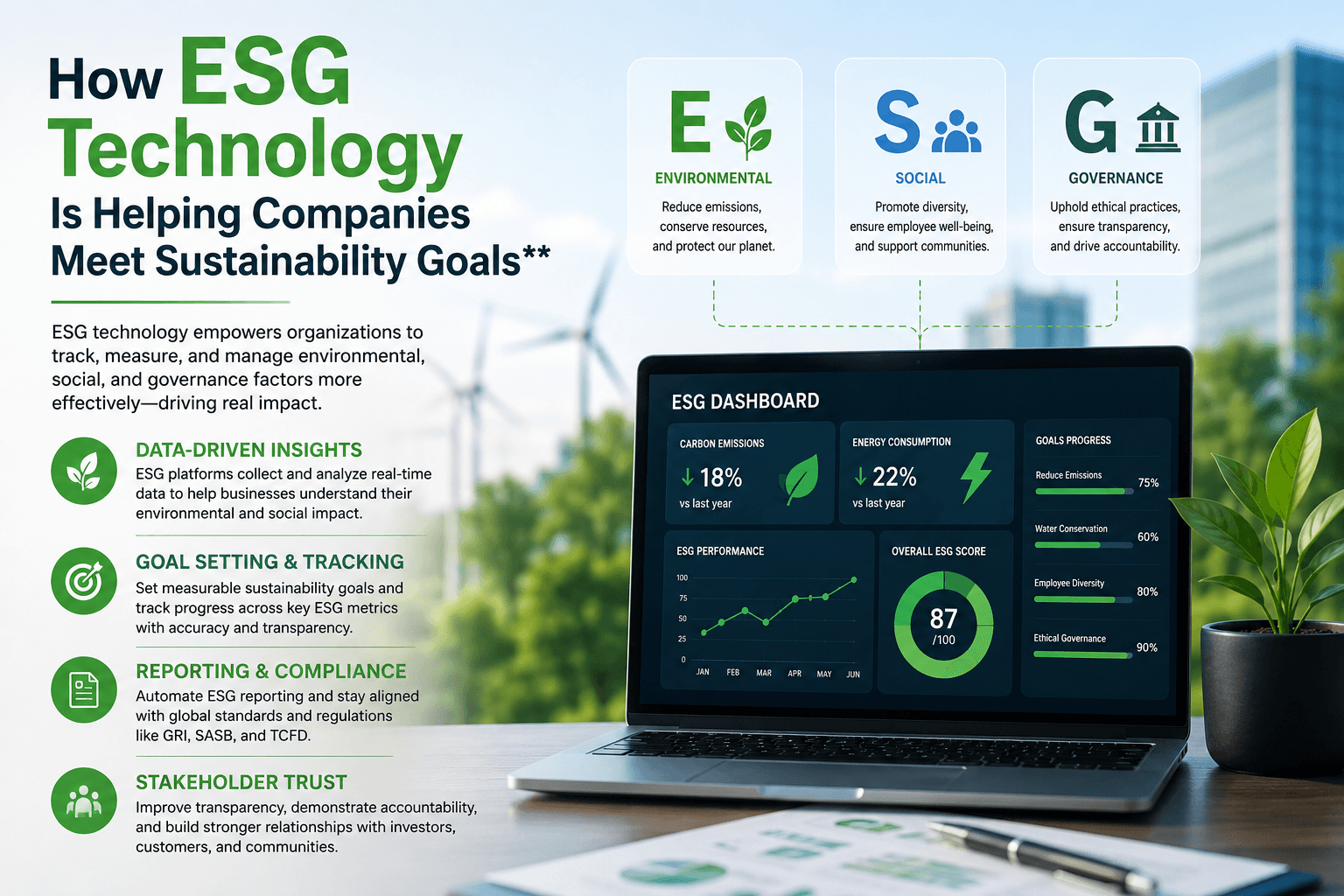

Environmental, Social, and Governance (ESG) initiatives have become a key priority for organizations across industries. Investors, customers, regulators, and business partners increasingly expect companies to operate responsibly while maintaining transparency and long-term profitability. As sustainability expectations continue to grow in 2026, businesses are turning to ESG technology to measure, manage, and improve their environmental and social impact.
At the same time, ESG reporting and sustainability management are becoming increasingly data-driven.
Organizations may need to collect information about carbon emissions, energy consumption, water usage, waste, employee conditions, supply chains, diversity, compliance, and corporate governance. Managing this information manually can be complicated, particularly for organizations operating across multiple locations and business units.
ESG technology is helping companies address this challenge.
By combining artificial intelligence, cloud computing, Internet of Things (IoT) sensors, data analytics, automation, and specialized sustainability platforms, businesses can collect, analyze, monitor, and report ESG information more efficiently.
What Is ESG Technology?
ESG technology refers to digital tools and platforms designed to help organizations manage environmental, social, and governance data and activities.
These technologies can help companies:
Measure carbon emissions
Monitor energy consumption
Track water usage
Manage waste
Analyze supply-chain risks
Monitor employee-related metrics
Automate ESG reporting
Identify compliance issues
Improve sustainability decision-making
Track progress toward environmental targets
Instead of relying on spreadsheets and disconnected data sources, companies can create centralized systems for managing sustainability information.
Why Companies Need ESG Technology
Sustainability programs can generate enormous amounts of data.
A multinational organization, for example, may have hundreds of facilities using different energy sources and operating under different environmental conditions. It may also have thousands of suppliers whose activities contribute to its overall environmental footprint.
Collecting and consolidating this information manually can be time-consuming and prone to inconsistencies.
ESG technology can automate much of the process.
Businesses can connect information from accounting systems, energy meters, enterprise software, supply-chain platforms, sensors, and other data sources.
This can create a more complete picture of corporate sustainability performance.
ESG Technology and Carbon Emissions
Reducing greenhouse gas emissions is one of the most important sustainability priorities for many businesses.
Companies need to understand where their emissions originate before they can reduce them.
ESG platforms can help organizations track emissions across areas such as:
Electricity consumption
Fuel usage
Transportation
Manufacturing
Business travel
Buildings
Purchased goods
Supply chains
Automated data collection can make it easier to identify emissions-intensive operations.
Companies can then use analytics to determine where efficiency improvements may have the greatest impact.
Real-Time Energy Monitoring
IoT technology is making energy management more intelligent.
Sensors and smart meters can collect real-time information about electricity, heating, cooling, machinery, and other energy-consuming systems.
AI and analytics can analyze this data to identify unusual consumption patterns.
For example, a business may discover that a facility is consuming significantly more energy during periods when production is low.
That information can help managers investigate potential equipment problems, inefficient processes, or unnecessary energy consumption.
Artificial Intelligence for Sustainability
AI is becoming an important component of ESG technology.
Machine learning can analyze large datasets to identify patterns, anomalies, and opportunities for improvement.
AI can potentially help businesses:
Forecast energy demand
Identify inefficient equipment
Analyze emissions data
Predict environmental risks
Optimize resource consumption
Evaluate supplier information
Automate sustainability reporting
AI can also help organizations turn large amounts of ESG data into actionable insights.
Instead of simply reporting that energy consumption increased, an analytics system could help identify which facilities or processes contributed most to the increase.
Automating ESG Reporting
ESG reporting can require organizations to collect information from multiple departments and locations.
Without centralized systems, employees may spend significant amounts of time gathering data and preparing reports.
ESG software can automate data collection, calculations, validation, and reporting workflows.
This can help organizations produce more consistent sustainability reports while reducing manual administrative work.
Automation can also create audit trails that show where data originated and how calculations were performed.
Improving Data Accuracy
One of the biggest challenges in sustainability management is data quality.
Incorrect, incomplete, or inconsistent information can undermine the credibility of ESG reporting.
Technology can help improve data quality by automatically validating information and identifying unusual values.
For example, if a facility suddenly reports an energy consumption figure that is significantly different from historical patterns, the system can flag the information for review.
This allows organizations to investigate potential data-entry errors or unusual operational events.
ESG and Supply Chain Management
A company's environmental and social footprint often extends beyond its own facilities.
Suppliers can contribute significantly to emissions, labor risks, resource consumption, and other ESG factors.
ESG technology can help companies collect supplier information and assess potential risks.
Organizations may use digital platforms to evaluate suppliers based on factors such as:
Environmental performance
Labor practices
Human rights policies
Compliance records
Geographic risks
Sustainability certifications
Carbon emissions
This can help businesses build more transparent and resilient supply chains.
ESG Technology and Social Responsibility
ESG is not only about environmental performance.
The social component includes areas such as employee wellbeing, workplace safety, diversity, labor practices, human rights, and community impact.
Digital platforms can help organizations collect and analyze social metrics.
For example, companies can use software to monitor workplace safety incidents, employee training, workforce demographics, and other relevant indicators.
Technology can help identify trends that may require management attention.
Strengthening Corporate Governance
Governance is another major component of ESG.
Companies need effective systems for compliance, risk management, internal controls, ethics, and accountability.
Governance technology can help organizations monitor policies, track approvals, manage compliance requirements, and maintain documentation.
Automated alerts can also notify relevant teams when policies or regulatory requirements require attention.
ESG Technology and Regulatory Reporting
Sustainability reporting requirements are becoming more complex across different markets.
Companies operating internationally may need to monitor multiple reporting frameworks and regulatory expectations.
ESG technology can help organizations organize the necessary information and create repeatable reporting processes.
However, software does not automatically guarantee compliance. Organizations still need appropriate legal, accounting, sustainability, and governance expertise to interpret requirements and validate reporting.
Cloud Computing and ESG Data
Cloud computing allows companies to centralize ESG information across different locations.
Instead of keeping sustainability information in isolated spreadsheets, organizations can store data in centralized platforms accessible to authorized teams.
Cloud systems can also make it easier to integrate information from multiple business applications.
This creates a foundation for more scalable ESG management.
ESG Dashboards and Decision-Making
Modern ESG platforms often provide dashboards that allow executives and sustainability teams to monitor key performance indicators.
A dashboard might show:
Total emissions
Energy consumption
Renewable energy usage
Waste generation
Water consumption
Supplier risk
Workplace safety metrics
Progress toward sustainability targets
Visualizing these indicators can help executives understand whether sustainability initiatives are producing measurable results.
Digital Twins for Sustainability
Digital twin technology can also contribute to sustainability strategies.
A digital twin is a virtual representation of a physical asset, facility, or process.
Businesses can use digital models to simulate operational changes before implementing them in the real world.
For example, a manufacturer could model different production scenarios to determine which configuration uses less energy while maintaining output.
This can help companies evaluate sustainability improvements with lower operational risk.
ESG Technology Can Support Cost Reduction
Sustainability and cost efficiency are not always separate objectives.
Reducing unnecessary energy consumption, minimizing waste, improving logistics, and optimizing resource use can also reduce operating expenses.
For example, an organization that uses AI to identify inefficient energy consumption may simultaneously reduce its carbon footprint and electricity costs.
This creates a stronger business case for sustainability investments.
Challenges of ESG Technology
Despite its potential, ESG technology has several challenges.
Data Integration
Companies often have information spread across different systems and departments.
Integrating these sources can be complex.
Data Quality
Technology is only as reliable as the information it receives. Poor data can produce inaccurate sustainability insights.
Implementation Costs
Advanced ESG platforms, sensors, analytics systems, and integrations can require significant investment.
Employee Adoption
Employees need training to use new systems effectively and understand their responsibilities for ESG data.
Greenwashing Risks
Technology can make reporting easier, but it cannot replace genuine sustainability improvements.
Companies must ensure that ESG claims are supported by accurate evidence and measurable results.
The Future of ESG Technology
The future of ESG management will likely become increasingly automated and intelligent.
AI systems may continuously monitor sustainability metrics, identify emerging risks, forecast environmental performance, and recommend corrective actions.
IoT networks could provide real-time information about energy, water, emissions, and equipment performance.
Supply-chain platforms may provide greater visibility into supplier sustainability.
Meanwhile, advanced analytics could help companies understand how sustainability decisions affect costs, operational performance, and long-term business resilience.
The ultimate shift will be from ESG reporting to ESG intelligence.
Instead of using technology primarily to produce reports after the fact, businesses will increasingly use real-time data to make sustainability decisions as part of everyday operations.
Conclusion
ESG technology is becoming an important tool for companies seeking to meet sustainability goals while improving operational efficiency.
By combining AI, IoT, cloud computing, data analytics, automation, and specialized ESG platforms, organizations can gain better visibility into their environmental, social, and governance performance.
The technology itself is not a substitute for meaningful sustainability action. However, it can provide the data, transparency, monitoring, and automation required to turn sustainability goals into measurable business initiatives.
As ESG expectations continue to evolve, companies that build strong digital foundations for sustainability may be better positioned to reduce environmental impact, manage risks, improve transparency, and create long-term value.
Frequently Asked Questions
1. What is ESG technology?
ESG technology refers to software, platforms, sensors, analytics tools, AI systems, and other digital technologies that help organizations manage environmental, social, and governance activities and data.
2. How does ESG technology help companies meet sustainability goals?
ESG technology helps companies collect sustainability data, monitor performance, identify inefficiencies, automate reporting, track targets, assess risks, and make more informed sustainability decisions.
3. How does AI support ESG management?
AI can analyze large amounts of ESG data to identify patterns, predict trends, detect anomalies, optimize resource consumption, and provide insights that can support sustainability decisions.
4. Can ESG technology help reduce carbon emissions?
Yes. ESG platforms can help organizations measure emissions, identify major sources of carbon output, monitor changes over time, and evaluate opportunities to reduce emissions.
5. What role does IoT play in ESG technology?
IoT sensors can collect real-time information about energy consumption, water usage, equipment performance, environmental conditions, and other sustainability metrics.
6. Can ESG technology automate sustainability reporting?
Yes. ESG software can automate data collection, calculations, validation, dashboards, and portions of sustainability reporting. Human review is still important to ensure that reported information is accurate and appropriate.
7. How does ESG technology improve data accuracy?
Automated data collection and validation can reduce manual entry errors. Systems can also identify unusual values, missing information, and inconsistencies for review.
8. How can companies use ESG technology to manage supply-chain sustainability?
Businesses can use ESG platforms to collect supplier information, assess environmental and social risks, monitor supplier performance, and improve visibility into sustainability issues across their supply chains.
9. What are the environmental benefits of ESG technology?
Potential benefits include better energy efficiency, reduced emissions, improved waste management, optimized resource consumption, and greater visibility into environmental performance.
10. Does ESG technology only focus on environmental issues?
No. ESG technology can address environmental, social, and governance factors, including emissions, energy, workplace safety, employee metrics, human rights, compliance, risk management, and corporate governance.
11. Can ESG technology reduce business costs?
It can. Better monitoring of energy, materials, waste, transportation, and other resources can reveal opportunities to reduce unnecessary operating expenses while improving sustainability.
12. What are the biggest challenges of implementing ESG technology?
Common challenges include data integration, poor data quality, implementation costs, cybersecurity, employee adoption, system complexity, and the need to align technology with appropriate ESG frameworks.
13. Is ESG technology useful for small businesses?
Yes. Small businesses can start with simple tools for monitoring energy consumption, emissions, waste, or ESG reporting and gradually expand their technology as their sustainability programs mature.
14. How does cloud computing support ESG initiatives?
Cloud-based platforms allow organizations to centralize ESG data from different facilities, departments, and business systems. They can also make collaboration, reporting, and data analysis easier.
15. Can ESG technology help prevent greenwashing?
Technology can improve transparency by creating better records, data trails, and measurable sustainability metrics. However, preventing greenwashing also requires honest communication, appropriate governance, and independent verification where necessary.
16. What ESG metrics can technology track?
Depending on the platform, businesses can track emissions, energy consumption, water usage, waste, renewable energy use, workplace safety, employee metrics, supplier risks, compliance activities, and other ESG indicators.
17. How does ESG technology help with regulatory requirements?
ESG platforms can help organizations organize relevant information, establish repeatable data-collection processes, maintain records, and prepare reports. Companies still need to determine which requirements apply and verify their reporting.
18. What is the future of ESG technology?
The future is likely to include more AI-powered analytics, real-time IoT monitoring, automated reporting, predictive sustainability models, intelligent supply-chain monitoring, and systems that recommend actions based on ESG performance.
19. Can ESG technology help companies achieve net-zero goals?
It can support net-zero strategies by helping businesses measure emissions, identify emission sources, monitor reduction initiatives, evaluate energy efficiency, and track progress toward defined targets.
20. Why is ESG technology becoming important for businesses?
ESG technology gives companies the tools needed to manage increasingly complex sustainability data and goals. It can improve transparency, operational efficiency, risk management, reporting, and decision-making while helping organizations track measurable progress toward sustainability objectives.