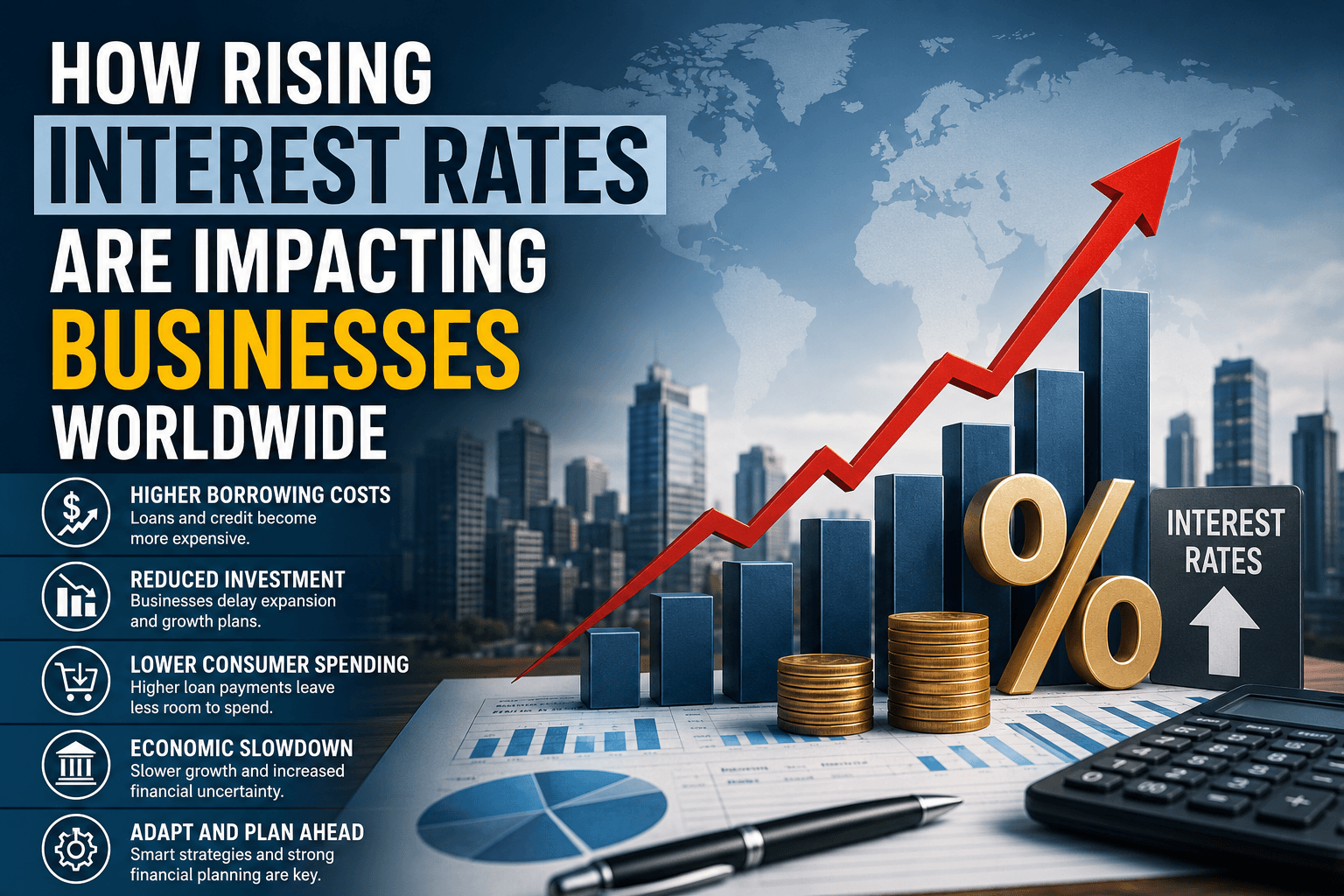

Over the past few years, rising interest rates have become one of the most significant economic challenges for businesses around the world. As central banks continue adjusting monetary policy to combat inflation, companies of all sizes are feeling the effects. From higher borrowing costs to changing consumer spending habits, rising interest rates are reshaping the global business landscape in 2026.
Understanding how these changes impact businesses is essential for entrepreneurs, investors, and business leaders looking to stay competitive in an evolving economy.
Why Interest Rates Are Rising
Interest rates are increased by central banks to slow inflation and stabilize the economy. When inflation rises rapidly, higher interest rates make borrowing more expensive, encouraging consumers and businesses to spend less. This helps reduce demand and ease inflationary pressures over time.
While this policy supports long-term economic stability, it also creates short-term challenges for businesses across nearly every industry.
Higher Borrowing Costs
One of the most immediate impacts is the increased cost of borrowing money.
Businesses often rely on loans to:
Expand operations
Purchase equipment
Invest in technology
Hire employees
Manage cash flow
As interest rates rise, monthly loan repayments become more expensive. Companies with variable-rate debt face particularly large increases in financing costs, reducing profitability and limiting expansion plans.
Small businesses, which typically depend more heavily on bank financing, often experience the greatest financial pressure.
Reduced Consumer Spending
Higher interest rates also affect consumers.
As mortgage payments, credit card interest, and personal loan costs increase, households often reduce discretionary spending. Consumers become more cautious about purchasing non-essential products and services.
Industries commonly affected include:
Retail
Hospitality
Travel
Automotive
Luxury goods
Entertainment
Businesses serving essential needs generally experience less severe impacts than those relying on discretionary consumer spending.
Slower Business Expansion
Many organizations postpone expansion projects during periods of high interest rates.
Companies may delay:
Opening new locations
Hiring additional staff
Building new facilities
Launching major product lines
Entering international markets
Instead, executives prioritize operational efficiency, cost control, and maintaining healthy cash reserves.
Pressure on Real Estate Markets
Commercial real estate is particularly sensitive to interest rate increases.
Developers face higher financing costs, while businesses reconsider purchasing office buildings, warehouses, or retail spaces.
This often results in:
Slower construction activity
Lower commercial property demand
Increased leasing instead of purchasing
Delayed infrastructure investments
The effects can extend across construction, manufacturing, logistics, and property management industries.
Increased Focus on Efficiency
Economic uncertainty encourages businesses to become more efficient.
Many organizations are investing in:
Artificial intelligence
Process automation
Cloud computing
Data analytics
Digital transformation
These technologies help reduce operating costs while improving productivity, allowing companies to remain competitive despite higher financing expenses.
Challenges for Startups
Startups frequently depend on venture capital and external funding to support growth.
When interest rates rise:
Investors become more cautious.
Venture capital funding often slows.
Business valuations decline.
Fundraising becomes more competitive.
As a result, startups increasingly focus on profitability rather than rapid expansion, emphasizing sustainable growth over aggressive scaling.
Impact on Global Trade
Higher interest rates can also influence international trade.
Stronger currencies, changing exchange rates, and reduced consumer demand may affect exports and imports. Businesses involved in global supply chains must adapt pricing strategies, manage currency risks, and diversify suppliers to maintain stability.
Companies with international operations often increase financial planning efforts to navigate uncertain economic conditions.
Opportunities Despite Higher Rates
Although rising interest rates create challenges, they also present opportunities.
Businesses with strong financial positions can benefit by:
Acquiring competitors at lower valuations
Negotiating better supplier agreements
Investing during periods of reduced competition
Strengthening customer relationships
Improving operational efficiency
Organizations that manage costs effectively often emerge stronger once economic conditions improve.
Strategies for Businesses
To navigate rising interest rates successfully, companies should:
Reduce unnecessary debt.
Improve cash flow management.
•. business economics
FAQs
1. What are rising interest rates, and why do central banks increase them?
Rising interest rates refer to increases in the cost of borrowing money, usually set by central banks to control inflation and stabilize the economy. Higher interest rates encourage saving, reduce excessive borrowing, and help slow rising prices, but they also increase financing costs for businesses and consumers.
2. How do higher interest rates affect businesses?
Higher interest rates increase the cost of loans, credit lines, and business financing. Companies often face higher monthly repayments, reduced profitability, slower expansion plans, and increased pressure on cash flow, especially if they rely heavily on borrowed capital.
3. Why are small businesses more affected by rising interest rates?
Small businesses usually have limited financial reserves and rely more on bank loans or credit facilities. As borrowing costs rise, they may struggle to finance inventory, hire employees, invest in equipment, or expand operations compared to larger corporations with stronger balance sheets.
4. How do rising interest rates influence business investment decisions?
Companies often delay expansion projects, reduce capital expenditures, postpone hiring, and reconsider mergers or acquisitions when financing becomes more expensive. Businesses tend to prioritize essential investments with faster returns.
5. What industries are most vulnerable to higher interest rates?
Real estate, construction, manufacturing, retail, automotive, technology startups, and capital-intensive industries are among the sectors most affected because they frequently depend on financing for growth and operations.
6. Can rising interest rates reduce consumer spending?
Yes. Higher borrowing costs increase mortgage, credit card, and loan payments for consumers, leaving less disposable income. Reduced consumer spending can lower demand for products and services, affecting business revenues across multiple industries.
7. How do rising interest rates impact startup companies?
Startups often depend on venture capital, investor funding, or business loans. Higher interest rates can reduce investment activity, increase financing costs, and make fundraising more difficult, slowing innovation and business growth.
8. What effect do higher interest rates have on business profits?
Businesses may experience lower profit margins due to increased interest expenses, weaker consumer demand, higher operating costs, and slower revenue growth. Companies with significant debt are usually affected the most.
9. How do rising interest rates affect hiring and employment?
Many businesses slow recruitment, freeze hiring, reduce overtime, or delay workforce expansion to control costs. In some cases, companies may restructure operations or reduce staff if economic conditions worsen.
10. Do rising interest rates affect international businesses?
Yes. Multinational companies may face currency fluctuations, changing trade conditions, increased financing expenses, and slower global demand. Exporters and importers often experience additional challenges due to exchange rate volatility.
11. How can businesses manage higher borrowing costs?
Companies can reduce unnecessary expenses, refinance debt when possible, improve cash flow management, diversify funding sources, negotiate better supplier terms, and prioritize high-return investments to minimize the impact of rising interest rates.
12. What role does inflation play in interest rate decisions?
Central banks often increase interest rates to reduce inflation by slowing economic activity. When inflation declines, borrowing costs may eventually stabilize or decrease, depending on broader economic conditions.
13. How do rising interest rates affect commercial real estate?
Higher financing costs reduce demand for commercial property purchases and development projects. Businesses may delay office expansions, warehouse construction, or retail investments until borrowing conditions improve.
14. Are businesses less likely to take loans during periods of high interest rates?
Yes. Many companies postpone borrowing because higher loan costs reduce profitability and increase financial risk. Businesses often seek alternative financing methods or rely more on internal cash reserves.
15. How do investors respond to rising interest rates?
Investors may shift their portfolios toward lower-risk assets, reduce investments in high-growth companies, or focus on businesses with strong cash flow, stable earnings, and lower debt levels.
16. Can rising interest rates create business opportunities?
Yes. Financial institutions, savings providers, insurance companies, and businesses with strong cash reserves may benefit from higher interest income. Companies that manage debt effectively can also gain a competitive advantage during periods of tighter financial conditions.
17. How should businesses prepare for future interest rate increases?
Organizations should strengthen financial planning, monitor debt levels, improve budgeting, maintain healthy cash reserves, diversify revenue streams, and regularly assess financing strategies to remain resilient during changing economic conditions.
18. How do higher interest rates affect supply chains?
Businesses may reduce inventory purchases, delay supplier payments, or negotiate longer payment terms to preserve cash flow. Financing challenges throughout the supply chain can also contribute to production delays and higher operating costs.
19. What is the long-term impact of rising interest rates on the global economy?
Over time, higher interest rates can help reduce inflation and stabilize economic growth. However, prolonged periods of elevated borrowing costs may slow investment, reduce business expansion, increase unemployment, and weaken global economic activity before recovery begins.
20. What strategies can businesses use to remain competitive during periods of rising interest rates?
Businesses can improve operational efficiency, adopt digital technologies, automate routine processes, strengthen customer relationships, reduce unnecessary expenses, diversify products and services, and focus on sustainable long-term growth. Companies that adapt quickly and maintain financial discipline are often better positioned to succeed despite higher borrowing costs.