
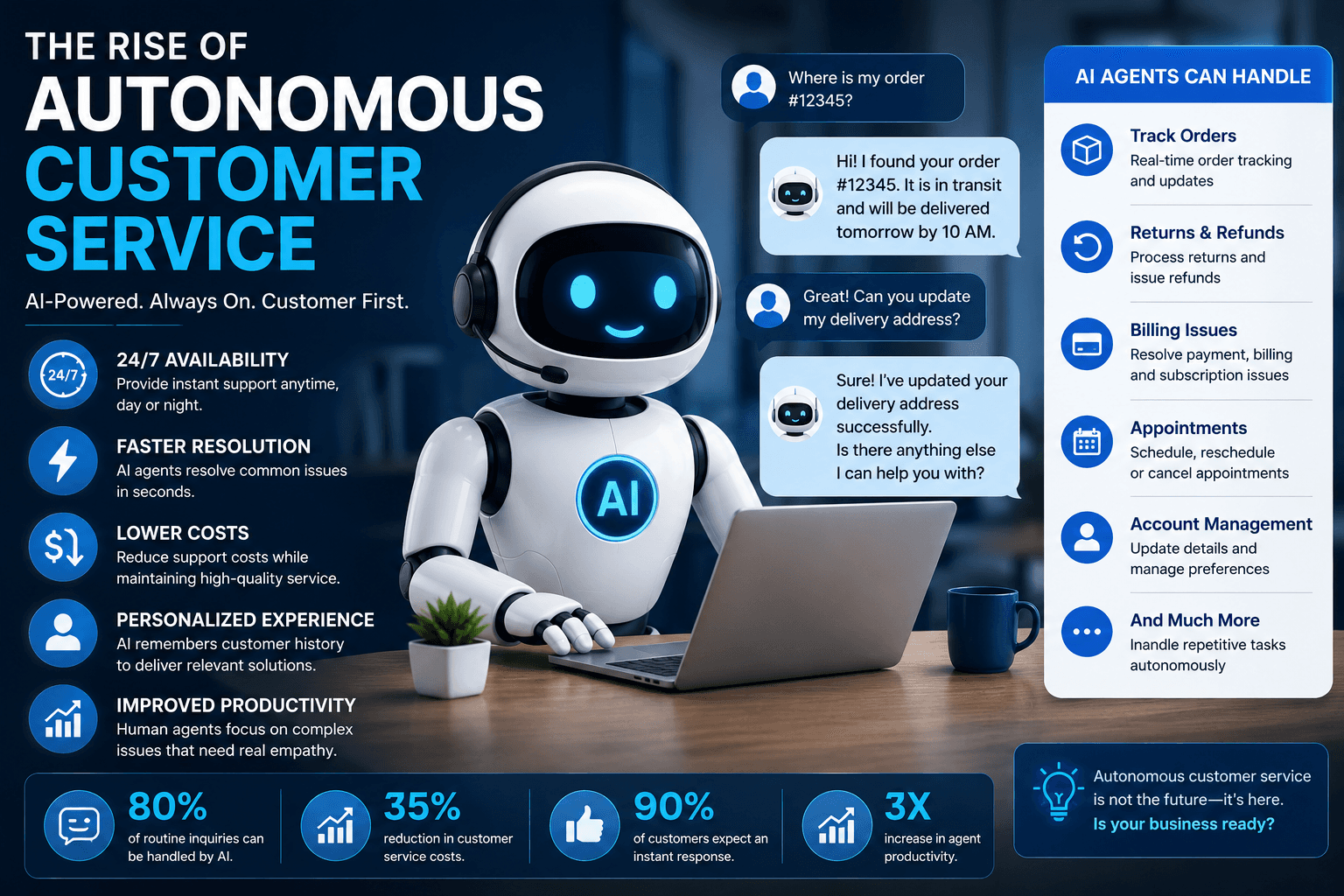

Customer service is undergoing a major transformation. In 2026, businesses are moving beyond traditional chatbots to autonomous customer service—AI systems that can understand requests, solve problems, process refunds, track orders, schedule appointments, and even make decisions without constant human intervention.
As customer expectations continue to rise, autonomous AI is becoming essential for businesses that want to deliver faster, smarter, and more personalized support.
What Is Autonomous Customer Service?
Autonomous customer service uses advanced AI agents that can complete entire customer support tasks independently. Unlike basic chatbots that follow scripted responses, autonomous AI understands context, remembers previous interactions, and takes action.
For example, an AI agent can:
Process product returns
Cancel or modify subscriptions
Track shipments
Update customer information
Schedule appointments
Resolve billing issues
Escalate only complex cases to human agents
Why Businesses Are Adopting Autonomous AI
Customers expect immediate responses 24/7. Hiring large support teams is expensive, while autonomous AI provides continuous support without delays.
Businesses are adopting AI because it helps:
Reduce operational costs
Improve customer satisfaction
Shorten response times
Handle thousands of conversations simultaneously
Increase employee productivity
Key Benefits
1. 24/7 Customer Support
AI agents never sleep, ensuring customers receive assistance anytime.
2. Faster Issue Resolution
Most common questions can be answered within seconds without waiting for a human representative.
3. Lower Support Costs
Businesses can reduce staffing costs while maintaining high-quality service.
4. Personalized Experiences
AI remembers customer history, preferences, and previous purchases to provide more relevant assistance.
5. Better Human Productivity
Support staff can focus on complex issues while AI handles repetitive tasks.
Industries Seeing the Biggest Impact
Autonomous customer service is transforming:
E-commerce
Banking
Healthcare
Telecommunications
Travel & Hospitality
Insurance
SaaS Companies
Education
Best Practices for Businesses
To successfully implement autonomous customer service, companies should:
Train AI using accurate business knowledge.
Keep customer information secure.
Allow easy transfer to human agents when necessary.
Regularly update AI with new policies and products.
Monitor AI performance and customer feedback.
Challenges to Consider
Businesses should address:
Data privacy and compliance
AI transparency
Handling complex or emotional situations
Preventing incorrect automated decisions
Building customer trust
The best approach combines AI efficiency with human expertise.
The Future of Customer Support
Industry experts predict that autonomous AI will become the first point of contact for most customer interactions. Human agents will focus on strategic, high-value, and emotionally sensitive cases, while AI manages routine requests.
Companies that invest in autonomous customer service today will be better prepared to meet future customer expectations.
Final Thoughts
Autonomous customer service is redefining how businesses interact with customers. By automating repetitive tasks and delivering instant, personalized support, AI helps companies improve efficiency while enhancing the overall customer experience.
Organizations that embrace this technology now will gain a significant competitive advantage in the years ahead.
The Rise of Autonomous Customer Service: What Businesses Need to Know in 2026 — 20 FAQs
1. What is autonomous customer service?
Autonomous customer service refers to customer support systems powered by artificial intelligence that can understand customer requests, make decisions within defined boundaries, access business information, and complete tasks with limited human intervention. Unlike traditional chatbots that mainly provide predefined answers, autonomous systems can potentially handle multi-step processes such as checking an order, updating customer information, initiating a return, scheduling an appointment, or escalating a complex issue to a human agent. In 2026, autonomous customer service is increasingly focused on completing customer outcomes rather than simply responding to questions.
2. How is autonomous customer service different from traditional chatbots?
Traditional chatbots are generally designed to answer frequently asked questions or guide customers through predefined conversation flows. Autonomous customer service systems are more capable of understanding natural language, maintaining context, using information from multiple business systems, and taking actions on behalf of customers. For example, instead of telling a customer where to find their order status, an autonomous AI system could retrieve the order information, identify a shipping delay, explain the situation, and potentially initiate an approved resolution. The key difference is the movement from answering questions to completing tasks.
3. Why is autonomous customer service becoming important in 2026?
Businesses are facing growing customer expectations for fast, personalized, and always-available support. At the same time, customer service teams often face high workloads, repetitive requests, staffing challenges, and pressure to control operating costs. Autonomous AI can help organizations handle routine interactions at scale while allowing human employees to focus on complex cases. Advances in generative AI, AI agents, natural-language processing, speech technology, and enterprise integrations are making autonomous customer service more practical for a wider range of organizations.
4. Can autonomous AI completely replace human customer service agents?
Complete replacement is unlikely to be appropriate for most businesses. Autonomous AI can be highly effective for repetitive, predictable, and clearly defined requests, but human expertise remains valuable for emotionally sensitive situations, complex negotiations, unusual problems, complaints, high-value customers, and decisions requiring judgment. A stronger approach is often a human-AI customer service model, where AI handles routine interactions and humans take over when a situation requires empathy, authority, or specialized expertise. Businesses should design clear escalation rules rather than assuming every interaction should be automated.
5. What tasks can autonomous customer service systems perform?
Depending on their integrations and permissions, autonomous customer service systems can perform tasks such as answering product questions, checking order status, processing eligible returns, updating customer information, scheduling appointments, providing account information, troubleshooting common technical problems, sending documents, and routing complex cases. More advanced systems can coordinate multiple steps across CRM, order-management, payment, scheduling, and knowledge-management platforms. However, businesses should restrict autonomous actions according to risk, authorization, and regulatory requirements.
6. How do AI agents support autonomous customer service?
AI agents provide the reasoning and task-execution capabilities behind many autonomous customer service workflows. An AI agent can interpret a customer's objective, determine which steps are required, access approved tools or business systems, perform actions, evaluate the results, and continue the workflow when appropriate. For example, if a customer reports a delayed delivery, an AI agent could retrieve the order, examine shipping information, determine the available options, and initiate an approved resolution. This makes AI agents fundamentally different from systems that only generate conversational responses.
7. How can autonomous customer service improve customer experience?
Autonomous customer service can improve customer experience by reducing waiting times, providing 24/7 availability, maintaining conversation context, and resolving straightforward problems without requiring customers to repeat information. It can also provide more consistent responses across different channels. When properly designed, autonomous systems can reduce customer effort by completing tasks instead of directing customers through multiple menus or asking them to contact different departments. The quality of the experience, however, depends heavily on AI accuracy, system integration, escalation design, and the company's ability to provide human assistance when necessary.
8. Can autonomous customer service provide personalized support?
Yes. Autonomous customer service can use authorized customer information, previous interactions, account history, preferences, and current context to provide more personalized assistance. For example, an AI system could recognize a customer's existing subscription and provide information specifically relevant to that account rather than giving a generic response. However, personalization must be balanced with privacy and security. Businesses should only use information appropriately, clearly define access permissions, and avoid creating experiences that make customers feel that their personal information is being used unnecessarily.
9. What role does generative AI play in autonomous customer service?
Generative AI enables customer service systems to understand natural language and produce flexible responses instead of relying entirely on predefined scripts. It can summarize conversations, explain complex information, draft responses, interpret customer intent, and support multi-step interactions. When combined with tool access and business-system integrations, generative AI can become part of an autonomous workflow capable of taking actions. Businesses still need safeguards because generative AI can produce inaccurate or inappropriate information if it lacks reliable data, proper instructions, or sufficient oversight.
10. How can businesses ensure that autonomous customer service provides accurate information?
Businesses should connect autonomous systems to reliable and controlled sources of information rather than allowing them to generate important answers without verification. Retrieval systems, approved knowledge bases, real-time business data, validation rules, access controls, and human escalation can improve reliability. Organizations should also test AI systems against realistic customer scenarios and continuously monitor their performance. For high-impact areas such as financial transactions, healthcare-related information, legal matters, or account security, additional verification and human oversight may be necessary.
11. What are the biggest risks of autonomous customer service?
Major risks include incorrect responses, unauthorized actions, privacy violations, cybersecurity threats, biased outcomes, poor escalation, excessive automation, and customer frustration when the system cannot understand a complex situation. There is also a risk that businesses may give AI systems too much authority without establishing appropriate controls. Organizations should therefore define exactly what an AI system can access, what actions it can perform, when it must request confirmation, and when a human employee must take over.
12. How does autonomous customer service reduce business costs?
Autonomous systems can reduce costs by handling large volumes of repetitive customer requests without requiring a proportional increase in support staff. AI can also assist human agents by summarizing conversations, retrieving information, suggesting solutions, and automating administrative tasks. This can allow employees to spend more time on complex cases and relationship-building activities. However, businesses should evaluate the complete cost of implementation, including AI infrastructure, software, integration, monitoring, security, employee training, and ongoing maintenance, rather than assuming automation automatically produces savings.
13. What industries can benefit most from autonomous customer service?
Autonomous customer service can benefit industries with high volumes of repetitive customer interactions, including retail, e-commerce, banking, telecommunications, travel, hospitality, insurance, software, logistics, utilities, and subscription businesses. For example, an e-commerce company may automate order-status requests and returns, while a telecommunications provider may automate troubleshooting and account inquiries. The most suitable applications are generally those where processes are well-defined, business information is accessible, and the consequences of an incorrect action can be effectively controlled.
14. How does autonomous customer service work across multiple channels?
Advanced customer service systems can operate across websites, mobile applications, messaging platforms, email, social channels, and voice interfaces while maintaining relevant context. This can allow customers to start an interaction through one channel and continue it through another without repeatedly explaining the same issue. Businesses need integrated customer data and appropriate identity-management systems to make this possible. A genuinely omnichannel AI experience requires more than placing the same chatbot on multiple platforms; the systems must share the appropriate context and business information.
15. What is the role of voice AI in autonomous customer service?
Voice AI is becoming an important part of autonomous customer service because many customers still prefer speaking rather than typing when dealing with businesses. Modern voice systems can recognize natural speech, understand conversational intent, respond verbally, and potentially perform actions through connected business systems. This could make automated phone support more flexible than traditional interactive voice-response menus. However, voice systems need strong identity verification, accurate speech recognition, clear escalation processes, and appropriate security controls, especially when handling sensitive account information.
16. How should businesses decide which customer service tasks to automate?
Businesses should begin by identifying high-volume, repetitive, well-defined processes where automation can provide measurable value without creating excessive risk. Examples may include order tracking, appointment scheduling, frequently requested account information, basic troubleshooting, and eligible return requests. Companies should then evaluate the complexity, data requirements, financial impact, privacy implications, and consequences of errors for each workflow. High-risk or highly sensitive processes should generally receive stronger human oversight. Starting with controlled use cases allows organizations to measure performance before expanding autonomy.
17. What skills will customer service employees need as AI adoption increases?
As AI handles more repetitive tasks, customer service employees may increasingly focus on complex problem-solving, relationship management, escalation handling, negotiation, empathy, and AI supervision. Employees may also need to understand how AI systems work, how to verify AI-generated information, how to intervene when automation fails, and how to identify unusual customer situations. Rather than simply eliminating customer service roles, AI can change the nature of those roles by moving employees toward higher-value interactions that require human judgment.
18. How can businesses protect customer data when using autonomous AI?
Businesses should implement strong identity verification, access controls, encryption, data governance, audit logging, and strict permissions for AI systems. Autonomous agents should only access the information and tools necessary to perform their assigned tasks. Organizations should also establish policies for data retention, third-party AI providers, sensitive information, and employee access. Regular security testing and monitoring are important because an autonomous system connected to multiple business applications can create significant risks if its permissions or integrations are improperly configured.
19. What will autonomous customer service look like in the future?
Future autonomous customer service systems are likely to become more proactive and capable of coordinating complete customer journeys. Instead of waiting for customers to report problems, AI could identify certain issues and offer solutions before customers contact support. AI agents may also coordinate across CRM, billing, logistics, inventory, scheduling, and other enterprise systems. The most advanced experiences could combine text, voice, predictive analytics, and real-time personalization. Nevertheless, businesses will need to maintain appropriate human oversight and governance as AI systems receive greater decision-making authority.
20. What should businesses know before adopting autonomous customer service in 2026?
Businesses should view autonomous customer service as a transformation of the entire support workflow rather than simply another chatbot project. Successful implementation requires reliable customer data, clear business processes, strong system integrations, security controls, AI governance, employee training, performance monitoring, and well-defined human escalation. Companies should begin with practical use cases where the value is measurable and the risks are manageable. The goal should not be maximum automation; it should be better customer outcomes through the right balance of AI autonomy and human expertise.