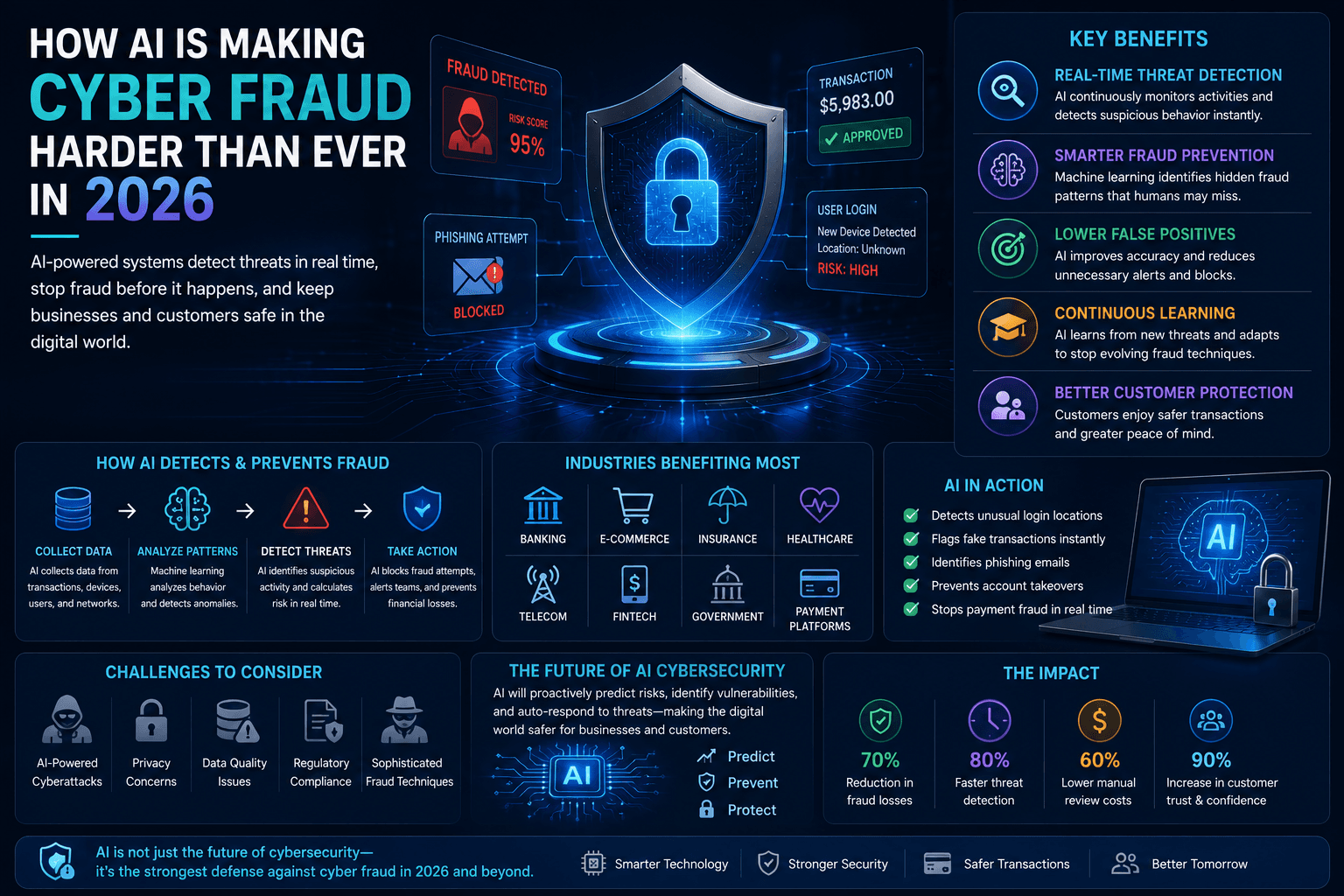

Cybercrime continues to evolve, but so do the technologies designed to stop it. In 2026, artificial intelligence has become one of the strongest defenses against cyber fraud. From detecting suspicious transactions to identifying phishing attacks in real time, AI is helping businesses and financial institutions stay one step ahead of cybercriminals.
As digital payments and online transactions increase worldwide, AI-powered fraud prevention is becoming an essential part of modern cybersecurity.
What Is AI-Powered Fraud Detection?
Ai POWERED fraud detection uses machine learning, behavioral analytics, and real-time monitoring to identify unusual activities that may indicate fraud.
Unlike traditional security systems that rely on predefined rules, AI continuously learns from new threats and adapts to changing attack methods.
For example, AI can:
Detect unauthorized account access
Identify fake transactions instantly
Recognize phishing emails
Prevent identity theft
Monitor suspicious login behavior
Stop payment fraud before it happens
Why Businesses Are Investing in AI Security
Traditional fraud detection systems often react after an attack occurs. AI analyzes millions of data points in real time, allowing businesses to detect and prevent threats before damage is done.
Companies adopting AI cybersecurity benefit from:
Faster fraud detection
Reduced financial losses
Improved customer trust
Better regulatory compliance
Stronger data protection
Key Benefits
1. Real-Time Threat Detection
AI continuously monitors networks and transactions, identifying suspicious behavior within seconds.
2. Smarter Fraud Prevention
Machine learning identifies hidden fraud patterns that humans may overlook.
3. Lower False Positives
Modern AI systems reduce unnecessary security alerts while improving detection accuracy.
4. Continuous Learning
AI improves automatically by learning from every new cyberattack and fraud attempt.
5. Better Customer Protection
Customers enjoy safer online banking, shopping, and digital payment experiences.
Industries Benefiting the Most
AI fraud detection is protecting:
Banking
E-commerce
Insurance
Healthcare
Telecommunications
Government
Financial Technology (FinTech)
Online Payment Platforms
Best Practices for Businesses
Organizations should:
Combine AI with human security experts.
Regularly update cybersecurity policies.
Train employees to recognize phishing attempts.
Encrypt sensitive customer information.
Monitor AI systems for emerging threats.
Challenges to Consider
Businesses should also prepare for:
AI-powered cyberattacks
Privacy concerns
Data quality issues
Compliance with security regulations
Sophisticated fraud techniques
Cybersecurity requires constant improvement as attackers continue developing new methods.
The Future of AI Cybersecurity
Experts predict AI will become the primary defense system for digital businesses. Instead of responding after an attack occurs, AI will proactively identify vulnerabilities, predict risks, and automatically stop threats before they spread.
Businesses that invest in AI-powered fraud prevention today will build stronger security, protect customer trust, and reduce financial risk in the years ahead.
Final Thoughts
AI is transforming cybersecurity by making cyber fraud more difficult, expensive, and risky for criminals. Through intelligent monitoring, predictive analytics, and real-time threat detection, businesses can defend themselves against increasingly sophisticated attacks.
As cyber threats continue evolving, AI-powered security will remain one of the most valuable investments organizations can make.
FAQs: How AI Is Making Cyber Fraud Harder Than Ever in 2026
1. Why is AI making cyber fraud harder to detect in 2026?
AI is making cyber fraud more difficult to detect because criminals can use advanced technologies to create more convincing messages, imitate communication styles, automate scams, and adapt their approaches quickly. Traditional fraud detection systems often rely on recognizable patterns, but AI can help attackers generate new variations that do not look identical to previous scams. This creates a constantly changing threat environment in which businesses and individuals need more advanced detection methods, stronger authentication, and continuous monitoring.
2. How is generative AI being used in cyber fraud?
Generative AI can make fraudulent communications more convincing by producing realistic emails, messages, websites, documents, and other content. It can also help attackers customize communications for specific targets using publicly available information. This means that fraudulent messages may contain fewer obvious spelling mistakes or generic statements than traditional scams. Organizations therefore need to look beyond basic writing quality when determining whether a communication is legitimate.
3. Can AI create more convincing phishing attacks?
Yes. AI can help criminals produce highly personalized phishing messages that appear relevant to specific individuals or organizations. A fraudulent message may imitate the language, tone, or communication style associated with a legitimate business or colleague. AI can also make it easier to generate large numbers of variations, making it harder for security teams to rely on simple keyword-based detection. Strong identity verification, email security, employee awareness, and multi-factor authentication remain important defenses.
4. How are deepfakes increasing the risk of financial fraud?
Deepfake technology can generate or manipulate audio, video, and images to make someone appear or sound like another person. In financial fraud, criminals may attempt to impersonate executives, customers, employees, or other trusted individuals. A fake voice message or video could potentially be used to support a fraudulent payment request or social-engineering attempt. Businesses should therefore avoid relying solely on voice or video as proof of identity and should use independent verification procedures for sensitive transactions.
5. Can AI-powered fraud imitate a company executive?
AI can help criminals create communications that appear to come from executives or other trusted employees. This may involve generating convincing text, imitating communication patterns, or combining different forms of synthetic media. Businesses can reduce this risk by requiring additional verification for unusual financial requests, changes to payment details, sensitive account actions, or urgent transfers. Employees should be encouraged to verify high-risk requests through a separate trusted communication channel.
6. How are businesses using AI to fight AI-powered cyber fraud?
Businesses are increasingly using AI for fraud detection, anomaly monitoring, behavioral analysis, identity verification, transaction monitoring, and threat detection. AI systems can examine large volumes of activity and identify patterns that may indicate suspicious behavior. For example, an organization may use machine learning to identify unusual login behavior or transactions that differ significantly from an account's normal activity. Combining AI-based detection with human investigation can provide stronger protection than relying on either approach alone.
7. Why are traditional cybersecurity defenses sometimes insufficient against AI-enabled fraud?
Traditional security tools often depend on known indicators, predefined rules, signatures, or previously observed attack patterns. AI-enabled fraud can change rapidly and generate new variations of malicious content. Attackers may also combine social engineering with legitimate-looking websites, compromised accounts, and synthetic media. This means organizations increasingly need layered security that combines behavioral analysis, identity verification, endpoint protection, employee awareness, transaction controls, and continuous threat monitoring.
8. How can individuals protect themselves from AI-powered cyber fraud?
Individuals should be cautious about unexpected requests for money, passwords, verification codes, or sensitive information, even when the request appears to come from someone familiar. Important requests should be independently verified using a trusted communication method. Strong unique passwords, multi-factor authentication, software updates, secure payment practices, and careful examination of links can also reduce risk. People should remember that realistic voices, images, messages, or videos are no longer sufficient proof that a communication is genuine.
9. What role will AI play in the future of fraud prevention?
AI is likely to become an increasingly important part of fraud prevention because it can process enormous amounts of information and identify unusual patterns quickly. Future systems may combine transaction behavior, device information, authentication signals, communication patterns, and other indicators to identify suspicious activity. AI may also help security teams investigate incidents and prioritize threats. However, human oversight will remain important because automated systems can produce false positives and may not understand every business or social context correctly.
10. What should businesses do to prepare for AI-powered cyber fraud in 2026?
Businesses should assume that fraudulent communications may become increasingly sophisticated and should build security processes around verification rather than appearance alone. Organizations should strengthen multi-factor authentication, establish approval controls for financial transactions, train employees to recognize sophisticated social engineering, protect privileged accounts, monitor unusual activity, and regularly test incident-response procedures. Companies should also evaluate how AI is being used internally and establish governance around synthetic media and automated decision-making. The strongest defense in 2026 is likely to be a combination of advanced technology, clear processes, employee awareness, and human judgment.