
Introduction
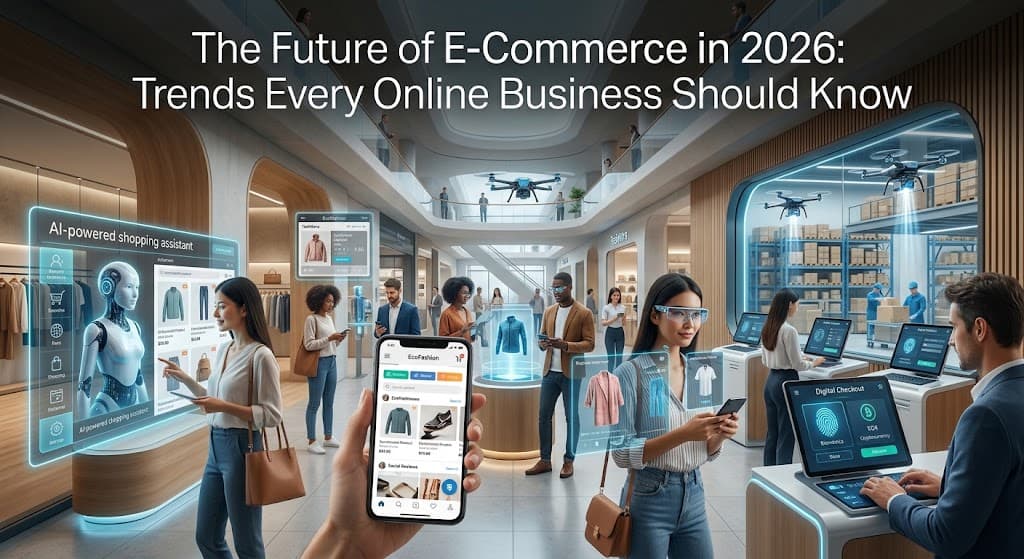
E-commerce continues to transform the way people discover, compare, and purchase products. In 2026, online businesses are increasingly using artificial intelligence, automation, social commerce, personalized experiences, digital payments, and faster delivery systems to compete in a changing marketplace.
For entrepreneurs, understanding the latest e-commerce trends in 2026 can help identify opportunities, improve customer experiences, and build more efficient online businesses.
1. AI Is Transforming E-Commerce
Artificial intelligence is becoming an important tool for online retailers. Businesses can use AI to analyze customer behavior, generate product descriptions, provide customer support, identify trends, and personalize shopping experiences.
AI can also help businesses automate repetitive tasks, allowing teams to spend more time on strategy and customer relationships.
2. AI-Powered Shopping Assistants
AI shopping assistants can help customers find products based on their needs, preferences, and budgets. Instead of searching through hundreds of products, shoppers can interact with conversational tools that provide recommendations.
These systems can make product discovery more interactive and convenient.
3. Personalized Shopping Experiences
Personalization is becoming increasingly important in e-commerce. Online stores can use customer behavior and purchase information to provide relevant recommendations, content, and offers.
Examples include recommended products, personalized emails, recently viewed items, and customized promotions.
4. Social Commerce Is Growing
Social media and online shopping are becoming more closely connected. Businesses can use social platforms to showcase products, engage audiences, and direct customers toward purchases.
Short-form videos, product demonstrations, creator content, and live shopping can help brands connect with potential buyers.
5. Short-Form Video Marketing
Video has become an important part of digital commerce. Businesses can demonstrate products, explain features, answer customer questions, and show products being used in real-life situations.
Short videos can also make product discovery more engaging for mobile users.
6. Mobile Commerce Continues to Expand
Many customers use smartphones as an important part of the shopping journey. Mobile-friendly websites, apps, digital wallets, fast checkout, and responsive product pages can improve the mobile shopping experience.
Businesses that make mobile purchasing simple can reduce unnecessary friction during checkout.
7. Faster and More Flexible Delivery
Delivery is a major part of the customer experience. Online shoppers increasingly value accurate delivery information, flexible delivery options, tracking, and convenient returns.
Businesses are therefore investing in better logistics, inventory systems, and fulfillment strategies.
8. Buy Now, Pay Later and Digital Payments
Digital payment methods are giving consumers more ways to complete online purchases. Depending on the market and provider, shoppers may have access to digital wallets, installment services, bank transfers, cards, and other payment options.
Offering trusted and convenient payment methods can make checkout easier.
9. Voice and Conversational Commerce
Voice assistants and conversational interfaces can change how customers search for products. Instead of typing traditional keywords, users can describe what they need using natural language.
As conversational AI improves, product discovery may become more interactive.
10. Augmented Reality Shopping
Augmented reality can allow shoppers to visualize products before buying them. Depending on the retailer, customers may be able to preview furniture in a room, explore product details, or virtually try certain items.
This technology can help customers understand products before making purchasing decisions.
11. Omnichannel E-Commerce
Customers often move between websites, social media, mobile apps, and physical stores. Omnichannel strategies aim to create a more consistent experience across these different channels.
For example, a customer might discover a product on social media, research it on a website, and purchase it through a mobile device.
12. Sustainable E-Commerce
Environmental considerations are becoming part of business and consumer discussions. E-commerce companies can explore recyclable packaging, reduced packaging waste, efficient shipping, responsible sourcing, and product recycling programs.
Sustainability strategies can also help businesses identify opportunities to reduce operational waste.
13. Subscription E-Commerce
Subscription models allow customers to receive products or services on a recurring schedule. Common examples include beauty products, food and beverage products, household items, software, and digital memberships.
Businesses need to provide consistent value and make subscription management easy for customers.
14. Customer Reviews and Social Proof
Reviews remain an important part of online shopping. Customers often use ratings, written reviews, photographs, and videos to understand products before purchasing.
E-commerce businesses can encourage genuine customer feedback and display useful product information clearly.
15. Better Product Search
Search technology is becoming more sophisticated. AI-powered search can understand natural-language queries and customer intent instead of relying only on exact keywords.
Visual search is another developing area, allowing shoppers to search using images or pictures of products.
16. E-Commerce Automation
Automation can help online businesses manage repetitive operations. Businesses can automate email campaigns, inventory notifications, order updates, customer support workflows, and certain marketing activities.
The goal is not simply to automate everything but to use technology where it improves efficiency without reducing customer service quality.
17. Data-Driven E-Commerce
Online stores can collect information about product views, conversions, customer behavior, traffic sources, and sales performance.
Analyzing this information can help businesses understand which products perform well and where customers leave the purchasing process.
18. Cybersecurity and Customer Trust
As e-commerce grows, protecting customer information becomes increasingly important. Businesses need appropriate security measures for accounts, payment information, websites, and internal systems.
Strong authentication, secure payment processing, software updates, access controls, and employee awareness can help reduce common security risks.
19. The Growth of Niche Online Stores
Large marketplaces are not the only option for entrepreneurs. Niche online stores can focus on specific audiences and specialized products.
A focused brand can build its identity around a particular customer need, interest, lifestyle, or professional market.
20. The Future of E-Commerce in 2026
The e-commerce industry is moving toward more personalized, automated, conversational, and connected shopping experiences.
AI can help businesses understand customers and automate operations, while social commerce and short-form video can influence product discovery. At the same time, payment technology, logistics, cybersecurity, and customer service remain essential parts of online retail.
Businesses that understand their customers, provide useful products, maintain transparent policies, and use technology responsibly can adapt to the changing e-commerce environment.
Conclusion
The future of e-commerce in 2026 is being shaped by AI, personalization, social commerce, mobile shopping, digital payments, automation, augmented reality, better logistics, and data-driven decision-making.
For online businesses, technology provides new opportunities, but successful e-commerce still depends on fundamentals such as product quality, customer trust, competitive pricing, reliable delivery, secure payments, and excellent service.
Entrepreneurs who combine useful technology with a strong understanding of their customers can build adaptable online businesses and respond to changing shopping habits.
Frequently Asked Questions
1. What are the biggest e-commerce trends in 2026?
Major trends include AI-powered shopping, personalization, social commerce, mobile commerce, automation, digital payments, conversational shopping, and improved logistics.
2. How is AI changing e-commerce?
AI can support product recommendations, customer service, search, marketing, data analysis, content creation, and business automation.
3. What is social commerce?
Social commerce combines social media and online shopping, allowing businesses to promote and sell products through social platforms.
4. Why is personalization important in e-commerce?
Personalization can help customers discover products and content that are more relevant to their interests and shopping behavior.
5. Is mobile commerce still growing?
Mobile devices remain an important part of online shopping, making mobile-friendly websites and checkout experiences essential for many e-commerce businesses.
6. What is conversational commerce?
Conversational commerce uses chat interfaces, AI assistants, or messaging tools to help customers discover products and receive shopping assistance.
7. How does augmented reality help online shopping?
AR can allow customers to visualize certain products in their environment or explore products virtually before purchasing.
8. What is omnichannel e-commerce?
Omnichannel e-commerce connects different customer touchpoints, such as websites, apps, social media, and physical stores.
9. Why are customer reviews important?
Reviews can provide shoppers with additional information about product quality, usability, and customer experiences.
10. What payment methods should an online store offer?
Options vary by market, but businesses may offer cards, bank payments, digital wallets, and other trusted payment solutions.
11. What is e-commerce automation?
E-commerce automation uses software to handle repetitive activities such as order updates, email campaigns, inventory alerts, and certain customer-service tasks.
12. How can small businesses compete in e-commerce?
Small businesses can focus on niche markets, strong customer service, unique products, useful content, personalized experiences, and efficient digital marketing.
13. What is visual search?
Visual search allows users to search for products or information using an image rather than relying only on text.
14. Why is cybersecurity important for online stores?
E-commerce businesses handle customer accounts, payment information, and other sensitive data, making security an important part of customer trust.
15. What is subscription e-commerce?
Subscription e-commerce provides products or services to customers on a recurring schedule, usually through recurring payments.
16. How can businesses improve e-commerce conversion rates?
They can improve product information, website speed, mobile usability, checkout simplicity, trust signals, payment options, and customer support.
17. Will AI replace e-commerce employees?
AI can automate certain tasks, but businesses still require people for strategy, relationship management, creativity, operations, and many customer-facing responsibilities.
18. Why is short-form video useful for e-commerce?
Short videos can demonstrate products, explain features, answer questions, and help customers discover products.
19. What is sustainable e-commerce?
Sustainable e-commerce includes practices such as reducing packaging waste, improving shipping efficiency, using responsible materials, and considering product lifecycle impacts.
20. What is the future of online shopping?
Online shopping is becoming increasingly personalized, mobile-friendly, automated, social, and AI-assisted while customer trust, security, convenience, and service remain important.