
Introduction
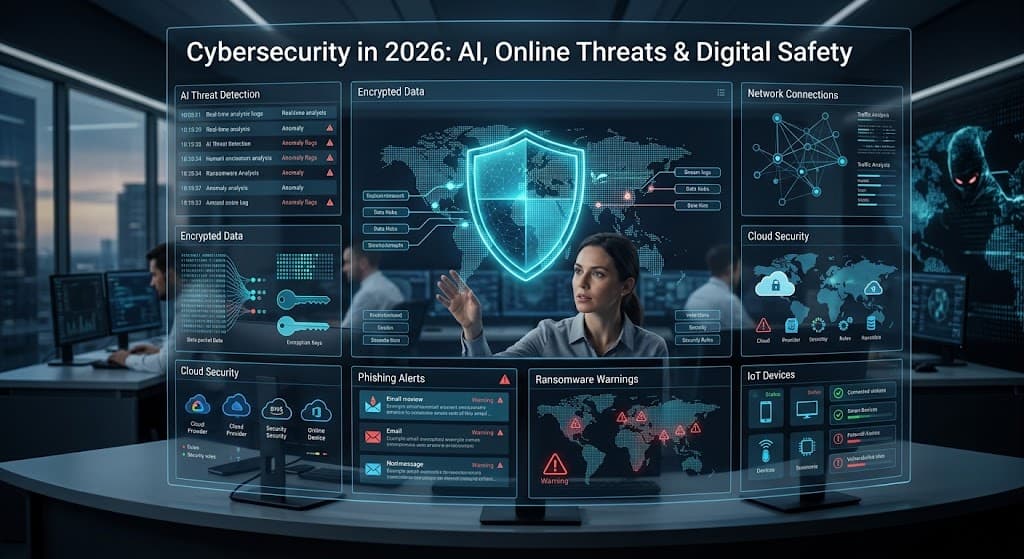
Cybersecurity is becoming increasingly important as people, businesses, and governments rely on connected devices and digital services. In 2026, artificial intelligence, cloud computing, IoT devices, and sophisticated cyberattacks are shaping the cybersecurity landscape.
1. The Growing Importance of Cybersecurity
More personal information, financial activity, and business operations are taking place online, increasing the importance of protecting digital systems and sensitive data.
2. AI-Powered Cyberattacks
Attackers can use AI to automate certain activities, generate convincing messages, analyze information, and adapt attacks more quickly.
3. AI for Cybersecurity Defense
Security teams are also using AI and machine learning to detect unusual behavior, identify potential threats, analyze large amounts of security data, and support incident response.
4. Ransomware Threats
Ransomware remains a significant cybersecurity concern. These attacks can restrict access to systems or data and demand payment from victims.
5. Phishing Is Becoming More Sophisticated
Phishing attacks increasingly use personalized and convincing messages to trick users into revealing passwords, financial information, or other sensitive data.
6. Cloud Security
As organizations move applications and data to cloud environments, protecting cloud accounts, configurations, applications, and access permissions has become an important security priority.
7. IoT Security Challenges
Smart cameras, appliances, industrial sensors, wearables, and other connected devices can create additional security risks when they are poorly configured or not regularly updated.
8. Zero-Trust Security
Zero-trust approaches are designed around the principle of continuously verifying users, devices, and access rather than automatically trusting systems inside a network.
9. Passwordless Authentication
Passkeys, biometrics, security keys, and other authentication technologies are providing alternatives to traditional passwords and can reduce certain password-related risks.
10. Mobile Device Security
Smartphones and tablets contain sensitive personal and financial information, making device updates, secure authentication, app permissions, and privacy settings increasingly important.
11. Data Privacy in the Digital Age
Organizations collect enormous amounts of information. Strong privacy practices and responsible data handling are therefore important parts of modern cybersecurity.
12. The Future of Cybersecurity
Cybersecurity will continue evolving alongside technology. Organizations are likely to combine AI-assisted defenses, stronger authentication, security monitoring, employee education, and resilient infrastructure to address emerging threats.
Of course! Here are more SEO-friendly headings + 20 FAQs for your cybersecurity article.
13. Identity Theft and Digital Fraud
Identity theft can occur when criminals obtain personal information and use it for unauthorized activities. Strong authentication and careful handling of personal data can help reduce exposure.
14. Cybersecurity for Small Businesses
Small businesses can face risks from phishing, malware, weak passwords, and outdated software. Basic security practices can provide an important layer of protection.
15. Security in Remote and Hybrid Work
Remote work can introduce additional security considerations, including unsecured networks, personal devices, and access to company systems from different locations.
16. The Role of Security Awareness Training
Employees are an important part of an organization's security strategy. Regular training can help people recognize suspicious links, messages, attachments, and login requests.
17. Endpoint Security in 2026
Laptops, smartphones, tablets, and other endpoints can become targets for cyberattacks. Endpoint security tools help organizations monitor and protect these devices.
18. Supply Chain Cybersecurity
Businesses often depend on software vendors, cloud providers, and third-party services. A security issue within one supplier can potentially affect connected organizations.
19. Protecting Personal Data Online
Using strong authentication, keeping software updated, reviewing privacy settings, and being cautious with unexpected messages are practical ways to improve personal digital security.
20. Cybersecurity and Artificial Intelligence
AI is creating both opportunities and challenges for cybersecurity. Security teams can use AI to analyze threats, while attackers may also use similar technologies to improve their methods.
21. Preparing for Future Cyber Threats
Organizations are increasingly focusing on security monitoring, backup strategies, incident-response plans, vulnerability management, and employee awareness to prepare for changing threats.
22. Why Cybersecurity Skills Matter
As digital systems expand, cybersecurity knowledge is becoming valuable across technology, finance, healthcare, education, government, and other industries.
FAQs
1. What is cybersecurity?
Cybersecurity is the practice of protecting computers, networks, applications, devices, and data from unauthorized access, attacks, damage, or disruption.
2. Why is cybersecurity important in 2026?
The increasing use of cloud services, AI, connected devices, digital payments, and online platforms makes protecting digital information increasingly important.
3. How is AI changing cybersecurity?
AI can help security teams analyze large amounts of information, identify unusual activity, detect potential threats, and support security operations.
4. Can hackers use AI?
Yes. AI can potentially be misused to automate or improve certain cyberattack activities, including creating convincing fraudulent messages.
5. What is ransomware?
Ransomware is malicious software that can prevent users from accessing systems or data and may demand payment from victims.
6. What is phishing?
Phishing is a type of social-engineering attack in which attackers use deceptive messages or websites to encourage people to reveal sensitive information.
7. How can I protect myself from phishing?
Avoid clicking unexpected links or attachments, verify unusual requests independently, check website addresses carefully, and use strong authentication.
8. What is zero-trust security?
Zero trust is a security approach that continuously verifies users, devices, and access rather than automatically trusting someone because they are inside a network.
9. What are passkeys?
Passkeys are a modern authentication method designed to let users sign in without traditional passwords, typically using cryptographic credentials supported by their device.
10. Is a password manager useful?
Password managers can help users create and securely store unique passwords, reducing the need to remember multiple credentials.
11. Why are software updates important for cybersecurity?
Updates can include security fixes that address vulnerabilities in operating systems, applications, browsers, and connected devices.
12. What is cloud security?
Cloud security involves protecting cloud-based applications, infrastructure, accounts, configurations, and data from unauthorized access and other threats.
13. Are smartphones vulnerable to cyberattacks?
Yes. Smartphones can be targeted through malicious apps, phishing, unsafe networks, account attacks, and other techniques.
14. What is IoT security?
IoT security focuses on protecting internet-connected devices such as cameras, smart appliances, sensors, and industrial equipment.
15. How can businesses improve cybersecurity?
Businesses can use strong authentication, regular updates, access controls, backups, security monitoring, employee training, and incident-response planning.
16. What is endpoint security?
Endpoint security protects devices such as computers, laptops, smartphones, and tablets that connect to an organization's systems.
17. Why is cybersecurity awareness important?
People who understand common cyber threats may be better prepared to recognize suspicious messages, links, login requests, and other potential attacks.
18. What is identity theft?
Identity theft occurs when someone obtains and misuses another person's personal information, potentially for financial or other unauthorized activities.
19. What are the biggest cybersecurity challenges in 2026?
Key challenges include increasingly sophisticated phishing, ransomware, AI-assisted attacks, cloud-security risks, IoT vulnerabilities, data breaches, and third-party security risks.
20. What is the future of cybersecurity?
Cybersecurity is likely to increasingly combine AI-assisted detection, stronger authentication, automated monitoring, privacy protections, employee education, and resilient security infrastructure.