
Introduction
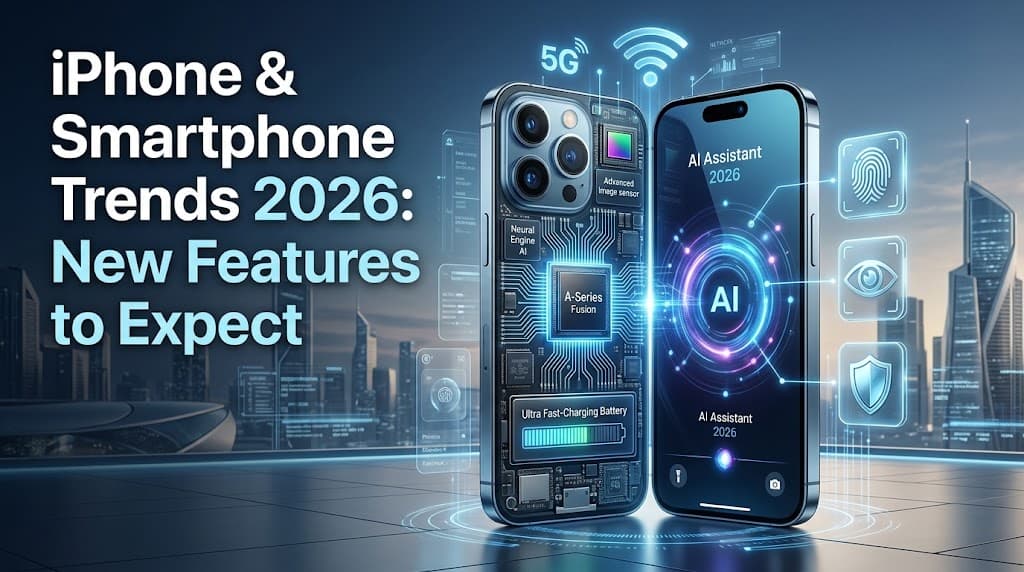
Smartphones continue to evolve rapidly in 2026. Instead of focusing only on faster processors and better cameras, manufacturers are increasingly competing through artificial intelligence, battery technology, privacy, displays, connectivity, and smarter software experiences.
Consumers now expect their phones to do more than make calls, browse social media, and take pictures. Modern smartphones are becoming personal AI assistants, productivity devices, entertainment hubs, and even tools for managing everyday tasks.
So, what smartphone features are people looking for in 2026? From smarter AI capabilities to longer battery life and improved cameras, several trends are shaping the next generation of mobile devices.
1. AI-Powered Smartphones Are Becoming Mainstream
Artificial intelligence is one of the biggest smartphone trends in 2026.
Instead of requiring users to open separate applications, AI features are increasingly integrated directly into the operating system. Smartphones can help summarize messages, organize information, edit photos, translate conversations, generate text, and assist with everyday tasks.
The biggest change is the move toward on-device AI. Processing more AI tasks directly on the phone can improve speed and privacy while reducing dependence on cloud services.
Consumers increasingly want smartphones that understand context and provide useful assistance without requiring complicated commands.
2. Longer Battery Life Is Still a Top Priority
Despite improvements in smartphone technology, battery life remains one of the most important purchasing factors.
In 2026, consumers are looking for phones that can comfortably last throughout a busy day. Manufacturers are responding with more efficient processors, improved battery designs, faster charging, and better power management.
Fast charging is also becoming increasingly important. Users want to spend less time connected to a charger and more time using their devices.
Future smartphones are likely to focus not only on larger batteries but also on energy efficiency and intelligent battery management.
3. Smartphone Cameras Are Getting Smarter
Camera technology remains a major selling point.
Modern smartphones already offer multiple lenses, advanced stabilization, computational photography, and impressive low-light performance. In 2026, AI is taking smartphone photography even further.
AI-powered cameras can automatically improve lighting, remove unwanted objects, enhance details, and optimize images based on the scene.
Video recording is also becoming more advanced. Better stabilization, improved microphones, higher-resolution recording, and smarter editing tools are attracting creators and everyday users alike.
For many consumers, a smartphone has effectively replaced a traditional point-and-shoot camera.
4. Brighter and More Efficient Displays
Smartphone displays are another area receiving significant attention.
Consumers want screens that are bright enough to use outdoors while remaining comfortable for long periods. High refresh rates provide smoother scrolling and gaming, while improved display technology can make colors and contrast more impressive.
Foldable smartphones are also continuing to influence the market. Foldable designs can provide larger screens while maintaining a relatively compact form factor.
However, consumers still expect manufacturers to improve durability, reduce visible display creases, and make foldable devices more affordable.
5. Privacy and Security Are Becoming More Important
As smartphones store increasing amounts of personal information, privacy is becoming a major concern.
Phones now contain photographs, financial information, conversations, passwords, location information, and other sensitive data.
Consumers therefore want stronger security features, including improved biometric authentication, encrypted data, secure AI processing, and better control over app permissions.
Privacy-focused features could become an increasingly important factor when people choose between competing smartphone brands.
6. Faster and More Reliable Connectivity
Connectivity continues to improve as mobile networks evolve.
5G remains important, while newer network technologies are expected to provide faster speeds, lower latency, and better reliability in supported regions.
Modern smartphones are also improving Wi-Fi performance and Bluetooth connectivity.
For consumers, better connectivity means faster downloads, smoother video calls, improved cloud gaming, and more reliable streaming.
7. More Powerful Smartphone Processors
Smartphone processors are becoming increasingly sophisticated.
Performance is no longer only about opening apps quickly. Modern chips are designed to handle AI workloads, gaming, photography, video editing, multitasking, and other demanding applications.
Dedicated AI processing capabilities are particularly important because they allow smartphones to perform advanced tasks more efficiently.
For users, this means smartphones can potentially remain useful and responsive for longer periods.
8. More Durable Smartphone Designs
Consumers increasingly want smartphones that can survive everyday accidents.
Manufacturers are improving glass, frames, water resistance, and other protective features. Durability is especially important because premium smartphones can be expensive to replace.
Repairability is also receiving greater attention. Consumers and regulators are increasingly interested in products that can be repaired rather than completely replaced when a component fails.
Longer software-support periods can further extend the useful life of smartphones.
9. Foldable and New Smartphone Designs
Foldable phones continue to represent one of the most interesting areas of smartphone innovation.
Book-style foldables can transform from traditional phone-sized devices into larger tablet-like screens. Flip-style models offer a compact design when folded.
Manufacturers are also experimenting with thinner designs and new form factors.
The biggest challenge remains balancing innovation with affordability, durability, battery life, and practicality.
10. Smartphones Are Becoming Productivity Tools
Smartphones are increasingly being used for work and education.
Users can attend video meetings, edit documents, manage projects, create presentations, communicate with teams, and use AI assistants directly from their phones.
Larger displays, desktop-style interfaces, improved multitasking, and better accessories are making smartphones more useful as productivity devices.
For students and professionals, these features can make a smartphone a much more powerful everyday tool.
What Consumers Really Want in 2026
Although manufacturers continue to introduce flashy new features, consumers often prioritize practical improvements.
The most desirable smartphone features include:
Longer battery life
Faster charging
Better cameras
Useful AI tools
Bright and durable displays
Strong privacy protection
Long-term software updates
Better performance
Durable designs
Reliable connectivity
Affordable pricing
The key trend is that consumers want technology that solves real problems rather than simply adding complexity.
How AI Could Change Smartphones Further
AI may become the defining smartphone technology of this generation.
Instead of simply responding to questions, future AI assistants could help users organize schedules, manage communications, summarize information, search through personal content, and automate repetitive tasks.
However, this development also raises questions about privacy and data security.
Consumers will likely expect manufacturers to provide transparent controls explaining what information AI systems can access and how that information is processed.
Are Expensive Smartphones Still Worth Buying?
Not necessarily.
Premium smartphones offer advanced processors, cameras, displays, and additional features, but mid-range devices are becoming increasingly capable.
For many consumers, a mid-range phone may provide everything they need, particularly if they primarily use their device for messaging, social media, photography, streaming, and everyday productivity.
The best smartphone in 2026 is therefore not automatically the most expensive one. It is the device that provides the features a particular user actually needs.
What to Look for When Buying a Smartphone in 2026
Before purchasing a new phone, consumers should consider more than specifications.
Look at:
Battery: Check real-world battery performance and charging speed.
Camera: Consider photo quality in different lighting conditions rather than megapixel numbers alone.
Software support: Longer update commitments can significantly extend a phone's useful life.
AI features: Determine whether the AI tools are genuinely useful for your daily activities.
Durability: Water resistance and strong materials can help protect your investment.
Performance: Choose a processor suitable for your gaming, productivity, and multitasking needs.
Price: Compare the complete package instead of paying extra for features you may never use.
The Future of Smartphones
The smartphone industry is moving toward devices that are more intelligent, personalized, efficient, and connected.
AI will likely remain at the center of this transformation, while improvements in batteries, cameras, displays, processors, and connectivity will continue to make phones more capable.
At the same time, consumers will increasingly demand privacy, durability, affordability, and longer software support.
The smartphone of the future may feel less like a traditional mobile device and more like an intelligent personal computer that fits in your pocket.
Conclusion
The biggest smartphone trends in 2026 are not simply about making devices faster. They are about making smartphones smarter, more useful, more secure, and more efficient.
AI-powered features, longer battery life, advanced cameras, improved displays, stronger security, foldable designs, and better connectivity are all shaping the industry.
For consumers, the growing competition between smartphone manufacturers is good news. As technology improves, buyers have more choices across premium, mid-range, and budget categories.
The winners in the 2026 smartphone market will likely be the devices that combine innovative technology with features that genuinely improve everyday life.
FAQs
1. What is the biggest smartphone trend in 2026?
AI-powered smartphone features are among the biggest trends, with manufacturers integrating AI into cameras, productivity tools, search, communication, and device management.
2. Are smartphones becoming more powerful in 2026?
Yes. Newer processors are designed to improve performance, gaming, multitasking, photography, and AI processing.
3. Is smartphone AI useful?
It can be, particularly for tasks such as summarizing information, editing photos, translating content, writing, and organizing everyday activities.
4. Are foldable phones becoming more popular?
Foldable smartphones continue to attract attention because they provide larger displays in compact designs, although price and durability remain important considerations.
5. Will smartphone batteries improve in 2026?
Manufacturers are continuing to improve battery capacity, charging technology, processor efficiency, and intelligent power management.
6. Are smartphone cameras replacing digital cameras?
For everyday photography, smartphones have already replaced many compact cameras. Advanced cameras still offer advantages for professional photography.
7. Why is on-device AI important?
On-device AI can process certain tasks directly on the smartphone, potentially improving response times and privacy.
8. What smartphone feature do consumers want most?
Battery life, camera quality, performance, AI capabilities, durability, and price are among the most important factors for buyers.
9. Are expensive smartphones worth buying?
It depends on the user. Premium phones can offer advanced features, but many mid-range devices provide excellent value.
10. How important is 5G in 2026?
5G remains important for faster mobile connectivity, although the benefits depend on network availability in a user's location.
11. Will smartphones become thinner?
Manufacturers continue to work on thinner designs, but they must balance thinness with battery capacity, durability, cameras, and cooling.
12. Are smartphone displays improving?
Yes. Higher brightness, smoother refresh rates, better efficiency, and improved durability are important display trends.
13. How important is smartphone security?
It is extremely important because smartphones contain personal, financial, communication, and location data.
14. Will smartphone software support become longer?
Longer software-support periods are becoming increasingly important as consumers want to keep their phones for several years.
15. What should I check before buying a smartphone?
Consider battery life, camera performance, processor, display, software support, durability, connectivity, AI features, and overall price.
16. Are mid-range smartphones good in 2026?
Yes. Mid-range phones can offer strong performance and useful cameras and displays without the price of premium models.
17. What role will AI play in future smartphones?
AI could become a central part of smartphone operating systems, helping users with communication, search, productivity, photography, and automation.
18. Will smartphone cameras improve further?
Yes. AI processing, sensors, stabilization, computational photography, and video capabilities are expected to continue improving.
19. What makes a smartphone future-proof?
A capable processor, long software support, good battery health, strong connectivity, durable hardware, and useful AI capabilities can help a phone remain relevant longer.
20. What is the future of smartphones?
The future is likely to focus on intelligent AI assistants, better battery technology, advanced cameras, flexible displays, stronger privacy, and increasingly personalized experiences.