

Introduction
What if the computers of the future were not made entirely from silicon, metal, and wires? Scientists are exploring a fascinating possibility: using living biological cells as computing systems.
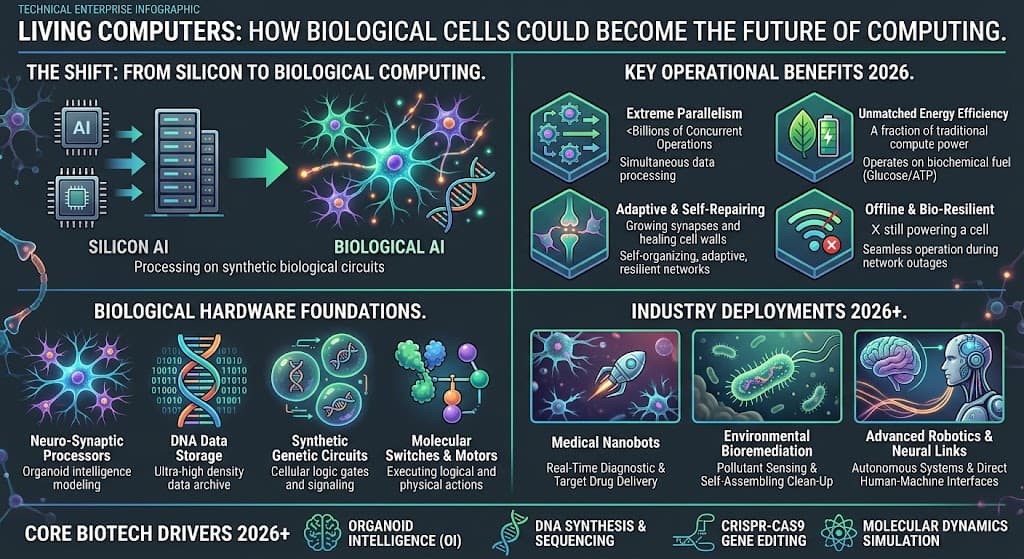
This emerging field, often connected with biocomputing, biological computing, and organoid intelligence, explores how biological materials can process information and potentially perform certain computing tasks.
Instead of relying only on traditional electronic circuits, future systems could combine biology with technology to create a completely new type of computer.
What Are Living Computers?
Living computers are experimental computing systems that use biological components—such as cells, neurons, DNA, or microorganisms—to process information.
Traditional computers use electrical signals moving through semiconductor circuits. Biological systems, however, can process information through complex networks of chemical and electrical signals.
Researchers are investigating whether these natural capabilities can be used for computation.
The concept is still in its early stages, but it could eventually complement traditional computing rather than simply replace it.
How Could Biological Cells Perform Computation?
Biological cells constantly receive information from their surroundings and respond to it.
For example, cells can:
Detect chemical signals
Communicate with other cells
Change their internal state
Store biological information
Respond to environmental changes
Form complex networks
Scientists can potentially use these behaviors to create systems that perform specific computational tasks.
What Is Organoid Intelligence?
One particularly interesting area is organoid intelligence.
Researchers can grow small three-dimensional clusters of biological cells called organoids. Some organoids can contain networks of neurons that exhibit certain properties of biological neural systems.
Scientists are studying whether these biological networks can interact with computers and learn to perform simple tasks.
This does not mean researchers have created a miniature human brain or a conscious computer. The technology remains experimental.
Why Are Scientists Interested in Biological Computing?
Modern AI systems require enormous amounts of computing power and energy.
Biological brains, meanwhile, are remarkably efficient at certain types of information processing.
This has encouraged researchers to investigate whether biological systems could offer new approaches to computing.
Potential advantages include:
High energy efficiency
Parallel information processing
Adaptability
Learning capabilities
Complex pattern recognition
New approaches to AI
Biological Computing vs Traditional Computing
Traditional computers use electronic components such as processors, memory chips, and transistors.
Biological computers could use cells, neurons, DNA, or other biological materials.
Traditional Computing | Biological Computing |
|---|---|
Uses electronic circuits | Uses biological systems |
Silicon-based hardware | Cells or biological materials |
Digital electrical signals | Biological and electrical/chemical signals |
Highly standardized | More biologically variable |
Mature technology | Experimental technology |
Biological computing is not currently positioned to replace conventional computers for everyday tasks.
Instead, researchers are exploring where biological systems might provide unique advantages.
The Role of Neurons
Neurons are especially interesting because they naturally process and transmit information.
A network of neurons can receive signals, modify connections, and respond to patterns.
This makes neural biological systems particularly interesting for research into:
Learning
Pattern recognition
Adaptive computing
AI
Robotics
Brain-computer interfaces
Scientists are investigating how biological neural networks could communicate with electronic systems.
Could Living Computers Help Artificial Intelligence?
Possibly.
Today's AI models can require significant computational resources for training and operation. Biological systems may offer alternative ways to process certain types of information.
Researchers are exploring whether biological neural networks could contribute to future AI systems that are more adaptive and energy efficient.
However, biological computing is not yet capable of replacing modern AI hardware at scale.
DNA Computing
Another branch of biological computing is DNA computing.
DNA stores enormous amounts of biological information in a very compact molecular structure.
Researchers have demonstrated ways of using DNA molecules to perform specific computational operations.
DNA computing could potentially be useful for specialized problems involving:
Data storage
Molecular analysis
Complex calculations
Biotechnology
Medical research
Could DNA Become a Data Storage System?
One of the most exciting possibilities is DNA-based data storage.
Unlike conventional storage technologies, DNA can store huge amounts of information in an extremely small physical space.
Scientists are researching methods for encoding digital information into DNA and later retrieving it.
However, practical challenges such as cost, speed, reliability, and laboratory requirements still need to be addressed.
Living Computers and Healthcare
Biological computing could eventually have applications in healthcare research.
For example, biological systems could potentially be used to study how cells respond to drugs or environmental changes.
Future applications might include:
Drug discovery
Disease research
Personalized medicine
Cellular modeling
Biological simulations
These applications could help researchers understand complex biological processes.
Living Computers and Robotics
Biological computing could also influence robotics.
Traditional robots generally depend on electronic processors and programmed algorithms. Future systems could potentially combine electronics with biological neural networks.
Such hybrid systems might be able to adapt to their environments in new ways.
This could be particularly interesting for:
Autonomous robots
Soft robotics
Adaptive machines
Prosthetics
Brain-computer interfaces
Major Challenges
Living computers are exciting, but significant challenges remain.
1. Biological Variability
Living cells do not behave exactly like standardized electronic components. Their behavior can vary between experiments.
2. Maintaining Cells
Biological systems require carefully controlled environments to remain healthy and functional.
3. Speed
Electronic processors can perform calculations extremely quickly. Biological systems may be slower for many conventional computing tasks.
4. Scaling
Creating a small biological computing experiment is very different from building a reliable large-scale computer.
5. Ethics
The use of living biological materials raises important ethical questions, particularly when researchers work with neural tissues.
Could Living Computers Become Conscious?
This is one of the most interesting questions surrounding biological computing.
Current experimental biological computing systems should not be assumed to possess consciousness, human-like intelligence, or self-awareness.
Researchers are actively studying the properties and limitations of biological neural systems, and ethical considerations become increasingly important as the technology develops.
Will Living Computers Replace PCs?
It is unlikely that biological computers will simply replace laptops and smartphones.
Instead, the future may involve hybrid computing, where electronic and biological technologies work together.
Traditional processors could handle conventional calculations while biological systems perform specialized tasks such as pattern recognition, adaptation, or molecular computation.
The Future of Biological Computing
Living computers remain an emerging research field, but they represent a completely different way of thinking about computation.
The future could combine:
AI + Biology + Electronics + Biotechnology
Such hybrid systems might help researchers develop new approaches to computing, medicine, robotics, and data storage.
The technology is still far from everyday consumer use, but its development could reshape our understanding of what a computer can be.
Conclusion
Living computers may sound like science fiction, but biological computing is already an active area of scientific research.
By exploring neurons, organoids, DNA, and other biological systems, researchers are investigating whether nature's information-processing capabilities can be combined with modern technology.
The biggest opportunity may not be replacing traditional computers, but creating new hybrid systems that combine the strengths of biology and electronics.
If successful, biological computing could become one of the most unusual and important technologies of the future.
FAQs
1. What is a living computer?
A living computer is an experimental computing system that uses biological components such as cells, neurons, organoids, or DNA to perform computational tasks.
2. Are living computers real?
Yes. Researchers are conducting experiments involving biological computing, including neural organoids and DNA-based computation. However, the technology is still in its early stages.
3. What is biological computing?
Biological computing is the use of biological systems or materials to store, process, or transmit information.
4. What is organoid intelligence?
Organoid intelligence is an emerging research area that investigates whether laboratory-grown biological organoids, particularly neural organoids, can be used in computing and learning experiments.
5. Can human brain cells be used for computing?
Researchers have explored biological neural cells and neural organoids for experimental computing applications. These systems are highly different from a complete human brain.
6. What is DNA computing?
DNA computing uses molecules of DNA to encode information and perform specific computational operations.
7. Can DNA store digital information?
Yes. Researchers have demonstrated methods for encoding digital information in DNA, although the technology is not yet a mainstream replacement for hard drives or solid-state storage.
8. Are biological computers faster than normal computers?
Not generally. Electronic computers are much faster for many conventional calculations. Biological computing is being investigated for specialized tasks where biological properties could provide advantages.
9. Why are scientists interested in living computers?
Scientists are interested because biological systems can process information efficiently, adapt to changing conditions, and perform complex forms of pattern recognition.
10. Could living computers improve AI?
They might contribute to new approaches to AI, particularly in areas involving adaptive learning and biological neural networks, but this remains an experimental field.
11. What is a neural organoid?
A neural organoid is a laboratory-grown three-dimensional collection of cells designed to model certain aspects of nervous-system development or organization.
12. Can biological computers learn?
Some experimental biological neural systems can show forms of adaptation or learning in controlled research settings. This should not be confused with human-like intelligence.
13. What are the advantages of biological computing?
Potential advantages include energy efficiency, adaptability, parallel processing, and the ability to work with complex biological information.
14. What are the disadvantages of living computers?
Challenges include biological variability, maintaining living cells, limited scalability, slower processing for many tasks, cost, and ethical considerations.
15. Can living computers replace silicon chips?
There is currently no reason to expect biological systems to completely replace silicon chips. They may instead become specialized or hybrid components of future computing systems.
16. How could living computers be used in medicine?
Potential applications include drug testing, disease research, cellular modeling, biological simulations, and studying how living systems respond to treatments.
17. Could biological computers be used in robotics?
Possibly. Researchers could explore biological neural systems as components of adaptive or hybrid robotic systems.
18. What is hybrid biological computing?
Hybrid biological computing combines biological components with electronic hardware and software to create systems that use the strengths of both technologies.
19. Could biological computing save energy?
It could potentially reduce energy consumption for certain specialized computing tasks, but researchers still need to determine how biological systems compare with modern hardware in practical applications.
20. Is biological computing safe?
Biological computing requires careful laboratory procedures, biological safety practices, and ethical oversight. Safety depends on the specific biological materials and research methods involved.
21. Could living computers become conscious?
There is currently no evidence that experimental biological computing systems are conscious. Questions about consciousness and ethical treatment become important areas for discussion as biological neural systems become more sophisticated.
22. What industries could benefit from biological computing?
Potential areas include healthcare, biotechnology, pharmaceuticals, robotics, artificial intelligence, data storage, and scientific research.
23. How is biological computing different from AI?
AI is primarily a field of computational methods and algorithms. Biological computing explores the use of biological materials or systems themselves as part of computation. The two fields can potentially overlap.
24. When will living computers become mainstream?
There is no reliable timeline. Biological computing is still experimental, and substantial technical, economic, and ethical challenges must be addressed before widespread commercial adoption.
25. What is the future of living computers?
The most likely future is not biological computers replacing conventional machines, but hybrid systems where biology, AI, electronics, and biotechnology work together for specialized applications.