
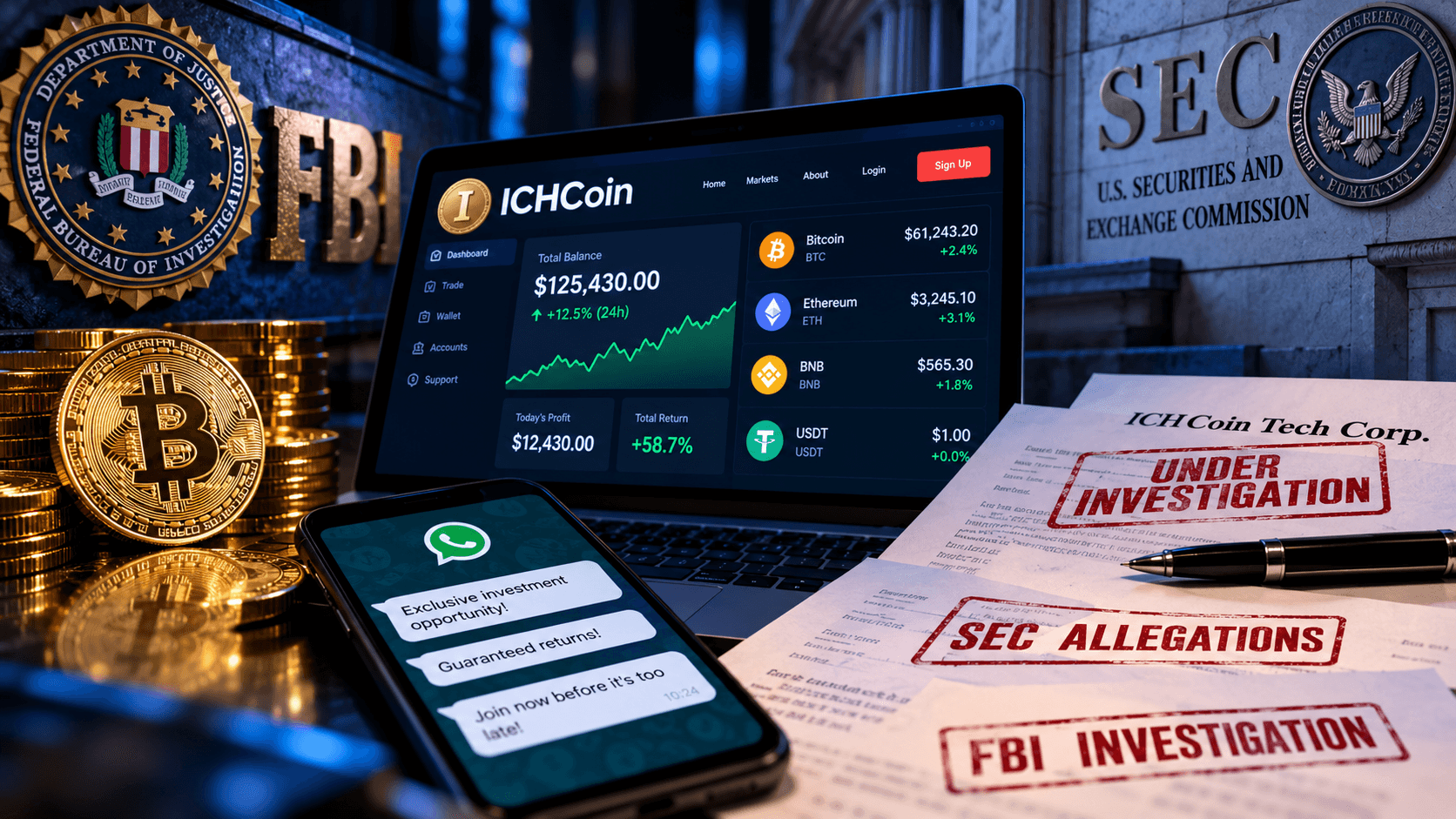

The cryptocurrency market continues to attract investors looking for new financial opportunities, but fraudulent investment schemes can exploit that interest through convincing websites, artificial trading profits, and misleading claims about technology.
The ICHCoin case illustrates why investors should independently verify cryptocurrency platforms before transferring funds. The U.S. Federal Bureau of Investigation (FBI) sought information from potential victims of ICHCoin in September 2024. In August 2026, the U.S. Securities and Exchange Commission (SEC) announced a separate civil enforcement action alleging false statements in the company's regulatory filings.
The case provides an opportunity to examine the warning signs identified by investigators, the allegations made by regulators, and the verification steps investors can take before trusting an unfamiliar investment platform.
What Was ICHCoin?
ICHCoin was associated with an investment platform that purported to use artificial intelligence-assisted software to trade cryptocurrency.
On September 26, 2024, the FBI's Houston Division published a notice seeking to identify potential victims of ICHCoin and similar investment platforms. The agency said it believed ICHCoin primarily targeted victims from December 2023 onward.
The FBI identified several warning signs associated with the platform and similar schemes, including unsolicited messages through WhatsApp or Telegram, promises of definite investment returns, suspicious advertisements promoting mobile applications, and requests that investors misrepresent transactions to their banks.
The FBI notice is an official source for understanding the investigation. It does not, by itself, establish that every person or business associated with a similarly named service committed fraud.
Primary source: FBI — Seeking Victim Information in ICHCoin Investigation
What Did the SEC Allege in 2026?
On August 28, 2026, the SEC announced charges against Ichcoin Tech Corp. relating to alleged false statements in regulatory filings.
According to the SEC's litigation release, the complaint alleged that the company made false statements in a Form ADV filing submitted on January 25, 2024. The filing reportedly included claims about the company's eligibility for exempt reporting adviser status, an office address in Albany, New York, and a telephone number and identification details.
The SEC alleged that the company was not eligible for the reporting status it claimed, did not maintain an office at the stated Albany address, and supplied identifying information that could not be substantiated as represented.
The agency filed its civil complaint in the U.S. District Court for the Northern District of New York on August 27, 2026. It sought injunctive relief and civil monetary penalties.
These are allegations made in a civil enforcement action. A complaint is not a final judgment, and the allegations should not be presented as judicially proven facts.
Primary source: SEC — Ichcoin Tech Corp., Litigation Release No. 26623
Five Crypto Investment Red Flags Highlighted by the Case
1. Promises of Guaranteed or Definite Returns
Investment promotions that promise definite returns deserve careful scrutiny. Cryptocurrency markets are volatile, and legitimate investment strategies cannot eliminate all risk.
Investors should ask how returns are generated, what risks are involved, and whether the performance claims can be independently verified.
2. Unsolicited Messages on WhatsApp or Telegram
The FBI identified unsolicited messaging-app contact as a warning sign in the ICHCoin investigation.
An unfamiliar person may approach a prospective investor, introduce an investment opportunity, and encourage them to move conversations to a private messaging platform.
Private messaging is not inherently suspicious. However, an unsolicited investment pitch combined with pressure to deposit cryptocurrency warrants additional verification.
3. Suspicious Investment Applications
A professional-looking mobile application does not prove that an investment business is genuine.
Before installing a trading application, verify the developer, official website, company identity, and relevant regulatory claims. Avoid downloading applications from unfamiliar links sent through private messages or advertisements.
4. Misleading Company or Regulatory Information
The SEC's allegations concerning Ichcoin Tech Corp. demonstrate why investors should independently check company details and regulatory representations.
A company registration, regulatory filing, or claimed license should be verified through the issuing authority. Registration alone does not necessarily authorize a company to offer investment services.
Investors should also confirm that the website, legal entity, and people promoting the investment actually correspond to the records they find.
5. Requests to Misrepresent Financial Transactions
The FBI identified requests to lie to a bank about transaction activity as another warning sign.
Investors should never misrepresent the purpose of a payment to a bank or financial institution to facilitate an investment. Such a request should prompt them to stop and independently verify the transaction before proceeding.
How Investors Can Verify a Crypto Investment Platform
Before sending money to an unfamiliar cryptocurrency platform, investors should conduct several checks:
Verify the company: Search official corporate records and confirm the legal entity's identity.
Check regulatory claims: Search the relevant regulator's official database and confirm whether the firm is authorized for the service it offers.
Inspect the website: Verify the exact domain and independently confirm contact details.
Review the investment claims: Look for transparent fees, credible explanations of returns, and meaningful risk disclosures.
Check the application: Confirm the developer and source before installing trading software.
Preserve evidence: Keep copies of promotional materials, communications, payment instructions, and transaction records.
No single check guarantees safety. A company may have a registration record without being authorized to provide a particular financial service, while a polished website may still misrepresent its operations.
What Should Investors Do If They Suspect Fraud?
Anyone who suspects that they have been targeted by a cryptocurrency investment scam should stop sending funds and preserve relevant evidence.
Records may include wallet addresses, transaction hashes, emails, messaging-app conversations, website URLs, and screenshots of account activity.
Investors should contact the relevant cryptocurrency exchange or financial institution through its official channels and report suspected fraud to the appropriate law enforcement agency or financial regulator.
They should also be cautious of people promising guaranteed recovery in exchange for upfront payments. The FBI warns that recovery services can themselves be fraudulent.
The FBI's official guidance is available at Cryptocurrency Investment Fraud.
Final Verdict: What the ICHCoin Case Teaches Investors
The ICHCoin investigation highlights the importance of independently checking investment claims, company identities, and regulatory information.
The FBI's 2024 victim-information notice identified specific warning signs associated with ICHCoin and similar investment platforms. The SEC's 2026 civil action separately alleged false statements in Ichcoin Tech Corp.'s regulatory filings.
Together, these official records provide a useful case study in why investors should not rely solely on advertised returns, professional-looking applications, or claims of regulatory status.
However, responsible reporting requires a distinction between an investigative notice, allegations in a regulatory complaint, and a final court judgment. Readers should consult the original records and follow subsequent legal developments before drawing broader conclusions.