
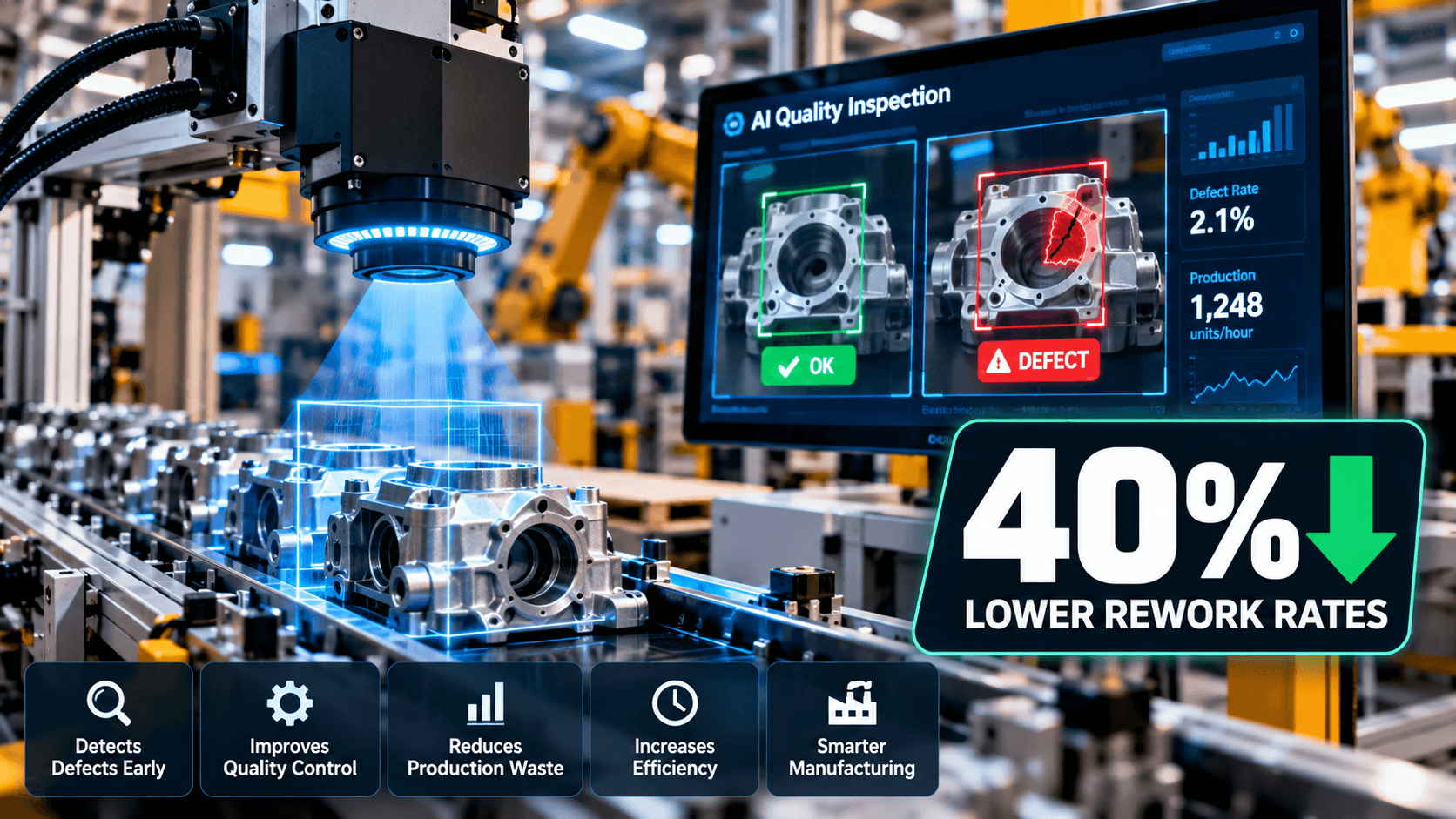

Manufacturing companies are under constant pressure to improve product quality, reduce production waste, and deliver finished goods faster. Yet one of the most expensive problems on the factory floor often begins with a small mistake: a defect that goes unnoticed during inspection.
A missing component, a hairline crack, a faulty weld, or a surface imperfection can travel through multiple production stages before anyone identifies it. By that point, correcting the problem may require additional labor, replacement materials, machine time, and repeated quality checks.
Artificial intelligence is changing how manufacturers approach this challenge. Vision AI systems use industrial cameras and machine learning models to identify visual defects, flag suspicious components, and provide quality teams with real-time information.
In suitable manufacturing environments, these systems can reduce missed defects, improve inspection consistency, and lower the amount of work required to repair nonconforming products. Some published case studies have reported improvements of approximately 40% in specific quality-related measures, although outcomes depend on the factory, product, and inspection process.
Why Traditional Quality Inspection Can Become a Production Bottleneck
Manual inspection remains important across manufacturing industries, including automotive components, electronics, textiles, food packaging, and industrial equipment.
Experienced inspectors can recognize unusual patterns, evaluate complex defects, and apply practical knowledge that automated systems may not possess. However, manual inspection can become difficult when production volumes increase or products require highly repetitive examinations.
Several challenges contribute to inconsistent quality control.
Human fatigue: Repeatedly inspecting similar components can make it harder to maintain consistent attention throughout a shift.
High production speeds: When products move rapidly along a production line, inspectors have limited time to examine each item.
Subjective judgments: Different inspectors may interpret borderline defects differently, especially when standards are difficult to apply consistently.
Sampling limitations: Inspecting only a portion of production can leave defects in products that were never examined.
Delayed reporting: When quality records are entered manually, production managers may not identify recurring defects until hours or days later.
These limitations do not mean that human inspectors are unnecessary. Instead, they highlight opportunities to combine human expertise with automated visual inspection.
What Is Vision AI in Manufacturing?
Vision AI is a form of artificial intelligence that enables computer systems to interpret images and video.
In manufacturing, industrial cameras capture images of products, components, surfaces, or assemblies. AI models analyze these images to identify patterns associated with acceptable products and known defect categories.
Depending on the application, a system may detect scratches, cracks, missing parts, incorrect labels, soldering defects, misaligned components, or variations in product appearance.
A typical Vision AI inspection system includes four components:
Industrial cameras and lighting: Capture clear, consistent images of products moving through the production process.
AI inspection software: Analyzes images using models trained or configured for particular products and defect types.
Decision and alert systems: Flag suspected defects and communicate findings to operators or production equipment.
Quality data dashboards: Record inspection outcomes, identify recurring problems, and support investigations into the causes of defects.
Some systems inspect every product, while others examine selected samples or support human inspectors at critical checkpoints. The appropriate configuration depends on the production environment and the consequences of missing a defect.
How Vision AI Can Reduce Factory Rework
Rework occurs when a product must undergo additional processing to correct a problem before it can be accepted. It consumes resources that could otherwise be used to manufacture new products.
Vision AI can help reduce this burden in several ways.
1. Detecting Defects Earlier
The earlier a defect is identified, the fewer production stages a faulty component is likely to pass through.
For example, an electronics manufacturer may use Vision AI to identify a misaligned component immediately after placement. Correcting the issue at that stage can be less expensive than discovering it after soldering, final assembly, and testing.
Early detection can also help manufacturers identify process changes that cause defects to appear more frequently.
2. Improving Inspection Consistency
An AI model can apply the same configured inspection criteria across repeated examinations without experiencing human fatigue.
This consistency is valuable when manufacturers produce large volumes of similar components or need to maintain uniform quality standards across multiple shifts.
However, consistent output does not automatically mean correct output. AI systems can still miss unfamiliar defects or incorrectly reject acceptable products. Performance must be measured against real production conditions.
3. Reducing Unnecessary Reinspection
When inspection decisions are inconsistent, manufacturers may spend additional time examining products that are actually acceptable.
Vision AI can help prioritize suspicious items for closer review and direct human attention toward areas that require judgment.
If the system achieves an appropriate balance between missed defects and false alarms, the factory may reduce unnecessary inspections while maintaining quality standards.
4. Identifying Recurring Production Problems
A Vision AI system can record defect types, locations, frequencies, and timestamps.
When combined with production data, these records may help engineers identify patterns associated with particular machines, materials, suppliers, or production settings.
For example, a rise in surface defects following a tooling change may indicate that equipment requires adjustment. Correcting the underlying cause can prevent additional defective products from entering the workflow.
Case Study: Reported 40% Reduction in Manufacturing Scrap
A published case study from ThinkDigits describes an AI- and machine-learning-based computer vision inspection system deployed for a global automotive supplier.
According to the provider, the project used 40 cameras to collect production-line images and trained a deep-learning model to identify split defects. The solution also incorporated operational data to support predictive quality analysis.
The company reported a 40% reduction in scrap and a 47% increase in yield following implementation.
These results illustrate how automated visual inspection may support manufacturing quality improvements. However, scrap reduction and rework reduction are different measures. The case study's reported 40% improvement concerns scrap, and it should not be presented as proof that every factory can reduce rework by the same percentage.
The case study is available at ThinkDigits — AI/ML-Based Computer Vision Inspection for a Global Automotive Supplier.
A separate published case study from pitchdeck.my describes an electronics manufacturer in Malaysia that introduced an AI vision spot-checking system. The provider reported that customer reject rates declined from 3.4% to 2.0% over three months, representing a reduction of approximately 41% relative to the starting rate.
That example concerns customer rejects rather than factory rework hours, demonstrating why manufacturers must distinguish between quality metrics when evaluating technology investments.
Source: Pitchdeck.my — AI Vision Inspection Case Study.
Both reports are provider-published accounts. Their results should be treated as reported case-study outcomes rather than independently verified benchmarks for all manufacturing operations.
Replacing Inspectors or Supporting Them?
Despite the headline, replacing the quality inspector entirely is not necessarily the best approach.
Vision AI is particularly effective at repetitive, clearly defined inspection tasks. Human inspectors remain valuable when defects are ambiguous, product requirements change, or an issue requires contextual judgment.
A more practical model combines automated detection with human supervision.
Under this approach, the AI system examines products, highlights suspected defects, and records its decisions. Inspectors review uncertain cases, verify important findings, and help investigate recurring problems.
Their responsibilities can gradually shift toward root-cause analysis, process improvement, supplier quality, and complex inspections.
The goal is not simply to reduce the number of inspectors. It is to improve the quality team's ability to prevent defects and make reliable decisions.
The Business Case: Calculating the Return on Investment
Before purchasing a Vision AI system, manufacturers should calculate the cost of their existing quality problems.
Relevant expenses include rework labor, scrap materials, repeat testing, warranty claims, customer returns, production downtime, and the cost of manual inspection.
A basic calculation can help estimate the opportunity.
Suppose a factory spends $200,000 annually on rework. If a properly validated Vision AI deployment reduces that cost by 20%, the potential annual gross saving would be $40,000.
This is an illustrative scenario, not a prediction of actual performance.
The manufacturer must then subtract the costs of cameras, lighting, computing hardware, software, system integration, model maintenance, training, and ongoing monitoring.
A successful business case should also account for the cost of false alarms and the consequences of defects that the system fails to detect.
Rather than relying on a vendor's advertised accuracy, companies should conduct a controlled pilot using their own products and production conditions.
Challenges Manufacturers Must Address
Vision AI is not a universal solution for every quality-control problem.
Image quality: Poor lighting, reflective materials, camera movement, or inconsistent positioning can make defects difficult to identify.
Insufficient training data: Models may perform poorly when they encounter defects that were not adequately represented during development.
Changing production conditions: New materials, suppliers, product designs, or equipment settings may affect detection performance.
False positives: Incorrectly flagging acceptable products can interrupt production and increase manual review.
Integration costs: Connecting inspection systems to existing production equipment and quality software may require specialized engineering.
Ongoing validation: Manufacturers need processes for reviewing performance, investigating failures, and updating models when products or operating conditions change.
These challenges make pilot testing and ongoing quality governance essential. AI inspection should support established quality procedures rather than bypass safety-critical verification requirements.
How Manufacturers Can Introduce Vision AI Successfully
A phased implementation can reduce risk and help businesses establish whether the technology delivers measurable value.
Step 1: Identify a costly defect category. Begin with a recurring problem that can be clearly defined and measured.
Step 2: Establish a baseline. Record the current defect rate, rework hours, scrap costs, inspection time, and customer returns.
Step 3: Collect representative images. Include acceptable products, common defects, borderline cases, and relevant variations in lighting and materials.
Step 4: Run a controlled pilot. Test the system alongside existing inspection procedures before allowing it to make production decisions independently.
Step 5: Measure operational outcomes. Compare missed defects, false alarms, rework costs, and inspection throughput against the baseline.
Step 6: Expand gradually. Deploy the system to additional products or production lines only after its performance has been validated.
This approach gives management a clearer understanding of the technology's limitations and the financial benefits it can realistically deliver.
The Future of AI-Powered Quality Control
As manufacturing systems become more connected, Vision AI is likely to play a growing role in automated inspection, production analytics, and predictive quality management.
Combining visual data with information from sensors, machines, and manufacturing execution systems can help companies identify the conditions associated with emerging defects.
The long-term opportunity extends beyond identifying defective products. It involves understanding why defects occur, correcting their causes, and preventing the same problems from recurring.
Manufacturers that invest in reliable data collection, employee training, and measurable quality improvements will be better positioned to determine where AI provides genuine value.
Conclusion
Vision AI offers manufacturers a practical way to improve inspection consistency, identify defects earlier, and reduce avoidable production waste.
Published case studies report substantial improvements in particular environments, including a 40% reduction in scrap at an automotive supplier. These results show the potential of AI-powered inspection, but they do not establish a universal 40% reduction in factory rework.
The strongest implementation strategy is to combine automated visual inspection with human expertise, validate results under real production conditions, and measure financial outcomes against a reliable baseline.
For manufacturers, the objective should not be to replace people simply because automation is available. It should be to build a quality-control process that detects problems sooner, prevents repeated failures, and produces reliable results at scale.
Editorial note: Reported case-study results in this article come from the linked providers. They have not been independently audited for this article. This content is for general business and technology information.