Introduction
Artificial intelligence has moved from being a futuristic concept to becoming part of everyday digital life. In 2026, AI is increasingly present in smartphones, education, shopping, entertainment, healthcare tools, workplaces, transportation, and online services.
What makes today's AI different is its ability to understand language, analyze large amounts of information, generate content, recognize patterns, and assist with increasingly complex tasks.
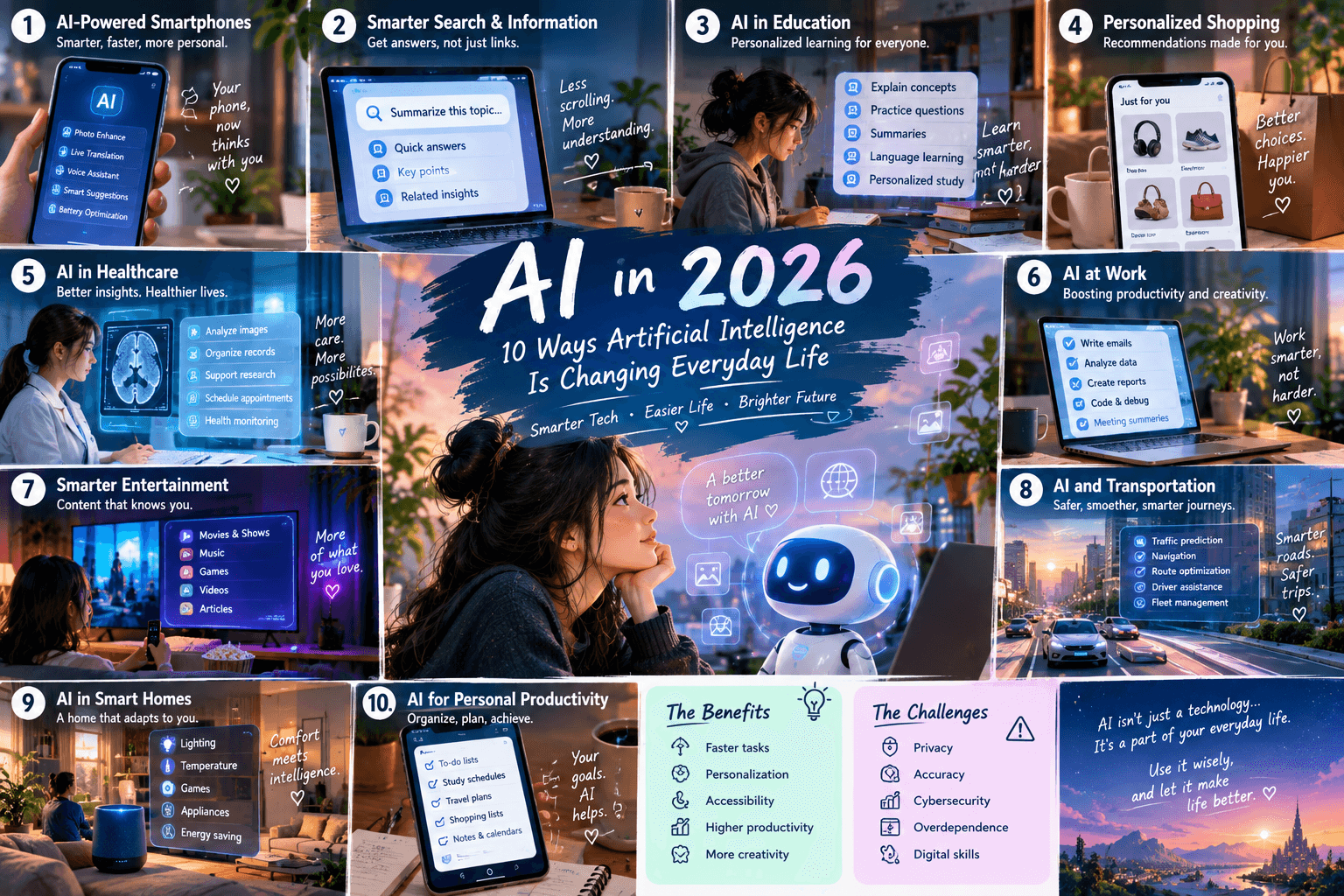
Here are 10 major ways AI is changing everyday life in 2026.
1. AI-Powered Smartphones
Smartphones are becoming more intelligent through built-in AI features.
AI can help users with:
Photo enhancement
Voice assistants
Live translation
Writing suggestions
Call summaries
Personalized recommendations
Image editing
Battery optimization
Instead of requiring separate applications for every task, AI features are increasingly being integrated directly into mobile devices.
2. Smarter Search and Information
AI is changing how people search for information online.
Traditional search often requires users to browse multiple pages. AI-powered search can summarize information, answer questions conversationally, organize complex topics, and help users discover relevant information more efficiently.
However, AI-generated information can contain errors, so important facts should still be checked against reliable sources.
3. AI in Education
Students and teachers are increasingly using AI-powered educational tools.
AI can assist with:
Explaining difficult concepts
Creating practice questions
Summarizing study material
Language learning
Personalized exercises
Brainstorming ideas
Providing feedback
The most effective use of AI in education involves using it as a learning assistant rather than simply relying on it to complete assignments.
4. Personalized Shopping
Online shopping is becoming more personalized with AI.
AI systems can analyze product information and user preferences to recommend products that may be relevant to individual shoppers.
AI can also help customers compare products, find information, generate shopping lists, and receive personalized suggestions.
Retailers are using these technologies to create more customized shopping experiences.
5. AI in Healthcare
AI is increasingly being used in healthcare research, administration, medical imaging, and digital health tools.
Potential applications include:
Analyzing medical images
Organizing medical information
Supporting research
Scheduling appointments
Summarizing documents
Monitoring certain health-related data
AI does not replace qualified medical professionals. Healthcare decisions require appropriate clinical expertise and human oversight.
6. AI at Work
AI is becoming a workplace productivity tool.
Employees can use AI to assist with:
Writing emails
Creating reports
Analyzing data
Preparing presentations
Research
Coding
Meeting summaries
Routine administrative tasks
AI agents can also handle certain multi-step workflows, depending on the software and permissions available.
7. Smarter Entertainment
Streaming platforms, games, music services, and social platforms use algorithms to personalize content.
AI can help recommend:
Movies
TV shows
Music
Games
Videos
Articles
Generative AI is also changing content creation by helping users produce images, audio, video, stories, and other creative material.
8. AI and Transportation
AI is playing an increasingly important role in transportation.
Applications include:
Traffic prediction
Navigation
Route optimization
Driver-assistance systems
Fleet management
Public transportation planning
AI can analyze large amounts of real-time information to help transportation systems operate more efficiently.
9. AI in Smart Homes
Smart-home technology is becoming more intelligent.
AI-powered systems can help manage:
Lighting
Temperature
Security
Appliances
Energy consumption
Voice-controlled devices
Instead of simply responding to commands, some systems can learn patterns and automate routine activities.
10. AI and Personal Productivity
AI can function as a digital assistant for everyday tasks.
People can use AI to help organize:
To-do lists
Study schedules
Travel plans
Shopping lists
Notes
Calendars
Personal projects
This makes AI increasingly useful not only for businesses but also for everyday personal organization.
Benefits of AI in Everyday Life
AI can provide several potential benefits.
Faster Tasks
AI can automate repetitive activities and reduce the time required for certain tasks.
Personalization
AI can adapt recommendations and experiences to individual preferences.
Accessibility
AI-powered translation, speech recognition, and assistive tools can make technology easier to use for more people.
Productivity
AI can help individuals organize information and complete certain tasks more efficiently.
Creativity
Generative AI provides new tools for creating text, images, music, video, and other forms of content.
Challenges of Everyday AI
AI also creates important challenges.
Privacy
AI services may process significant amounts of personal information, making privacy and data protection important considerations.
Accuracy
AI can produce incorrect or misleading information.
Cybersecurity
AI can be used by both defenders and attackers, creating new cybersecurity challenges.
Overdependence
Relying too heavily on AI can reduce opportunities to develop independent problem-solving and critical-thinking skills.
Digital Skills
People need to understand how AI works and how to evaluate its outputs responsibly.
How to Use AI Responsibly
A few simple practices can make everyday AI use safer and more effective:
Verify important information.
Avoid sharing unnecessary sensitive data.
Review AI-generated content before using it.
Use AI as an assistant rather than blindly following its recommendations.
Keep important decisions under appropriate human control.
Learn about the privacy policies of AI services you use.
The Future of Everyday AI
AI is likely to become even more deeply integrated into everyday technology.
Instead of always interacting with AI through a separate chatbot, people may increasingly encounter AI inside smartphones, websites, applications, vehicles, educational platforms, workplaces, and household devices.
The biggest change may be that AI becomes less visible while quietly performing more background tasks.
Conclusion
AI in 2026 is changing everyday life across education, work, shopping, entertainment, transportation, healthcare, smartphones, and personal productivity.
The technology offers powerful opportunities to save time, personalize experiences, and assist with complex tasks, but it also requires responsible use.
As AI becomes more common, knowing how to use it, how to question it, and when human judgment is necessary will become increasingly important.
FAQs
1. What is AI?
Artificial intelligence refers to computer systems designed to perform tasks that normally require human intelligence, such as understanding language, recognizing patterns, and solving problems.
2. How is AI changing everyday life in 2026?
AI is increasingly used in smartphones, search, education, shopping, entertainment, workplaces, transportation, healthcare tools, and smart homes.
3. Is AI available on smartphones?
Yes. Modern smartphones increasingly include AI-powered features for photography, translation, writing, voice assistance, and personalization.
4. How can AI help students?
AI can explain concepts, create practice questions, summarize material, assist with language learning, and provide study support.
5. Can AI replace teachers?
AI can provide educational assistance, but teachers provide human guidance, context, encouragement, assessment, and classroom interaction.
6. How does AI personalize shopping?
AI can analyze product information and user preferences to provide personalized recommendations and comparisons.
7. How is AI used in healthcare?
AI can assist with areas such as medical research, imaging analysis, administrative tasks, and information organization under appropriate professional oversight.
8. Can AI make mistakes?
Yes. AI systems can generate inaccurate information, so important outputs should be independently checked.
9. How does AI help at work?
AI can assist with writing, research, data analysis, coding, presentations, summaries, and routine administrative tasks.
10. What are AI agents?
AI agents are systems designed to perform multiple steps of a task or workflow with varying levels of human supervision.
11. Is AI used in entertainment?
Yes. AI can help recommend movies, music, games, videos, and other content based on user behavior and preferences.
12. How does AI help transportation?
AI can support navigation, traffic prediction, route planning, driver-assistance systems, and transportation management.
13. Can AI control smart homes?
AI-powered smart-home systems can assist with lighting, temperature, security, appliances, and energy management.
14. What are the main benefits of AI?
Potential benefits include faster task completion, personalization, accessibility, productivity, automation, and new creative tools.
15. What are the risks of AI?
Important concerns include privacy, inaccurate information, cybersecurity, overdependence, and inappropriate use.
16. Should I trust everything AI tells me?
No. AI-generated information should be evaluated and verified, especially when the information affects important decisions.
17. How can AI improve productivity?
It can automate repetitive tasks, organize information, summarize documents, assist with research, and help manage personal workflows.
18. Is AI useful for personal planning?
Yes. AI can help create schedules, travel plans, shopping lists, study plans, and project outlines.
19. What skills are important in an AI-powered world?
Critical thinking, digital literacy, communication, creativity, problem-solving, and the ability to evaluate AI outputs are increasingly useful.
20. What is the future of AI?
AI is likely to become increasingly integrated into everyday software, devices, workplaces, education, transportation, and other digital services.