
Introduction
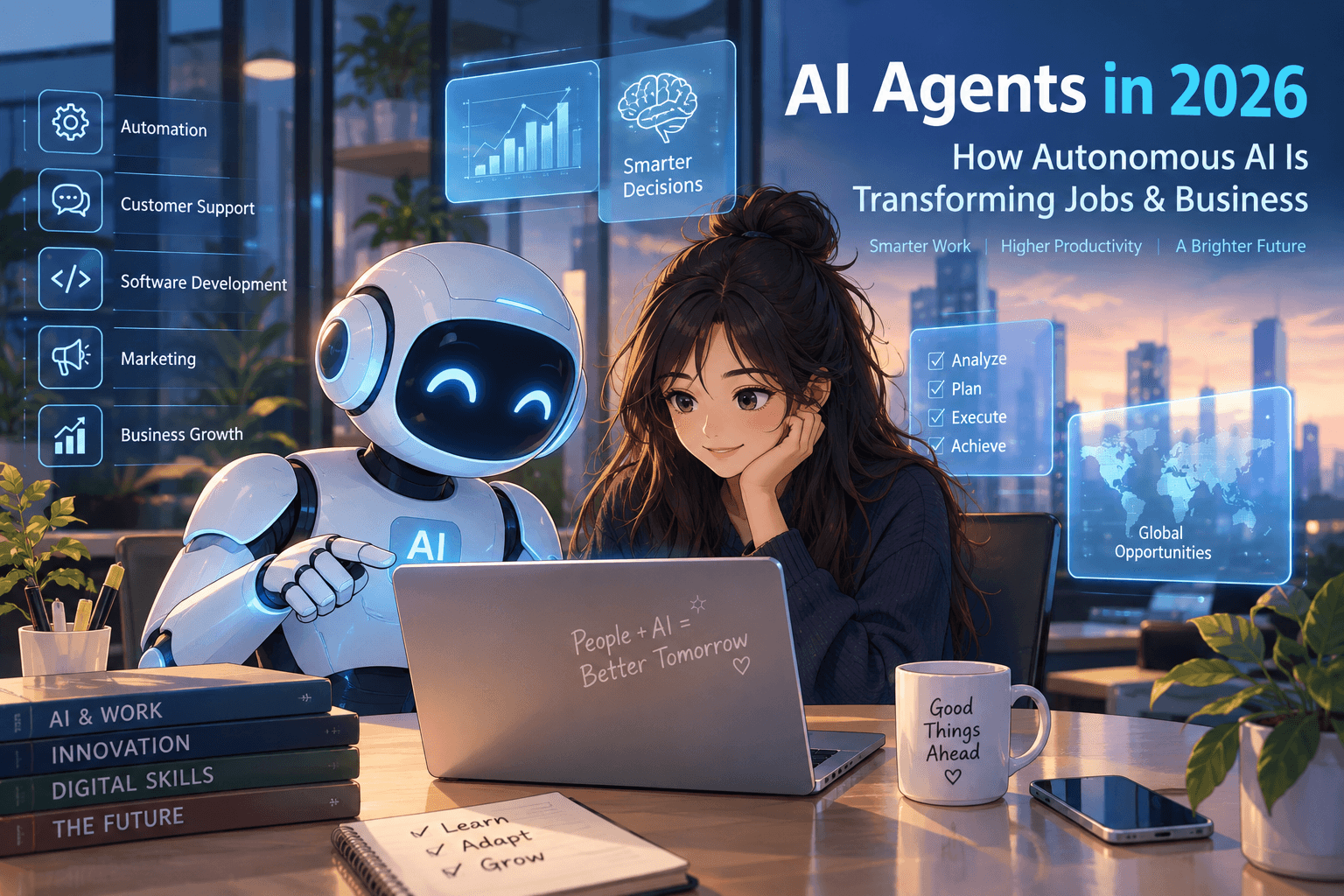
AI agents are becoming one of the most important developments in artificial intelligence in 2026. Unlike traditional AI tools that simply respond to individual prompts, AI agents can handle multi-step tasks, use software tools, analyze information, and work toward specific goals with less human intervention.
Businesses are increasingly exploring AI agents for customer service, marketing, software development, research, data analysis, sales, and administrative work. At the same time, workers are adapting to a changing job market where AI skills and human capabilities are becoming increasingly important.
What Are AI Agents?
AI agents are software systems designed to perform tasks autonomously or semi-autonomously. They can understand an objective, break it into smaller steps, use connected tools, evaluate results, and continue working until the task is completed or human input is required.
For example, instead of asking an AI to write a single email, an AI agent could potentially:
Review incoming customer information
Identify the purpose of the request
Draft a response
Check company policies
Update a CRM system
Schedule a follow-up
Notify a human employee when approval is needed
This ability to perform workflows makes AI agents different from simple chatbot systems.
How AI Agents Are Changing Businesses
1. Automating Repetitive Work
Businesses spend significant amounts of time on repetitive administrative activities. AI agents can assist with tasks such as data entry, document processing, scheduling, reporting, and information retrieval.
Automation allows employees to spend more time on activities requiring creativity, judgment, communication, and strategic thinking.
2. Improving Customer Support
AI-powered agents can handle common customer questions around the clock. They can retrieve information from company databases and provide personalized responses.
More complex issues can be transferred to human representatives, creating a combination of automated and human support.
3. Transforming Software Development
AI agents are increasingly being used throughout software-development workflows. They can help developers understand codebases, generate code, identify bugs, write tests, and document software.
Rather than completely replacing developers, these systems can function as development assistants that accelerate parts of the programming process.
4. Supporting Marketing Teams
Marketing departments can use AI agents to assist with:
Market research
Content planning
Audience analysis
Campaign monitoring
Email personalization
Competitor research
Performance reporting
Human marketers can then review outputs and make strategic decisions.
How AI Agents Could Affect Jobs
The impact of AI agents on employment is likely to vary significantly by occupation and task.
Jobs containing highly repetitive digital tasks may experience greater automation pressure. However, many occupations involve a combination of technical, interpersonal, creative, and decision-making responsibilities.
Instead of viewing the future simply as “AI versus humans,” many workplaces may increasingly involve humans working alongside AI systems.
Employees who understand how to use AI tools effectively may gain new opportunities, while some roles may change substantially.
Skills That Matter in the AI Era
As AI adoption grows, workers can develop a combination of technical and human skills.
AI Literacy
Understanding how AI systems work, what they can do, and where they can make mistakes is becoming increasingly useful.
Critical Thinking
AI-generated information still needs human review. Workers must be able to identify errors, inconsistencies, unsupported claims, and inappropriate recommendations.
Communication
Clear communication remains important because people still need to define goals, explain requirements, collaborate with teams, and communicate with customers.
Creativity
Creative thinking can help people use AI as a tool for developing new products, ideas, campaigns, and solutions.
Domain Expertise
AI tools become more useful when paired with knowledge of a specific industry or profession. Expertise allows workers to evaluate AI outputs and make informed decisions.
AI Agents and Small Businesses
AI agents aren't only relevant to large corporations. Small businesses may also use them to automate routine operations.
A small online store, for example, could use AI systems to help organize customer inquiries, summarize sales information, create marketing drafts, and monitor routine business processes.
This could allow smaller teams to handle more work without expanding every administrative function.
Challenges of AI Agents
Despite their potential, AI agents also create important challenges.
Accuracy
AI systems can make mistakes or misunderstand information. Human oversight remains important for sensitive or high-impact decisions.
Privacy
Organizations need to carefully manage the information AI systems can access, particularly when dealing with customer or employee data.
Security
An AI agent connected to business software can potentially perform actions within those systems. Strong permissions and security controls are therefore essential.
Accountability
Businesses need clear rules about who is responsible when an automated system makes an incorrect decision or takes an inappropriate action.
The Future of AI Agents
AI agents are likely to become increasingly integrated into everyday digital workflows. Instead of opening separate applications for every task, users may increasingly interact with AI systems that coordinate multiple tools and services.
The biggest change may not be the disappearance of entire professions. Instead, individual jobs could be redesigned around collaboration between people and AI.
Employees may increasingly focus on setting goals, reviewing AI-generated work, handling exceptions, making decisions, and managing relationships while AI systems handle portions of routine execution.
Conclusion
AI agents are changing how businesses approach automation, productivity, customer service, software development, and knowledge work. Their growing capabilities could reshape many job responsibilities while creating demand for new AI-related skills.
For workers and businesses, the important question is increasingly not simply whether AI will be used, but how people can use AI responsibly and effectively while keeping human judgment at the center of important decisions.
FAQs
1. What are AI agents?
AI agents are AI-powered systems designed to complete tasks or workflows with varying levels of autonomy.
2. How are AI agents different from chatbots?
Traditional chatbots generally respond to individual interactions, while AI agents can perform multi-step tasks and interact with tools or software.
3. Will AI agents replace jobs?
Their impact will differ across occupations and tasks. Some repetitive tasks may become automated, while other jobs may evolve through human-AI collaboration.
4. Which businesses can use AI agents?
Businesses across industries can potentially use AI agents for tasks such as customer support, research, administration, marketing, and software development.
5. Are AI agents available to small businesses?
Yes. AI-powered automation can be useful for small businesses as well as large organizations.
6. What skills are important in 2026?
AI literacy, critical thinking, communication, creativity, problem-solving, and industry-specific expertise are increasingly valuable.
7. Can AI agents work without humans?
Some agents can perform defined workflows with limited intervention, but human oversight is still important, especially for sensitive decisions.
8. Can AI agents make mistakes?
Yes. AI systems can produce inaccurate information or take inappropriate actions, so verification and safeguards are important.
9. How do AI agents help customer service?
They can answer routine questions, retrieve information, classify requests, and transfer complex cases to human representatives.
10. Are AI agents useful for programmers?
They can assist with coding, debugging, testing, documentation, and understanding software projects.
11. How can AI agents help marketers?
They can assist with research, content planning, audience analysis, campaign monitoring, and reporting.
12. What is the biggest challenge with AI agents?
Important challenges include accuracy, security, privacy, reliability, and accountability.
13. Will AI create new jobs?
AI adoption can create demand for roles involving AI development, implementation, oversight, data, security, and specialized applications.
14. What is human-AI collaboration?
It means people and AI systems work together, with AI handling suitable tasks while humans provide judgment, creativity, oversight, and decision-making.
15. Why are AI agents important in 2026?
They represent a shift from AI that simply generates responses toward systems capable of carrying out broader workflows.
16. Can AI agents use other software?
Depending on their design and permissions, AI agents can interact with applications, databases, APIs, and other digital tools.
17. Are AI agents secure?
Security depends on how an AI agent is designed, connected, monitored, and granted permissions. Strong access controls are essential.
18. How can students prepare for AI-driven workplaces?
Students can develop digital literacy, AI skills, communication, problem-solving, creativity, and strong knowledge in their chosen fields.
19. Can AI agents improve productivity?
They can automate or accelerate certain workflows, potentially allowing employees to focus more on higher-value activities.
20. What is the future of AI agents?
AI agents are expected to become increasingly integrated into business software and digital workflows, with humans continuing to provide oversight and strategic direction.
