
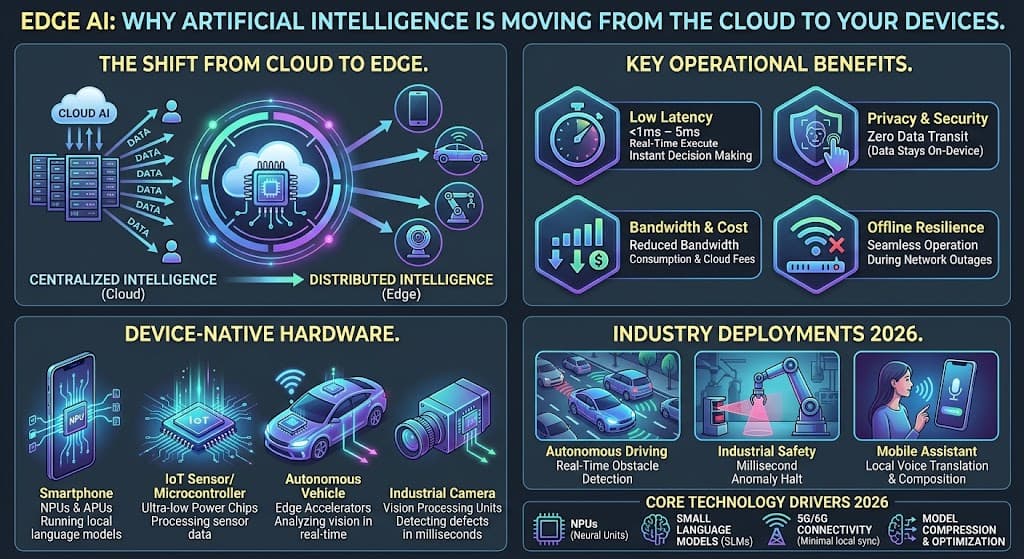

Edge AI is becoming one of the most interesting technology trends because it allows artificial intelligence to run directly on devices instead of sending every piece of data to the cloud. From smartphones and security cameras to cars, robots, and wearable devices, Edge AI is changing how intelligent technology works.
What Is Edge AI?
Edge AI refers to artificial intelligence that processes data locally on or near the device where the data is generated.
Traditional AI often works like this:
Device → Internet → Cloud Server → AI Processing → Device
With Edge AI, much of the processing happens locally:
Device → AI Processing on Device → Result
This can make applications faster, more private, and less dependent on an internet connection.
Why Is Edge AI Becoming Important?
The amount of data produced by connected devices is growing rapidly. Sending all of that information to cloud servers can create delays, increase bandwidth usage, and raise privacy concerns.
Edge AI addresses these challenges by processing information closer to the source.
1. Faster Responses
Because data does not always need to travel to a remote server, Edge AI can provide near-instant responses.
This is especially important for:
Autonomous vehicles
Industrial robots
Security systems
Smart cameras
Medical devices
Real-time translation
For applications where milliseconds matter, local AI processing can be extremely valuable.
2. Better Privacy
Edge AI can process sensitive information directly on a device rather than continuously uploading raw data to the cloud.
For example, a smartphone could analyze certain voice or image information locally without sending the original data to a remote server.
However, local processing does not automatically guarantee privacy. Devices still need strong security and responsible data handling.
3. Works With Limited Internet
One of Edge AI's biggest advantages is that some AI features can continue working when the internet connection is weak or unavailable.
This can be useful in:
Remote locations
Vehicles
Factories
Farms
Emergency situations
Offline mobile applications
Edge AI and Smartphones
Modern smartphones already contain specialized hardware designed to perform AI tasks efficiently.
Edge AI can power features such as:
Face recognition
Camera enhancements
Voice assistants
Translation
Image classification
Personalized recommendations
On-device security
As smartphone chips become more powerful, more AI workloads can potentially move from cloud servers to phones.
Edge AI in Smart Homes
Smart home devices can use Edge AI to understand and respond to their surroundings.
For example, a smart security camera could identify unusual movement locally and notify the homeowner.
Other applications include:
Smart doorbells
Home security systems
Voice-controlled devices
Energy management
Smart appliances
Occupancy detection
Edge AI in Autonomous Vehicles
Self-driving and advanced driver-assistance systems need to analyze huge amounts of information from cameras, radar, and other sensors.
Waiting for cloud processing could introduce dangerous delays.
Edge AI allows vehicles to process important information locally, helping them respond quickly to changing road conditions.
Edge AI in Healthcare
Healthcare is another promising area.
Edge AI could help medical devices analyze information locally, potentially supporting:
Patient monitoring
Wearable health devices
Medical imaging
Remote healthcare equipment
Real-time alerts
Healthcare applications require particularly careful validation, security, and regulatory oversight.
Edge AI in Manufacturing
Factories are increasingly using AI-powered machines and sensors.
Edge AI can help manufacturers detect problems while equipment is operating.
For example, an intelligent machine could analyze vibration or temperature data and identify signs of potential equipment failure.
This approach can support predictive maintenance, helping companies reduce unexpected downtime.
Edge AI and Robotics
Robots need to understand their surroundings and make decisions quickly.
Edge AI can allow robots to process camera and sensor information locally.
This can help robots:
Recognize objects
Navigate environments
Detect obstacles
Monitor equipment
Perform quality inspections
Edge AI vs Cloud AI
Feature | Edge AI | Cloud AI |
|---|---|---|
Processing | Local/device | Remote servers |
Response time | Often very fast | Depends on network |
Internet dependency | Lower | Usually higher |
Privacy potential | Higher for local processing | Data may leave device |
Computing power | Device-dependent | Large cloud infrastructure |
Scalability | More limited locally | Highly scalable |
In reality, the future will likely involve both Edge AI and Cloud AI working together rather than one completely replacing the other.
Challenges of Edge AI
Despite its advantages, Edge AI has limitations.
Limited Hardware
Small devices may have less computing power and memory than large cloud servers.
Energy Consumption
Running AI models locally can consume battery or electricity, especially on small devices.
Security Risks
If an AI-enabled device is compromised, attackers may attempt to manipulate the model or access sensitive information.
Model Updates
Keeping AI models updated across millions of devices can be challenging.
Development Complexity
Developers need to optimize AI models so they can operate efficiently on specific hardware.
The Future of Edge AI
The combination of AI chips, 5G, IoT, robotics, and increasingly efficient AI models could accelerate Edge AI adoption.
Instead of every intelligent device depending on a distant data center, many devices could become capable of making decisions independently.
The result could be a world where AI is not something users always access through a website or app. Instead, intelligence could become a built-in feature of everyday objects.
Conclusion
Edge AI represents a major shift in how artificial intelligence is delivered. By bringing AI processing closer to where data is created, it can provide faster responses, reduce dependence on cloud connectivity, and potentially improve privacy.
From smartphones and smart homes to autonomous vehicles, healthcare devices, factories, and robots, Edge AI could become an important foundation of the next generation of intelligent technology.
FAQs
1. What is Edge AI?
Edge AI is artificial intelligence that processes data locally on or near the device where the data is generated.
2. How is Edge AI different from cloud AI?
Edge AI processes information locally, while cloud AI generally sends data to remote servers for processing.
3. Is Edge AI faster than cloud AI?
It can be faster for certain applications because local processing can reduce network-related delays.
4. Does Edge AI require the internet?
Not always. Some Edge AI applications can operate without a continuous internet connection.
5. Is Edge AI more private?
It can improve privacy by allowing sensitive data to remain on the device, although overall privacy still depends on how the system is designed.
6. Where is Edge AI used?
It is used in smartphones, cameras, vehicles, robots, factories, wearables, smart homes, and other connected devices.
7. Can Edge AI work with IoT devices?
Yes. Edge AI and IoT are often combined to allow connected devices to analyze information locally.
8. What role does Edge AI play in self-driving cars?
It can help vehicles process sensor information locally and respond quickly to their surroundings.
9. Can Edge AI work offline?
Yes, if the required AI model and processing capabilities are available directly on the device.
10. What are the disadvantages of Edge AI?
Common challenges include limited hardware resources, energy consumption, security concerns, and difficulties updating models across many devices.
11. What devices can use Edge AI?
Edge AI can run on smartphones, cameras, smartwatches, vehicles, robots, industrial machines, drones, and other connected devices.
12. Why is Edge AI important for IoT?
Edge AI allows IoT devices to analyze data locally instead of sending everything to the cloud, enabling faster decisions and reducing network traffic.
13. Can Edge AI reduce cloud costs?
Yes. Processing some data locally can reduce the amount of information that needs to be transmitted and processed in the cloud.
14. What is an Edge AI chip?
An Edge AI chip is specialized hardware designed to efficiently perform AI and machine-learning calculations directly on a device.
15. Does Edge AI use machine learning?
Yes. Edge AI commonly uses machine-learning models optimized to run efficiently on local hardware.
16. Can Edge AI improve battery life?
It can in some situations, particularly when efficient AI hardware reduces the need for constant communication with cloud servers. However, running AI locally can also consume significant energy.
17. How does 5G support Edge AI?
5G can provide fast, low-latency connectivity between devices and nearby computing infrastructure, complementing local Edge AI processing.
18. Is Edge AI useful for businesses?
Yes. Businesses can use Edge AI for predictive maintenance, security monitoring, quality control, automation, logistics, and real-time analytics.
19. Can Edge AI be used in agriculture?
Yes. Edge AI can help analyze camera and sensor data for crop monitoring, irrigation management, pest detection, and agricultural automation.
20. What is TinyML?
TinyML refers to running machine-learning models on very small, low-power devices such as microcontrollers and sensors.
21. Can Edge AI improve security cameras?
Yes. AI-enabled cameras can analyze video locally to detect objects, unusual activity, or specific events without necessarily sending continuous video to the cloud.
22. What is on-device AI?
On-device AI is AI processing performed directly on a device such as a smartphone, computer, camera, or wearable.
23. Will Edge AI replace cloud computing?
Probably not. Edge AI and cloud computing are likely to work together, with devices handling time-sensitive tasks locally while cloud systems handle larger-scale processing and storage.
24. What skills are needed to develop Edge AI?
Edge AI development can require skills in machine learning, embedded systems, software development, AI model optimization, and hardware acceleration.
25. What is the future of Edge AI?
The future of Edge AI is likely to involve more intelligent smartphones, vehicles, robots, wearables, industrial systems, and IoT devices that can make decisions with less dependence on centralized cloud processing.