
Technology is increasingly connecting the physical and digital worlds. One of the most important innovations behind this transformation is the concept of the digital twin.
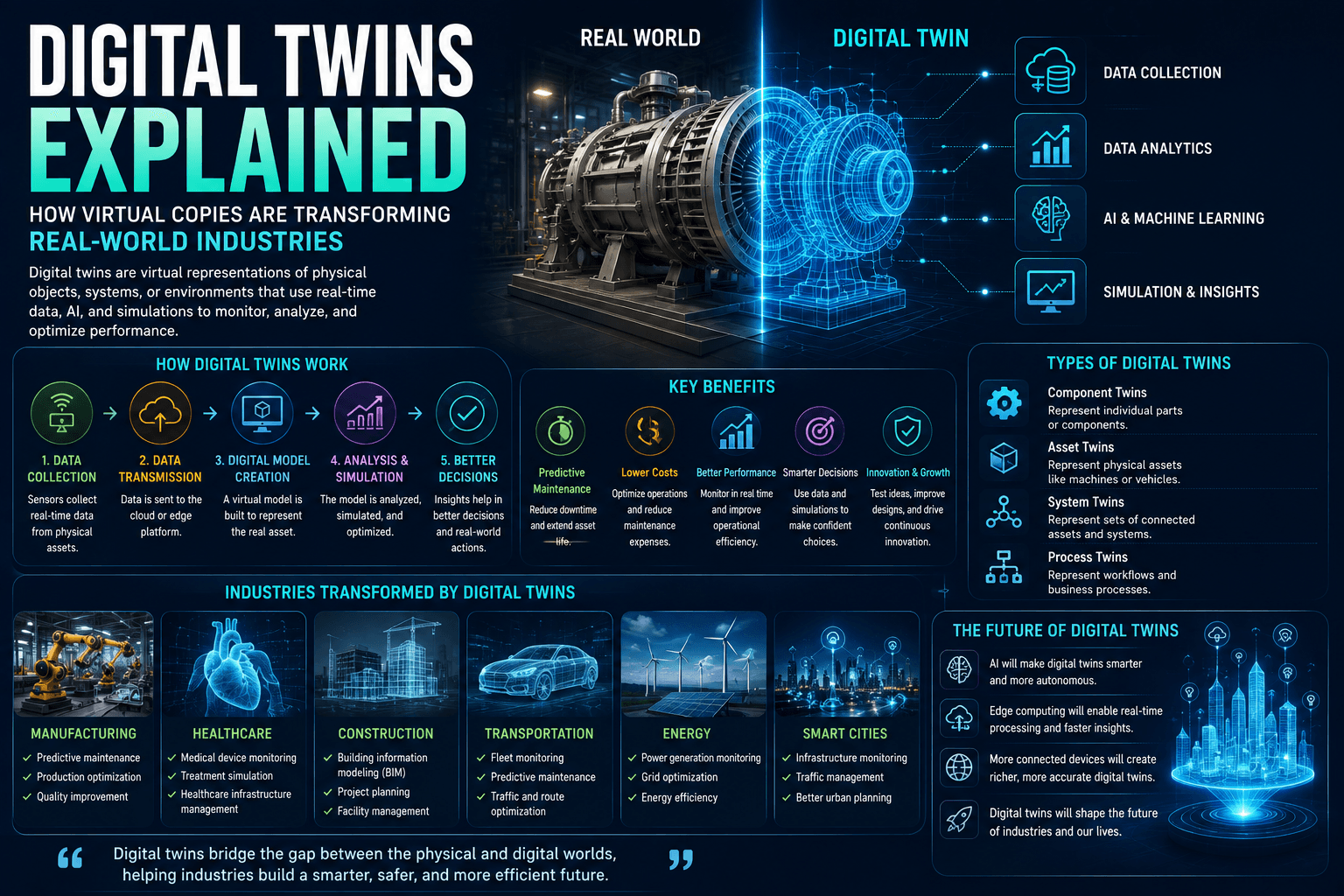
A digital twin is a virtual representation of a physical object, system, process, or environment. By combining real-world data with digital models, organizations can monitor, analyze, simulate, and improve physical systems.
In 2026, digital twins are being explored and used across industries such as manufacturing, healthcare, construction, transportation, energy, and smart cities.
This article explains what digital twins are, how they work, and how they are transforming real-world industries.
What Is a Digital Twin?
A digital twin is a digital representation of something that exists in the physical world.
The physical object or system may be connected to sensors and software that provide data to its digital counterpart.
For example, a digital twin could represent:
A machine
A vehicle
A building
A factory
A power system
A city infrastructure system
The digital model can help organizations understand how the real-world system is performing.
How Do Digital Twins Work?
Digital twins generally combine several technologies.
1. A Physical Object or System
The process begins with a real-world asset, such as a machine, vehicle, building, or industrial system.
2. Sensors and Data Collection
Sensors may collect information about:
Temperature
Movement
Pressure
Energy use
Performance
Location
Equipment condition
3. Data Processing
The collected data is processed using software and computing systems.
4. A Digital Model
The information is connected to a virtual representation of the physical system.
5. Analysis and Simulation
The digital twin can be used to analyze performance and, in some cases, simulate possible changes or future conditions.
Digital Twins vs Simulations
Digital twins and simulations are related but not exactly the same.
A traditional simulation usually models a specific situation.
A digital twin can be connected to ongoing real-world data from an actual physical system.
For example, a simulation might model how a machine could perform under certain conditions.
A digital twin may continuously receive data from the real machine and provide an updated digital representation.
Types of Digital Twins
Component Twins
These represent individual parts or components.
For example:
An engine component
A battery
A turbine part
Asset Twins
These represent complete physical assets.
Examples include:
Vehicles
Machines
Medical equipment
System Twins
System twins represent multiple connected assets working together.
For example, a system twin could represent an entire manufacturing process.
Process Twins
These focus on larger processes and operations.
Examples include:
Supply chains
Production workflows
Transportation systems
How Digital Twins Are Used in Manufacturing
Manufacturing is one of the major areas where digital twins are being used.
A digital twin can help organizations monitor:
Machine performance
Production efficiency
Equipment condition
Energy consumption
Manufacturers can potentially identify problems before they cause major disruptions.
Predictive Maintenance
One important application is predictive maintenance.
By analyzing equipment data, organizations may identify warning signs that a machine needs maintenance.
This can help reduce unexpected equipment failures.
Product Development
Digital models can also help engineers test and evaluate products before making physical prototypes.
This may reduce development time and costs.
Digital Twins in Healthcare
Digital twin technology has potential applications in healthcare and medical research.
Possible uses include:
Modeling medical equipment
Simulating biological systems
Supporting treatment research
Monitoring healthcare infrastructure
Healthcare applications require careful validation, privacy protection, and appropriate professional oversight.
Digital Twins in Smart Cities
Cities generate large amounts of information from transportation, infrastructure, utilities, and public systems.
Digital twins may help city planners analyze:
Traffic patterns
Energy use
Water systems
Infrastructure performance
Urban development
For example, a digital city model could help planners test the potential effects of changes before implementing them in the physical environment.
Digital Twins in Construction
Digital twins can help construction companies manage buildings and infrastructure.
A digital representation of a building may contain information about:
Structural systems
Energy usage
Equipment
Maintenance requirements
Building managers can use this information to monitor performance over time.
Digital Twins in Transportation
Transportation systems can benefit from digital representations of vehicles and infrastructure.
Potential applications include:
Fleet monitoring
Vehicle maintenance
Traffic management
Route optimization
Connected vehicles and sensors can provide information that supports real-time analysis.
Digital Twins in Energy
Energy companies can use digital twins to monitor and analyze complex systems.
Applications may include:
Power plants
Wind turbines
Solar facilities
Electrical grids
Digital models can help organizations understand equipment performance and improve maintenance planning.
Benefits of Digital Twins
Better Monitoring
Digital twins can provide a detailed view of physical systems.
Improved Decision-Making
Organizations can use data and analysis to make more informed decisions.
Predictive Maintenance
Potential problems may be identified before equipment completely fails.
Lower Costs
Improved monitoring and maintenance planning can help reduce certain operational costs.
Better Product Design
Digital testing can support product development before physical production.
Increased Efficiency
Organizations can identify opportunities to improve processes and reduce waste.
The Role of AI in Digital Twins
Artificial intelligence is becoming increasingly important in digital twin technology.
AI can help:
Analyze large amounts of sensor data
Identify patterns
Detect unusual activity
Predict potential problems
Support automated decision-making
AI-powered digital twins may become increasingly sophisticated as computing and data technologies improve.
However, AI systems should be carefully tested and monitored, particularly when they influence important real-world operations.
Challenges of Digital Twins
Digital twin technology also has important challenges.
Data Quality
A digital twin is only as useful as the data supporting it.
Inaccurate or incomplete data can lead to incorrect conclusions.
High Implementation Costs
Building and maintaining complex digital twin systems can require significant investment.
Cybersecurity
Connected systems can create security risks.
Organizations need strong protections for:
Sensors
Networks
Data
Software systems
Privacy
Digital twins involving people or sensitive environments may raise privacy concerns.
Complexity
Large systems can be difficult to model accurately.
Organizations may need specialized expertise in engineering, data science, AI, and software development.
Digital Twins and the Internet of Things
Digital twins often work closely with the Internet of Things (IoT).
IoT devices collect information from the physical world.
Digital twin platforms can use that information to create and update virtual models.
The combination of:
IoT
Cloud computing
Artificial intelligence
Edge computing
is helping make digital twins more powerful.
The Future of Digital Twins
Digital twins are likely to become increasingly advanced.
Future developments may include:
More real-time data
AI-powered analysis
Improved simulations
Better integration with IoT devices
More advanced 3D visualization
Greater use of Edge AI
In the future, organizations may use digital twins to test decisions before applying them to real-world systems.
How Businesses Can Start Using Digital Twins
Businesses interested in digital twin technology should begin with a clearly defined problem.
For example:
Reducing equipment downtime
Improving energy efficiency
Monitoring a specific asset
Optimizing a production process
Starting with a focused project can make it easier to evaluate the benefits.
Organizations should also consider:
Available data
Sensor infrastructure
Security requirements
Technology costs
Staff expertise
Best Practices for Digital Twin Implementation
Businesses should:
Define a clear purpose.
Start with a focused use case.
Ensure high-quality data.
Protect connected systems.
Test the digital model carefully.
Monitor system performance.
Keep the model updated.
Train employees.
Consider privacy requirements.
Expand gradually based on results.
Digital Twins and the Future of Industry
Digital twins are helping create a closer connection between physical assets and digital information.
Instead of waiting for problems to occur, organizations can increasingly monitor systems and identify potential issues earlier.
This shift could influence how products are designed, how factories operate, how cities are managed, and how infrastructure is maintained.
Final Thoughts
Digital twins are more than virtual 3D models. They can combine real-world data, software, sensors, artificial intelligence, and simulation to create useful representations of physical systems.
From manufacturing and healthcare to transportation and smart cities, digital twins have the potential to improve efficiency, monitoring, and decision-making.
However, successful implementation requires accurate data, strong cybersecurity, clear goals, and careful management.
As connected devices and AI continue to advance, digital twins may become an increasingly important part of the future of technology and industry.
Frequently Asked Questions
1. What is a digital twin?
A digital twin is a virtual representation of a physical object, system, process, or environment.
2. How does a digital twin work?
It can use data from sensors and connected systems to update and analyze a digital representation of a real-world asset.
3. What industries use digital twins?
Digital twins are used or explored in manufacturing, healthcare, construction, transportation, energy, and smart cities.
4. What is the difference between a digital twin and a simulation?
A simulation usually models a particular scenario, while a digital twin may be connected to ongoing data from a real-world system.
5. How does AI help digital twins?
AI can analyze data, identify patterns, detect anomalies, and support predictions.
6. Are digital twins expensive?
The cost depends on the size and complexity of the system. Large implementations may require significant investment.
7. What are the main benefits of digital twins?
Benefits may include better monitoring, predictive maintenance, improved efficiency, and better decision-making.
8. Are digital twins secure?
Connected digital twin systems can face cybersecurity risks, so strong security measures are essential.
9. What is the role of IoT in digital twins?
IoT devices can collect real-world data that helps update and inform digital twin models.
10. What is the future of digital twins?
The future may include greater use of AI, real-time data, advanced simulation, Edge AI, and more connected systems.